
Dementia and changing care needs: the person still comes first.
When familiar routines become harder, families need understanding, practical answers and a clear next step. This guide explains what can change, what can help, and how the right care home can support safety without losing sight of the person.
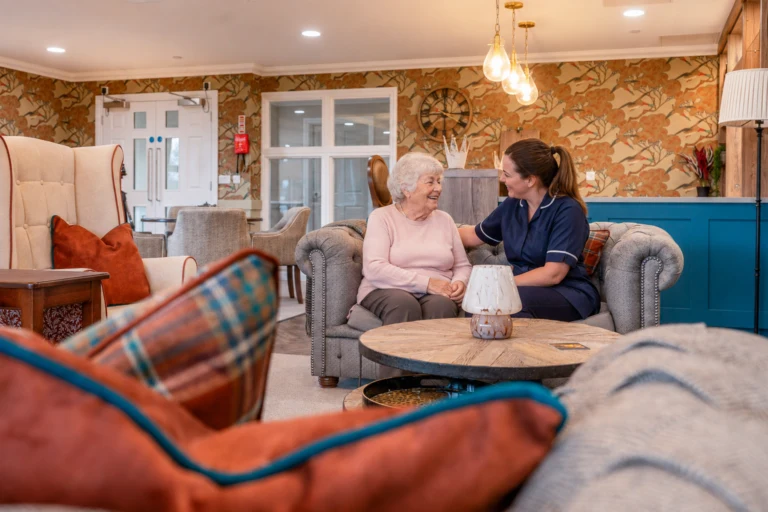
Can a nursing home support someone living with dementia?
Yes, when its staff, environment and care provision match the person’s assessed needs. Support can include help with daily routines, meals, medicines, meaningful activity and health monitoring. Esmere Gardens supports people with low to moderate dementia-related care needs, subject to assessment, suitability and availability. We cannot accommodate high-level or complex dementia care needs. A diagnosis or stage label alone does not establish suitability.
Dementia changes abilities. It does not define a person.
Dementia describes symptoms caused by conditions affecting the brain. These can affect memory, communication, judgement and everyday tasks. It is not simply an inevitable part of getting older. Someone may find a familiar conversation difficult but still enjoy music, humour, a favourite meal or being with people they trust.
Memory loss is not always the first sign. Persistent changes deserve a GP assessment, because other conditions can cause similar difficulties. A diagnosis helps families understand what is happening and plan support around the individual.
Background: Dementia UK: what dementia is, symptoms and diagnosis.
| Type | What families may notice | A useful question |
|---|---|---|
| Alzheimer’s disease | Recent memories, repeated questions or familiar tasks may become harder. | Which reminders help without causing frustration? |
| Vascular dementia | Thinking speed, planning, concentration or mobility may be affected. | What physical and everyday support is needed? |
| Dementia with Lewy bodies | Alertness can fluctuate; movement, sleep and visual experiences may change. | How will changes be recorded and discussed with clinicians? |
| Frontotemporal dementia | Language, behaviour or personality changes may be more noticeable than memory problems. | Does the service have the right skills for these particular needs? |
| Mixed dementia | More than one condition contributes to the person’s symptoms. | What does the combined picture mean for daily care? |
On a smaller screen, swipe the table sideways. This is an explanation, not a diagnostic checklist.
Type information: NHS: symptoms of different types of dementia. Symptoms overlap; the diagnosis does not tell you everything about the person’s abilities or risks.
Early, middle and later dementia: what might change?
Stages can help explain a changing picture, but they overlap and do not predict a fixed timescale. A person may need considerable help with one activity and manage another independently. Support should follow the person’s current needs, strengths and wishes.
| Broad stage | Possible changes | What supportive care focuses on |
|---|---|---|
| Earlier stage | Keeping appointments, handling money, recalling recent events or finding words may become difficult. | Preserving skills and choice, using helpful prompts and planning ahead together. |
| Middle stage | More help may be needed with dressing, orientation, communication or personal care. Sleep and continence may change. | Patient guidance, predictable routines, reassurance and support matched to each task. |
| Later stage | Extensive support may be needed with communication, mobility, eating, drinking and comfort. | Appropriate clinical input, comfort, dignity and care planning that reflects the person’s wishes. |
Further reading: Dementia UK: stages of dementia.
“Low to moderate care needs” at Esmere Gardens describes the support we can safely provide. It does not mean that everyone described as having “middle-stage dementia” is suitable. Distress, risk, health needs and the level of supervision required must all be assessed. High-level or complex dementia needs are outside our provision.
The bookcase analogy: why the feeling of a visit matters.
The Dementia Friends bookcase analogy imagines memories as books: newer experiences on higher shelves and older ones lower down. Shaking the shelves represents difficulty accessing memories. It can help explain why yesterday’s visit may be hard to recall while an older song feels familiar.
Remembering the event
Recent experiences may be harder to access.Older memories may feel more familiar.Experiencing the feeling
Someone may not recall a visit clearly, yet still feel reassured by warm, familiar company.
For families, the useful lesson is simple: a visit does not have to be remembered in detail to have value. Sit together, share something familiar and notice the person’s response. There is no need to turn the visit into a memory test.
Analogy attribution: Dementia Friends. The explanation and graphic are simplified, not a description of every person’s experience. Related information: Alzheimer’s Society: memory, communication and abilities in later dementia.
Small changes in communication can make a difficult moment gentler.
Allow time, reduce competing noise and speak directly to the person. A calm expression, a picture or a familiar object may help when words are difficult. Avoid assuming that someone understands nothing because they cannot easily answer.
| Situation | Try this | What to notice |
|---|---|---|
| A repeated question | Answer simply and reassuringly. Offer a visible reminder if it helps. | Is the person seeking reassurance rather than new information? |
| Too many choices feel overwhelming | Offer two clear options, with the items visible where possible. | Allow time for a response; do not answer immediately for them. |
| They say, “I want to go home” | Ask gently what they are missing. Respond to the feeling before giving more facts. | Could they be tired, uncomfortable, worried or seeking familiarity? |
| Conversation becomes difficult | Pause, listen and try a quieter setting, gesture or picture. | Glasses, hearing aids, tiredness and discomfort may matter. |
Communication guidance: Dementia UK: tips for communicating with a person with dementia.
How can the right care home make everyday life safer?
A supportive home aims to reduce avoidable risks while keeping meaningful choices and activity. No setting can promise to prevent every fall, illness or difficult day. What matters is how the team assesses risk, notices change and responds.
Support that arrives when it is needed
Help with washing, dressing, meals and medicines can be planned around the person. Ask how staff respond when someone needs help outside their usual routine, including overnight.
Familiarity and meaningful activity
A preferred breakfast, a quieter place to sit or a familiar activity can help a day feel more recognisable. Walking should be understood in context, with movement supported safely rather than automatically discouraged.
Attention to health and comfort
Ask how the home records changes in eating, drinking, sleep, mobility, pain and mood, and how concerns reach the right clinician. A change should lead to a question, not an assumption that “it is just dementia”.
Family knowledge that shapes care
Relatives can share what helps the person feel understood, with their consent or appropriate legal authority. Clear communication also helps families raise a concern before it becomes harder to resolve.
Care principles: NICE guidance on dementia assessment, management and support. These are questions to discuss with any provider, not a guarantee of an outcome.
Residential care or nursing care?
Residential care focuses on personal support and daily living. Nursing care adds care from registered nurses for assessed nursing needs. Dementia does not automatically mean someone needs nursing care, and a nursing home is not automatically equipped for every level of dementia support.
Reassurance close by. The individual at the centre.
At Esmere Gardens Nursing Home in Gloucestershire, we welcome conversations with families considering support for someone with low to moderate dementia-related care needs. Our starting point is a personal assessment: what the person enjoys, what they can do, what has changed and what support would be required.
| Part of life here | How it can support a care plan | Ask us |
|---|---|---|
| A purpose-built home | Private rooms and shared spaces offer opportunities for company, quieter moments and familiar belongings. | Which spaces and daily arrangements would suit my relative? |
| Nurses on site, day and night | Registered nursing support is available within the home, with clinical concerns led by the Clinical Lead team. | How would you monitor and respond to this person’s health needs? |
| Private GP access | Additional medical access works alongside NHS services. Arrangements are explained before admission. | What access is included and how is it arranged? |
| Meals and everyday enjoyment | Meals prepared by experienced chefs, activities and family time can form part of an individual routine. | How will you learn about food preferences, interests and dietary needs? |
| All-inclusive care arrangements | Families can discuss the proposed fee, inclusions and how assessed needs affect the care agreement. | What is included, what is excluded and when might fees be reviewed? |
Explore our dementia care provision, home and approach, and care fees and funding information.
Considering a move does not mean you have stopped caring.
Families can feel love, guilt, relief and uncertainty at the same time. Needing more support does not cancel the care already given. A useful conversation starts with what is becoming difficult, what the person wants and what family carers can realistically sustain.
A care home is one option. Support at home, day opportunities or a short break may also deserve discussion. If possible, explore choices before a crisis and involve the person throughout.
- Describe the changeWrite down specific examples, rather than deciding on a stage yourself.
- Discuss the optionsSpeak with the GP, care professionals and people the person wants involved.
- Visit and askSee the home, meet the team and discuss what a normal day could look like.
- Assess the fitReview needs, the proposed plan, fees and any limits before agreeing a move.
At Esmere Gardens, ask whether a visit could include lunch, time with an activity or a forthcoming community event. These opportunities depend on current arrangements and suitability; please contact us first. An assessed respite stay may also be an option to discuss.
Independent guidance: Dementia UK: considering a care home for a person with dementia.
| Write down | A prompt to complete |
|---|---|
| What matters to them | “A good day usually includes…” |
| What has changed | “Over the past few weeks, we have noticed…” |
| What helps | “When they feel worried, this often helps…” |
| Support at different times | “During the day they need… Overnight they need…” |
| Health and practical information | “We need to discuss medicines, mobility, eating, communication and…” |
| Questions that need an answer | “Before we decide, we need to understand…” |
Helping a new place feel more familiar
Agree a plan for familiar photographs, favourite toiletries and suitable personal belongings. Share preferred routines and helpful communication approaches. Arrange a named contact and a time to discuss how the person is settling. Adjustment can take time, and the plan may need changing.
More practical advice: Age UK: moving into a care home.
Dementia can also affect people under 65.
Young onset dementia means symptoms started before the age of 65. Memory problems may not be the first difficulty; changes in behaviour, language or other abilities can be prominent. Families may also be managing employment, parenting and financial commitments. Age-appropriate advice and support matter.
of people living with dementia in the UK are estimated by the Young Dementia Network to have young onset dementia.
Read what young onset dementia means and the Young Dementia Network’s facts and figures.
These resources are included to support understanding. They do not mean Esmere Gardens is a specialist young onset service or that a younger person will be suitable for admission. Discuss age eligibility and the person’s full needs with the team; specialist services may be more appropriate.
Dementia does not automatically remove someone’s right to choose.
In England and Wales, the Mental Capacity Act 2005 starts with a presumption of capacity. People must receive practical support to decide for themselves. A choice others consider unwise does not, by itself, prove that someone lacks capacity.
Capacity relates to a particular decision at the relevant time. Someone may manage everyday choices while needing a formal assessment for a more complex decision. If they lack capacity for that decision, the appropriate decision-maker must act in their best interests and consider less restrictive options, involving them as far as possible.
A relative does not automatically have legal authority to consent to a move or treatment. Ask what authority applies, whether a relevant attorney or deputy is involved, and what further safeguards may be required. This is a starting point for discussion, not individual legal advice.
Primary source: Mental Capacity Act 2005. Family explanation: Dementia UK: mental capacity and decision-making.
A sudden change needs attention, not an assumption.
Sudden confusion: seek immediate medical help
If someone suddenly becomes confused, call 999 or go to A&E, following NHS advice. Do not assume this is dementia progressing. Stay with them, speak calmly and take their medicines or medicine list if available.
Difficulty swallowing, coughing or choking during meals, or a wet-sounding voice after eating or drinking needs an urgent GP appointment or advice from NHS 111. A clinician may arrange a swallowing assessment and speech and language therapy input. Do not introduce thickened drinks or a modified diet without individual professional advice. For a life-threatening choking episode or severe breathing difficulty, call 999.
Questions about dementia care and moving into a home.
What level of dementia care can Esmere Gardens accommodate?
We consider people with low to moderate dementia-related care needs, subject to assessment, suitability and availability. We cannot accommodate high-level or complex dementia care needs. The assessment considers the person’s full needs and risks, not simply their diagnosis or a stage label.
Does a dementia diagnosis mean someone needs nursing care?
No. The appropriate support depends on the person’s daily needs and any nursing requirements. Esmere Gardens offers residential and nursing care, but having nurses on site does not mean every level of dementia need can be safely accommodated.
Can we visit before deciding?
Yes, please contact the team to arrange a visit and discuss suitability. Ask about meeting staff, seeing the spaces and whether lunch, an activity or a forthcoming event could be part of your visit. Any such arrangements must be agreed in advance.
Is a short respite stay possible?
A respite stay may be an option where the assessment confirms we can meet the person’s needs and a suitable room is available. It is not an automatic trial or a promise of a permanent place. Discuss the purpose, proposed support and arrangements with the team.
What if care needs increase after moving in?
Needs are reviewed and changes should be discussed promptly. We would explain what can safely be provided and involve the person, those appropriately involved and relevant professionals in planning. High-level or complex dementia needs are outside Esmere Gardens’ provision.
What should we bring to an initial care discussion?
Bring your questions and a short account of the person’s usual day, preferences and recent changes. Be ready to discuss medicines, health conditions, mobility, communication and support needed overnight. Ask the team how to share personal information securely.
Start with what matters to your family.
You do not need to have every answer before speaking to us. Tell us what has changed, what the person values and what is worrying you. We can explain our assessment process and help you understand whether Esmere Gardens could be an appropriate next step.
Esmere Gardens Nursing Home, Stow Road, Moreton-in-Marsh, Gloucestershire GL56 0DS. Low to moderate dementia-related care needs only; assessment, suitability and availability apply.
To download our brochure, click below to enter your details and to stay up to date with developments, news and events. During a tour of Esmere Gardens, you will be able to view all that the home has to offer at your leisure, ask any questions you may have and take a tour of this beautiful market town. Click below to arrange a show around.Request a Brochure
Book a tour