
Dementia is a group of conditions caused by diseases that affect the brain, changing memory, thinking and everyday abilities. It is not a normal part of ageing. Symptoms and progression differ between people, and dementia stages and memories do not tell the whole story. Mavis forgets a shopping trip soon after returning, yet stays happy and content all evening. The event has faded from her memory, but its positive feeling remains; emotional responses vary from person to person. Recognising signs and understanding changes can help families and carers offer thoughtful care. Dementia may affect routines, relationships and a person’s sense of self, but it does not define their life. Preferences, familiar comforts and ways to connect remain important. Support should adapt to changing needs while respecting choice and dignity.
Key Takeaways
- Dementia affects people differently; stage labels cannot predict every need.
- Prompts can support independence when familiar tasks become harder.
- Sudden changes need prompt medical advice.
- Feelings may remain after an event is forgotten.
- Dignity, choice and connection remain central to care.
What changes in everyday life during early-stage dementia?
In the early stages of dementia, familiar routines can become harder as memory, time or everyday decisions cause problems. Early-stage dementia, sometimes called mild dementia, describes symptoms that affect daily life; it is a broad stage, not a pattern everyone follows. Some people continue tasks independently for years, while others need support sooner. Offer help that keeps the person involved, rather than taking over tasks they can still do.
Someone may lose track of time, mix up night and day, miss a meal or struggle with a bill. Handling money, planning shopping or checking change can take more effort. These changes and activities becoming difficult are not proof of dementia: other health conditions can cause similar cognitive impairment. If memory loss or other symptoms persist, speak to a GP or healthcare professional.
Everyday tasks that may become harder
Short-term memory can make it difficult to retain new information, such as whether lunch has been eaten. A person may withdraw from friends or family if conversation feels difficult. A quiet invitation to a familiar activity may feel easier than a busy plan.
Changes in maths or money skills can make paying for items or managing bills harder. If a task becomes less safe, discuss practical ways to help without blame. A small change can protect confidence and choice.
Supporting independence and self-management
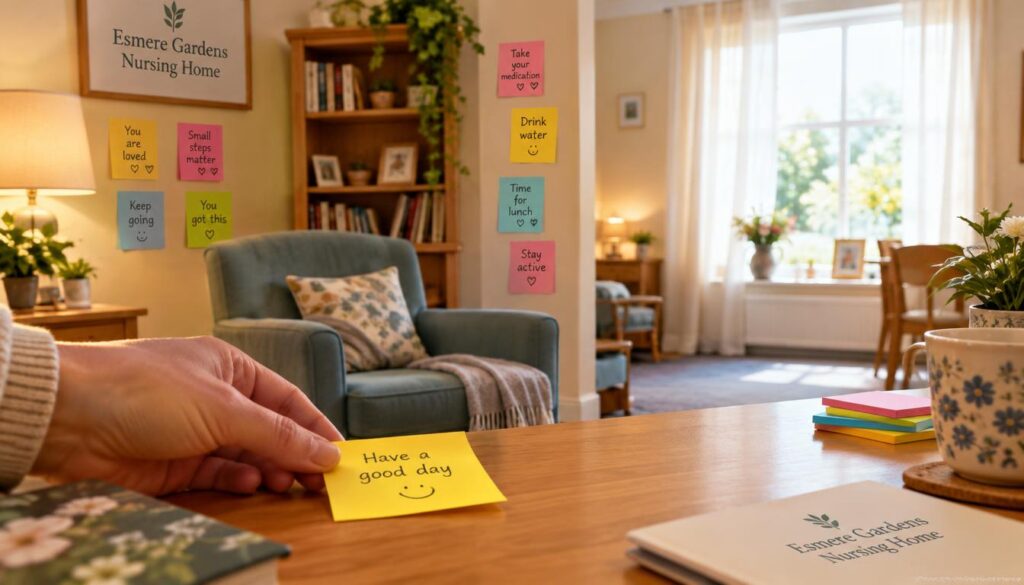
Post-it notes can support familiar routines. Keep each message short, clear and somewhere the person will see it. For example, you might:
- Label a cupboard with a Post-it note.
- Name the contents of a drawer with a note.
- Place a reminder on a door before leaving home.
Use prompts to support the person’s familiar routine, not to replace their say in it.
Ask whether a reminder helps and check that it still works. Too many notes can confuse, and a prompt useful for one task may not suit another.
Let your loved one set the pace. Offer to sit nearby, read a label or help with one step. Small choices can preserve control. Notice what the person can still do comfortably and where a prompt helps.
What support may be needed in middle-stage dementia?
The middle stage of dementia is an approximate guide, not a prediction of an individual’s needs. Moderate dementia can affect dressing, memory and awareness of surroundings. Match support to each task, allowing the person to do what they can safely.
As symptoms of dementia progress, everyday tasks may need more help. A familiar room can seem strange, and a person may not recognise family members. These changes vary between people, dementia types and stages; they do not follow a fixed timetable over the years.
Changes in memory, awareness and behaviour
Earlier memories may remain easier to recall than recent events. A childhood story, for example, may feel more familiar than a recent family visit. Dementia affects the brain, but its effects and the information a person can recall differ.
A person may seem anxious, restless or angry. Such behaviour is not deliberate. Notice what happened beforehand: discomfort, noise or a disrupted routine can contribute to problems. New or concerning behaviour needs professional advice, as pain, infection, medication or another health issue may be involved.
Incontinence can occur as dementia progresses, but it is not inevitable at this stage. Offer private, respectful care. If someone walks with purpose—sometimes called wandering—approach calmly and consider what they may need while keeping them safe.
Keeping choice in everyday support
Offer two suitable outfits or let the person manage the parts of dressing they can. Give one clear prompt at a time. Decision-making ability varies by activity: someone may choose food but need help preparing it. Involve them in decisions, ask before helping, and respect their wishes.
If someone resists care, pause and consider changing the timing, wording or setting. A familiar voice or quieter room may help. Keep choices manageable and preserve the person’s say in their day.
What care can help in late-stage dementia?
At a later stage of dementia, a person may need extensive help with communication, movement and daily care. Severe symptoms may include reduced speech, loss of walking ability and difficulty understanding their condition. Dementia is an umbrella term for diseases affecting the brain; vascular dementia and frontotemporal dementia are different types. Symptoms may vary between people and across stages. Suspected dysphagia, or difficulty swallowing, needs prompt advice from a GP or Speech and Language Therapy (SALT) team because of choking risk.
Speech may become limited, but facial expressions, gestures and touch can still communicate needs. Allow time to respond and do not rely on speech alone.
Communication, swallowing and mobility
Ten possible signs of declining health are: eating or drinking much less; weight loss; worsening swallowing; sleeping more or reduced alertness; declining mobility; repeated falls; recurrent infections or fever; increasing frailty; less speech or responsiveness; and greater dependence with personal care. These signs are not a checklist or a countdown to death. Symptoms may have other causes, and sudden changes need urgent medical assessment. Discuss comfort-focused or palliative support with the clinical team. In any stage, symptoms and progression differ; memory loss or a diagnosis alone cannot predict how much time remains. Vascular dementia and frontotemporal dementia also have individual patterns.
Contact a GP or SALT team promptly about swallowing problems so they can assess the person and advise on safe eating and drinking. The National Institute on Aging’s late-stage care advice covers safe movement, eating, swallowing and skin care. A care plan can record changing needs and who to contact.
Training for carers and care teams
Training helps carers protect safety and comfort as abilities change. Relevant topics include:
- Safer people-handling and hoisting.
- Pressure care to help prevent pressure ulcers.
- Wound care for nurses and senior carers.
- Alternative communication methods.
- International Dysphagia Diet Standardisation Initiative (IDDSI) and dysphagia.
- End-of-life care.
When comparing care options, ask how staff respond to mobility, communication and swallowing concerns. Our guide to questions to ask when viewing a dementia care home can help. Ask how the home shares health changes with family and involves them in decisions.
Care should reflect the person’s needs and comfort, with trained support. Seek prompt medical advice about swallowing difficulty or sudden decline.
Can moments of lucidity happen in late-stage dementia?
A person with dementia may have a brief period of clearer awareness, even at a later stage. Moments of lucidity describe a change in communication or ability, but they do not happen to everyone. There is no fixed duration, and these moments do not show that dementia has reversed.
For example, someone may recognise a family member, follow a conversation or express a thought more clearly than usual. Such changes can feel striking, especially after a long time with limited speech or response.
These events are not a reliable sign that death is near. The timing varies, and a clear moment cannot predict what will happen next. Symptoms of dementia also vary from person to person.
Family and others may find a brief moment of connection precious. Let it unfold without asking the person to remember more or make it last.
Rather than testing memory, respond to what the person communicates and follow their lead. Memory loss does not remove the value of a calm, caring presence.
How Dementia Stages and Memories Change Over Time
The three stages are a broad guide, not a timetable or diagnosis. Early, middle and late are also described as mild, moderate and severe. Symptoms may overlap, appear in a different order or not occur at all.
A person may manage some tasks while needing help with others. One ability can change before another, and progression varies. Dementia often worsens over years, but stages cannot predict exactly what will happen next.
Why the three stages are only a guide
This table shows common examples, not diagnostic criteria. Different types of dementia affect the brain in different ways. Alzheimer’s disease is the most common type; vascular dementia is linked to reduced blood flow to the brain, while dementia with Lewy bodies and frontotemporal dementia have other characteristic features. No type follows an identical pattern in everyone.
| StageOther common labelEveryday experienceSupport focus | |||
| Early | Mild | Some familiar tasks become harder | Prompts and practical support |
| Middle | Moderate | More daily tasks need help | Assistance that preserves choice |
| Late | Severe | Extensive help may be needed | Comfort, safety and communication |
Changes associated with different stages can overlap. Irritability, for example, may ease while memory loss continues. One change does not mean every ability has changed, and cognitive impairment varies between people.
What shapes one person’s experience
Other illnesses, medication, emotional wellbeing, family support and life history all shape daily experience. Familiar routines or music may bring comfort when other activities feel difficult.
The National Institute on Aging’s Alzheimer’s disease fact sheet describes mild, moderate and severe stages and notes that symptoms vary. Alzheimer’s disease is one type of dementia, not another name for all dementia.
Base support on what the person can do and needs today, rather than relying on a stage label.
When should a change in abilities prompt a health check?
A change over a day or two needs a different response from gradual decline. Sudden changes in thinking or behaviour can signal a health problem, not dementia progression. Contact a GP or NHS 111 urgently if the person becomes suddenly confused or noticeably unlike themselves.
Possible causes include delirium from an infection or a stroke. Do not assume sudden confusion is part of dementia or wait for it to pass. If you notice stroke signs, such as facial weakness, arm weakness or slurred speech, call 999. Prompt assessment can identify the cause and guide appropriate care; it can be difficult to assess the problem at home.
Keep observing the person’s behaviour and abilities. Note changes in sleep, mood, movement, attention or responses to familiar people, and when they began. This information can help a healthcare professional assess what has changed and decide what support is needed.
Discuss ongoing changes in mood or personality with a healthcare professional, too. They can have several causes, so an assessment is important before drawing conclusions about a diagnosis or stage. Describe what you have noticed without blaming the person.
The UCI MIND article on sustained personality changes discusses possible early signs, not sudden changes over a day or two. A sudden shift needs a health check whether or not the person has dementia.
Write down when the change began, what happened and whether anything else changed at the same time. A simple record is one of several useful ways to explain your concerns and help the professional assess the decline.
How can the bookcase analogy explain dementia and memory?
Imagine a bookcase holding memories and information gathered through life. This is an analogy, not a picture of how memories are stored in the brain. It places recent memories on higher shelves and older ones lower down.
In this example, dementia shakes the bookcase, so recent memories might fall first while some childhood memories remain. This can help explain why a person recalls distant events but forgets something from minutes ago.
The bookcase of memories
The hippocampus plays an important part in memory, but it is not a bookcase. Dementia affects the brain in different ways, and memory changes vary by person, disease and type. No pattern applies to everyone or every stage.
The bookcase helps families talk about these changes without assuming all memories fade in the same order.
The bookcase of emotion
The analogy presents emotion, associated with the amygdala, as a sturdy bookcase. A person may still feel something connected to an event they no longer recall, though emotional responses vary.
| FeatureMemory bookcaseEmotion bookcase | ||
| Brain area | Hippocampus | Amygdala |
| Analogy | Flimsy bookcase | Solid oak |
| What may remain | Earlier memories | Lasting feelings |
Research on emotional memory has found different patterns in Alzheimer’s disease and frontotemporal dementia. The Frontiers study of emotional memory explores these differences. Alzheimer’s disease research does not establish a rule for every person or other types of dementia.
A forgotten event may still leave an emotional trace, even when the person cannot explain the feeling.
How can you use the memory and emotion analogy in everyday care?
A forgotten conversation can still affect how safe or upset a person feels. Feelings may outlast details, but responses vary between people and types of dementia. Respond to the feeling you notice, rather than expecting the person to recall its cause.
Mavis argues with her daughter, who assumes everything will be fine because “Mum will forget by tomorrow”. Mavis forgets the disagreement but feels sad and insecure the next morning, then becomes angry with carer Sarah.
When a difficult moment is forgotten
Sarah may not know why Mavis is upset. A calm response can help her feel heard. Rather than correcting her, Sarah can offer reassurance.
This care principle can guide daily interactions:
Respond with kindness: the person may forget an event, but their feelings still matter.
Family, carers and healthcare professionals can share what they notice, so support reflects the person’s needs rather than guesses about memory. Emotional responses are one part of life with dementia, not a rule for every person or stage.
Keeping familiar experiences positive
After a shopping trip, Mavis forgets the outing but remains happy. This example shows how an activity’s emotional tone may matter even when its details fade. Alzheimer’s disease can affect memory and the brain in different ways; symptoms and experiences vary.
Practical care can include:
- Responding to the person’s feelings.
- Choosing positive shared activities.
- Changing familiar equipment only after an individual safety assessment.
For example, consider a whistling kettle only if it suits the person’s preferences and is safe. Familiar objects can support confidence, but changes should not create confusion or risk for the person or others.
Conclusion
Good dementia care starts with the person’s needs, choices and feelings today. The condition changes over time, but stage labels cannot predict exactly what support someone will need or how they will be in the years ahead. Alzheimer’s disease is one type of dementia; every person’s experience is individual. Respect, connection and a say in daily life should remain central.
At Esmere Gardens, our all-inclusive care offers clear fees, personalised support and a purpose-built environment. Residents can access a private GP, and a private dentist is coming soon. Read about private GP support at Esmere Gardens when considering clinical care for your family.
If you are comparing care homes, our guide to choosing a medical-led, compassionate home offers points to consider. Discuss changes with a healthcare professional and take the next step at a pace that feels right for your loved one.
FAQ
What is dementia, and what are signs?
When might dementia affect family recognition?
Can feelings remain after an event is forgotten?
How do I support early dementia independence?
When does sudden decline need urgent medical care?
Do dementia stages predict progression or lifespan?
To download our brochure, click below to enter your details and to stay up to date with developments, news and events. During a tour of Esmere Gardens, you will be able to view all that the home has to offer at your leisure, ask any questions you may have and take a tour of this beautiful market town. Click below to arrange a show around.Request a Brochure
Book a tour