

“How do I ask Mum to tour a care home without making her feel that the decision has already been made?”
That question comes from love, not failure. You may be noticing falls, missed medication, loneliness, memory changes or increasing frailty. Perhaps you are trying to coordinate care from London, or each visit ends with the same worry: is Mum or Dad still safe here alone?
The first goal is not to “win” an argument. It is to help your parent feel heard, preserve their choices and make the next step small enough to consider. A private care-home tour is not a commitment to move. It is a chance to meet people, see daily life and replace frightening assumptions with real information.
This guide explains how to talk to an elderly parent about a care home, what to look for when touring a long-term care facility, and how UK care can progress from independent living to residential, nursing or dementia support. It also explores why London families consider Esmere Gardens in the historic Cotswold market town of Moreton-in-Marsh for a reassuring long-term home.
The quick answer: invite, do not pressure
Begin with what matters to your parent: independence, familiar routines, safety, company or relief from managing the house. Speak about a visit, not a move. Offer two possible dates, agree that no decision is required on the day and ask the home to shape the tour around your parent’s interests.
During the visit, notice how staff speak to residents, whether the atmosphere feels calm and genuine, how health changes are handled, and whether the home could support your parent if their needs increase.
The best outcome is not simply that your parent agrees with you. It is that they remain part of a careful, informed and respectful decision.
Why families put Esmere Gardens on their tour list
- CQC-rated Good overall and Good across Safe, Effective, Caring, Responsive and Well-led.
- Several care pathways in one home: residential, nursing, dementia, respite and urgent care, subject to assessment.
- 24-hour nursing capability for residents who require nursing support.
- Dedicated onsite private GP support alongside nursing, NHS and specialist services where appropriate.
- All-inclusive care designed to give private, self-funding families greater clarity about regular services and costs.
- A connected Cotswold location in Moreton-in-Marsh, a historic market town with direct rail access from London.
Before you start the conversation: understand what the “no” may mean
When a parent says, “I am not going into a home,” they may not be rejecting care itself. They may be protecting everything the word home represents: privacy, identity, marriage, memories, neighbours, pets and the right to decide what happens next.
A refusal may also mean:
- “I am frightened that I will lose control.”
- “I think you want to get rid of me.”
- “I remember care homes from decades ago.”
- “I do not want to admit that daily life has become difficult.”
- “I worry I will never see my family or community again.”
- “I do not know how we will pay for it.”
Listen for the fear beneath the objection. If you answer only the words—by listing falls, forgotten tablets and unpaid bills—you may unintentionally make your parent defend their independence more fiercely. Begin by acknowledging what they could lose, then explore what the right support might help them keep.
A more helpful starting sentence
“Mum, I know staying in control matters to you. I’m worried that managing the house is taking more energy and that you’re spending too much time alone. Would you visit one place with me—not to decide anything, but so we both understand what the options really are?”
Lead with the life your parent wants, not a list of everything they can no longer do.
How to help a parent agree to tour a nursing or residential care home
1. Choose a calm moment—not the middle of a crisis
A rushed conversation after a fall, during an argument or while leaving hospital can feel like an ultimatum. If it is safe to do so, choose a quieter time when your parent is rested and able to engage. For someone living with dementia, that may mean the time of day when they are usually most alert and settled.
2. Use “we” and “I,” not “you must”
Try: “I am worried, and I want us to understand the choices.” Avoid: “You cannot cope anymore.” One opens a shared problem; the other can sound like a verdict.
3. Make the first decision smaller
You are asking for a tour, not permission to pack the house. Say clearly that visiting does not create an obligation. A cup of tea, lunch or a short look around may feel far more manageable than a formal “assessment visit.”
4. Connect the visit to your parent’s priorities
If your father misses company, ask to see the dining room and activities. If your mother loves gardening, arrange time in the garden. If health worries dominate, ask how nursing support, medicines and GP access work. The tour should answer their questions, not only yours.
5. Offer genuine choices
Would they prefer a morning or afternoon visit? Would they like a sibling, trusted friend or adviser to come? What are their non-negotiables? Choice restores agency even when the wider situation feels uncertain.
6. Be honest about concerns without using fear
You do not need to hide a pattern of falls, night-time confusion or carer exhaustion. Describe specific facts calmly: “There have been three falls this month, and I’m worried about what would happen overnight.” Then ask what solution would feel acceptable to them.
7. Expect more than one conversation
People rarely change their view about a major life decision in a single discussion. Give your parent time to absorb information. Return to the subject respectfully rather than treating the first “no” as either final or irrelevant.
8. Ask a trusted professional to help explain the options
A GP, social worker, occupational therapist, hospital discharge professional or care-home assessor may help separate clinical needs from family tension. The NHS recommends a needs assessment when considering whether a care home is suitable.
9. Respect capacity, wishes and legal safeguards
An adult should be assumed to have capacity unless it is established otherwise. A diagnosis of dementia does not automatically remove the right to decide. People should receive appropriate help to understand and communicate their choice. If a person cannot make the specific decision, any decision made for them must be in their best interests, take account of their wishes and use the least restrictive reasonable option.
For independent guidance, see the GOV.UK guidance on supporting decisions and best interests. Seek professional advice where capacity, safety, legal authority or family disagreement is uncertain.
Let us make the first visit feel less formal
Tell the Esmere Gardens team what your parent enjoys, what they are worried about and what would make the visit easier. The tour can focus on the questions that matter to your family.
What to look for when touring a long-term care facility
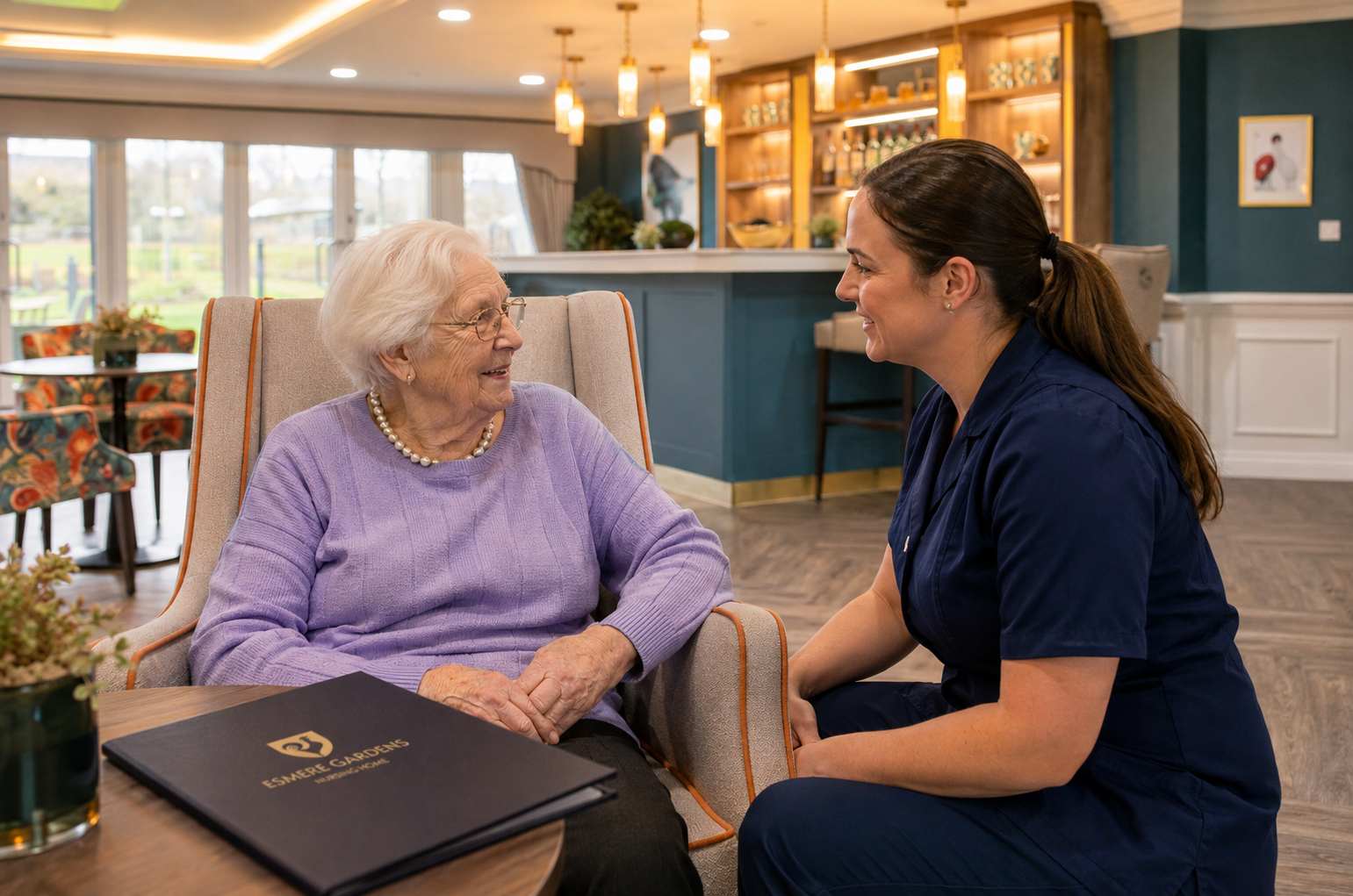
Beautiful rooms matter, but they are not the whole decision. Look at how the home feels when nobody appears to be performing for visitors. The strongest evidence is often found in ordinary moments.
| What to notice | Reassuring signs | Questions to ask |
|---|---|---|
| Welcome and atmosphere | Residents look comfortable; staff greet people by name; the pace feels calm rather than controlled. | How do you help a new resident settle during the first week? |
| Staff relationships | Conversations are warm, unhurried and respectful. Staff knock before entering private spaces. | How do you learn each resident’s history, routines and preferences? |
| Care and nursing | The team can clearly explain assessment, care planning, escalation and support at night. | What happens if mobility, health or medication needs change? |
| Dementia support | Routines, communication and surroundings support familiarity, dignity and reduced distress. | How do you respond when someone is anxious, restless or trying to leave? |
| Food and hydration | There is choice, flexible support and a plan for changing appetite or swallowing needs. | Can families join a meal, and how are special diets supported? |
| Daily life | Residents can join meaningful activities, enjoy quieter choices or continue personal interests. | What would an ordinary day look like for my parent? |
| Family involvement | The home explains communication, consent and how relatives can remain part of daily life. | Who contacts us after a health change, and how quickly? |
| Fees and continuity | Written inclusions, exclusions and possible changes are explained before admission. | Could my parent stay here if their assessed needs increase? |
Look beyond what you can photograph
Fresh décor can make a strong first impression. So can a garden, café or salon. But long-term confidence comes from less visible systems: staff knowledge, medicines management, clinical oversight, communication, safeguarding, emergency planning and whether changes are noticed early.
Read the latest inspection evidence
The Care Quality Commission regulates care homes in England. Read the current report rather than relying on an old brochure or a single headline rating. Esmere Gardens is currently rated Good overall and Good in all five assessed areas. You can verify this on the official Esmere Gardens CQC page.
Imagine an ordinary Tuesday—not only moving day
Could your parent choose when to get up? Would staff know how they take their tea? Is there somewhere peaceful to sit with family? What happens after a difficult night? The right home should support a meaningful life after the welcome flowers have gone.
Independent living to assisted living: progressive care options in the UK
“Assisted living” is widely searched online, but UK families may encounter different terms. The important question is not the label—it is what support the person needs today and what could be required later.
Independent living or retirement housing
Suitable for someone who can manage personal care and most daily tasks but wants a smaller home, community or easier maintenance. Support and staffing vary considerably, so check exactly what is available.
Home care
Carers visit the person’s own home for agreed tasks such as personal care, meals or medication prompts. This can preserve familiar surroundings, but it may become difficult when someone needs frequent help, overnight supervision, nursing support or more company than scheduled visits provide.
Extra-care or assisted-living housing
Usually combines a self-contained home with access to onsite care. Availability and service models differ. It may suit someone who values a private front door but needs planned support.
Residential care
Residential care at Esmere Gardens supports daily living, personal care, meals, medication routines, safety and companionship. It may be right when living alone has become unsafe or isolating but regular nursing intervention is not the primary need.
Nursing care
Nursing care at Esmere Gardens includes personal care alongside support from registered nurses for people with complex or changing health needs. The NHS describes nursing homes as providing personal care plus 24-hour care from qualified nurses.
Dementia care
Dementia care at Esmere Gardens is shaped around memory, communication, safety, familiarity and dignity. Depending on assessment, a person may need residential dementia care or dementia nursing care.
Respite care
Respite care may support recovery, give a family carer a break or allow someone to experience a care home before considering a permanent stay. It is not a disguised promise of long-term admission; any next step should remain subject to assessment, consent, suitability and availability.
Why progressive care matters
Moving home can be exhausting at any age and especially unsettling for someone living with dementia. A home that offers residential, nursing and dementia pathways may be able to review and adapt care as needs change, reducing the risk of another move.
This is always individual: no home should promise in advance that it can meet every future need. Ask how reassessment works and under what circumstances another setting might become necessary.
For independent guidance, read the NHS guide to care homes and the NHS guide to dementia and care homes.
Moving from London to a care home in the Cotswolds
For London families, choosing care can feel like choosing between closeness and quality of life. A Cotswolds home may offer more space, quieter surroundings and a different pace—but relatives still need to know that visits can remain part of ordinary family life.
Some families already have Cotswold connections. Others are moving an older parent closer to adult children who left London, choosing a midpoint between relatives, or looking for a long-term home outside the capital without becoming disconnected from it.
Ask practical questions before choosing distance
- Can close relatives visit by both rail and road?
- Is the home in a living community rather than an isolated setting?
- Can family join meals, celebrations or time in the garden?
- How will relatives receive updates when they cannot visit?
- Can care adapt, reducing the chance of another relocation?
- Does the location feel like somewhere your parent could belong—not somewhere they have been sent?
A move from London should not mean losing family connection. It should create a safer everyday life for your parent while helping visits become relaxed time together again—not hurried inspections of the fridge, medication and post.
Moreton-in-Marsh: a historic Cotswold town that remains connected

Moreton-in-Marsh offers something valuable to families considering countryside care: Cotswold character without complete isolation. It is a historic North Cotswold market town shaped by the Roman Fosse Way, known for its broad High Street, honey-coloured buildings and long market tradition.
It is also served by direct rail services from London. That connection can make regular visits more realistic for children, grandchildren and old friends who remain in the capital. The town’s shops, cafés, community life and surrounding countryside can help a care-home move feel connected to a recognisable place rather than removed from everyday life.
Learn more through the official Cotswolds tourism guide to Moreton-in-Marsh.
Esmere Gardens is on Stow Road, within reach of Moreton-in-Marsh, Chipping Campden, Stow-on-the-Wold, Broadway, Kingham, Daylesford, Bourton-on-the-Hill, Blockley and other North Cotswold communities.
Why tour Esmere Gardens for long-term residential care?
A website can tell you what a home provides. Only a visit can help you judge whether your parent might feel known there.
- Care that can be reviewed: residential, nursing and dementia pathways within one home, subject to ongoing assessment.
- Clinical reassurance: 24-hour nursing capability and dedicated onsite private GP support working alongside appropriate NHS and specialist services.
- Clearer private-care planning: an all-inclusive approach to care fees, with current inclusions, exclusions and terms explained before admission.
- Daily life beyond care tasks: comfortable living spaces, gardens, dining, activities and choices designed to help residents continue familiar routines.
- Family connection: relatives are encouraged to remain involved, subject to the resident’s wishes and appropriate care considerations.
- Independent evidence: a current CQC Good rating that families can check directly.
- A connected Cotswold setting: Moreton-in-Marsh combines countryside surroundings, a historic town and direct London rail access.
Explore life at Esmere Gardens, learn about the home, or arrange a private visit to see how the written promises feel in person.
You do not have to decide today
A private tour is simply the next piece of information. Bring Mum or Dad, bring your questions and take the time to notice how the home feels.
Care-home tour checklist: 20 questions to take with you
- How will you assess what care my parent needs now?
- How will my parent be involved in their care plan and everyday choices?
- What would their first day and first week look like?
- How do staff learn residents’ histories, preferences and routines?
- What staffing and nursing support is available overnight?
- How are falls, infections, pain and sudden confusion handled?
- How does onsite private GP support work in practice?
- How do you work with NHS services and external specialists?
- How are medicines reviewed, administered and monitored?
- How do you support anxiety, distress, wandering or changes linked with dementia?
- What activities are available, and can residents choose not to join?
- Can residents continue hobbies, religious practices and community connections?
- How flexible are waking, bathing, dining and bedtime routines?
- Can families visit, share meals or celebrate special occasions?
- Who keeps relatives informed, subject to consent and confidentiality?
- What is included in the fee, and what could cost extra?
- How and when can fees change?
- What happens if my parent’s mobility, memory or health needs increase?
- Could respite provide a gentle introduction before permanent care?
- Do you currently have a suitable room, and what are the next assessment steps?
One final question to ask yourself: after meeting the team, do you feel more informed and reassured—or more rushed and uncertain?
Visit Esmere Gardens Nursing Home in Moreton-in-Marsh
Esmere Gardens Nursing Home is located at Stow Road, Moreton-in-Marsh, Gloucestershire GL56 0DS.
Frequently asked questions about helping a parent consider a care home
How do I convince my parent to tour a nursing home?
Do not begin by trying to win an argument. Listen to what your parent fears losing, connect the visit to what matters to them and make the first step small. Explain that a tour is not a commitment, offer genuine choices about when and how to visit, and allow time for more than one conversation.
What if my parent refuses to discuss a care home?
Pause and try to understand the reason for the refusal. Use specific, calm examples of your concerns and explore alternatives together. A GP, social worker or other trusted professional may help. If safety or mental capacity is in question, seek appropriate professional advice rather than attempting to force a move.
Can someone with dementia decide whether to move into a care home?
A dementia diagnosis does not automatically mean a person lacks capacity. Capacity is decision-specific and may fluctuate. The person should be supported to understand and communicate their choice. If they cannot make the decision, the relevant decision-maker must follow the Mental Capacity Act and act in the person’s best interests.
What should I look for when touring a care home?
Observe how staff speak to residents, the everyday atmosphere, cleanliness, food, meaningful activity, privacy, family communication and clinical support. Ask how the home assesses needs, manages health changes, supports dementia, explains fees and adapts care over time. Check the latest CQC report.
What is the difference between residential care and nursing care?
Residential care provides accommodation, personal care, meals, support and companionship. Nursing care provides these services plus 24-hour support from qualified nurses for people with more complex health needs.
What does progressive care mean?
Progressive care means support can be reviewed and adjusted as a person’s needs change. A home offering residential, nursing and dementia pathways may reduce the need for another move, although continued suitability must always depend on individual assessment.
Can respite care help a parent try a care home?
Sometimes. Subject to assessment and availability, respite may provide short-term recovery, a family-carer break or an opportunity to experience daily life in the home. It should not be presented deceptively, and any permanent move requires a separate, careful decision.
Why might London families consider a care home in Moreton-in-Marsh?
Moreton-in-Marsh offers a Cotswold setting within a historic working market town and has direct rail access from London. For some families, this provides quieter surroundings for the resident while helping relatives and friends maintain regular contact.
Is Esmere Gardens a long-term nursing and residential care home?
Yes. Esmere Gardens provides permanent residential, nursing and dementia care as well as respite and urgent care, subject to assessment, suitability and room availability.
How do I arrange a tour of Esmere Gardens?
Call 01608 692222 or use the website contact form. Tell the team about your parent’s needs, interests and concerns so the visit can focus on what matters most to your family.
To download our brochure, click below to enter your details and to stay up to date with developments, news and events. During a tour of Esmere Gardens, you will be able to view all that the home has to offer at your leisure, ask any questions you may have and take a tour of this beautiful market town. Click below to arrange a show around.Request a Brochure
Book a tour