
At Esmere Gardens, residents receive overnight support shaped around their individual needs, with nursing oversight and care colleagues available to help. Furnished ensuite bedrooms, plus dedicated restaurant, café and pub spaces, give residents different places to feel at home. Overnight nursing care can help when you worry that a loved one may be alone, unsettled or unwell at night.
It is natural to wonder what happens after evening visits end and the home grows quieter. We explain how support is shaped around each person, so you can discuss your relative’s needs with the team clearly and calmly.
Families can ask how their relative’s own night-time needs would shape their care.
Key Takeaways
- Registered nurses are on site at Esmere Gardens throughout the day and night.
- Evening routines and overnight support reflect each resident’s assessed needs and preferences.
- Residents can request help through the nurse-call system.
- Intelligent fall detection adds support but does not replace care from staff.
- The nursing team can seek medical services according to the urgency of a concern.
- Family contact follows the resident’s wishes and agreed arrangements.
Are registered nurses present overnight?
Yes. Esmere Gardens has registered nurses on site 24 hours a day. On site means a nurse is physically present in the home, not waiting elsewhere to be called in. Registered nurses provide clinical oversight and personalised nursing care overnight.
The nursing team works with care colleagues, who support residents with everyday needs. Nurses monitor changes in wellbeing, manage and give medication, coordinate with other healthcare professionals, and make clinical decisions. They escalate concerns when needed, based on the resident’s situation.
| Overnight role | Where they are | What this means for support |
|---|---|---|
| Esmere Gardens’ registered nurse | Physically at the home | Provides nursing oversight and personalised nursing care |
| Nurse on call elsewhere | Off site until called | Is not physically present in the home |
| Care colleagues | At the home as part of the team | Support residents with everyday care needs |
This distinction matters when comparing 24-hour care with arrangements where a nurse is on call elsewhere. Home care and live-in care can offer different forms of support, but neither phrase alone tells you whether a registered nurse is physically present. Ask who provides nursing oversight and who supports day-to-day care.
At Esmere Gardens, the nursing team can review changes in a resident’s wellbeing and act on concerns. Care colleagues share relevant observations with nurses, helping the team understand what may have changed. Care is shaped around the person, rather than a single approach for everyone.
The Nursing and Midwifery Council sets out the professional standards for registered nurses, including the skills and knowledge needed for safe, compassionate care. Families can ask how the nursing and care roles work together at night. Clear answers can help you understand what the team’s presence means for your relative.
A nurse’s physical presence means nursing oversight is available within the home, rather than from an off-site on-call service.
That arrangement does not mean every resident needs the same support. The team’s role is to respond in line with each person’s needs and care plan, while respecting their choices and routines. A nurse being physically present at the home is different from a nurse being on call elsewhere.
Supporting a familiar evening routine
One resident may want to settle early, while another may prefer a drink or a quiet activity first. There is no single timetable for everyone. Staff can support an evening routine shaped around the resident’s preferences and assessed needs.
A familiar sequence may feel more comfortable than going to bed at a particular hour. Your loved one might like time to read, listen to music or sit quietly before settling. Staff can talk with the resident about what feels right and support their choices.
Personal care can be supported in a way that respects privacy and the person’s abilities. This may include help with changing, getting ready for bed or using the bathroom. Furnished ensuite bedrooms are part of Esmere Gardens’ setting, while the support each person wants remains individual.
These details can help the team understand what a familiar evening looks like:
- Preferred bedtime
- Comfort and settling preferences
- Personal care and bathroom assistance
- A drink
- A quiet activity
A resident may prefer a drink before bed, while someone else may not want one at that time. The same is true of personal care: one person may ask for assistance, while another may want more independence. Staff can follow the resident’s wishes within their assessed needs.
Families often know which small details make an evening feel familiar. You could tell the team whether your loved one prefers a certain order for getting ready, or whether quiet time helps them settle. Such details can be useful when discussing home care or live-in care needs, too.
There is no need to assume that a routine must stay fixed every night. A person’s preferences may change, or their support needs may shift. The team can take those changes into account when providing personal care and other help.
A familiar routine is not a rule that restricts someone’s choice. It is a way to make space for what matters to the resident, while giving staff a clearer sense of how to support them. The most useful routine is the one that reflects the resident’s own preferences and assessed needs.
How overnight support is planned
A resident’s assessed needs guide what support and monitoring are appropriate overnight. The approach is individual, not a schedule of constant checks for every person. Monitoring should match the resident’s assessed needs while respecting privacy, independence and rest.
The evening and night teams use a structured handover to support continuity. It highlights relevant changes in health, medication, wellbeing or support requirements. This gives the night team information that may affect the resident’s care.
Residents can request assistance using the nurse-call system. Esmere Gardens also uses intelligent fall-detection technology as additional support. These tools work alongside personal care; they do not take the place of staff attention or judgement.
| What it supports | How it relates to the resident’s needs | How staff remain involved |
|---|---|---|
| Nurse-call system | A way for residents to request assistance | Staff provide the requested support |
| Intelligent fall detection | Additional support for safety | Staff remain responsible for care |
| Individualised monitoring | Support based on assessed needs | Staff tailor care to the resident |
Not everyone needs the same level of monitoring. The team considers the person’s assessed needs and how support can balance safety with dignity, privacy, independence and rest. A one-size-fits-all approach could fail to reflect what matters to an individual.
For example, the need for support may differ from one resident to another and may change over time. The care plan and handover help staff carry relevant information forward, rather than assuming that yesterday’s needs are unchanged.
Technology can help staff stay aware of a resident’s needs, but it does not provide personal care or make every decision. People remain at the centre of the support. Staff use their knowledge of the resident alongside information from the nurse-call system and fall-detection technology.
Families can ask how an individual’s needs shape monitoring, and how the team protects privacy while providing support. It is also reasonable to discuss what happens if a resident’s needs change. Monitoring should support wellbeing while respecting privacy and the resident’s need for rest.
When someone becomes unsettled
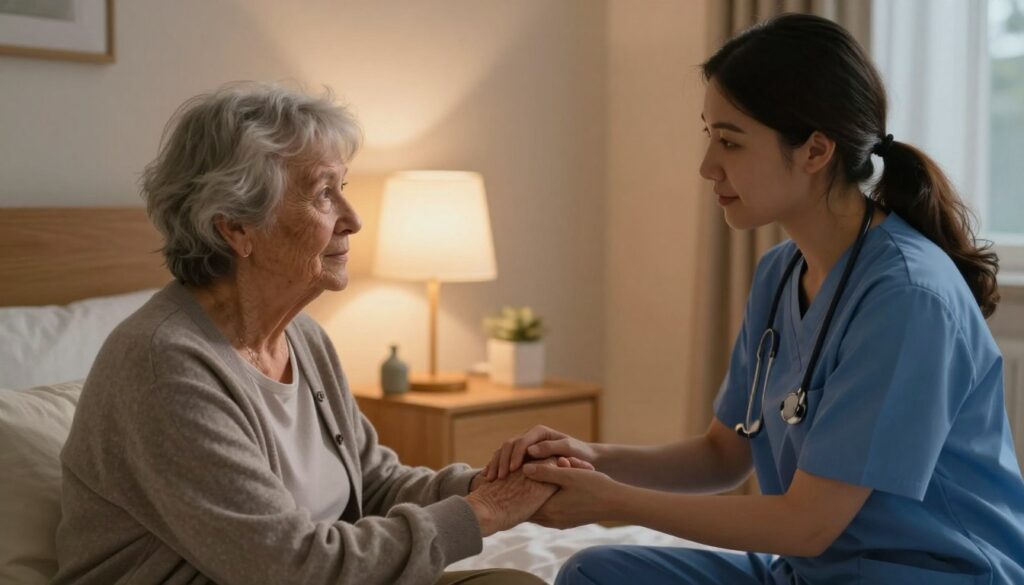
A resident who becomes unsettled at night should receive reassurance while staff consider what may be causing the change. A calm approach can help staff understand what the person needs. The nurse assesses the resident when clinically appropriate and decides whether further support is needed.
Staff may consider possible causes such as discomfort, pain, anxiety, needing the bathroom or a change in health. A person with dementia may find evening or night-time changes especially difficult. The team can use what it knows about the resident to guide its response.
Behavioural disturbances in dementia often peak in the late afternoon or evening, a pattern known as sundowning. This pattern affects up to two-thirds of people with dementia, and sleep disturbances are among the symptoms seen.
Neuropsychiatric symptoms, including sleep disturbances, occur in 60 to 90 per cent of people with dementia. Their prevalence rises as dementia becomes more severe, as outlined in the clinical reference on managing neuropsychiatric symptoms.
These figures describe patterns across groups, not what will happen to any one person. If your loved one has dementia, their own experience and usual habits matter. Staff can offer reassurance and consider whether a change in comfort, health or surroundings may be relevant.
Where clinically appropriate, the nurse assesses the resident and decides whether further monitoring, treatment or medical advice is needed. Staff can review concerns in light of what they observe and what the resident says, where they can share this. The person’s dignity and preferences remain central.
Illustrative scenario
If a resident who usually sleeps well becomes unsettled, staff offer reassurance and consider possible causes. Where clinically appropriate, the nurse assesses the resident and decides whether further monitoring, treatment or medical advice is needed. Staff keep the person’s dignity and preferences central.
This is an illustrative example, not a record of an actual resident’s experience. A change from someone’s usual pattern is a reason for the team to understand their needs and review the concern.
When someone becomes unwell
If a resident becomes unwell, the nurse assesses what has changed and decides what further help is appropriate. The next step depends on urgency and the nature of the concern. The nursing team can access suitable medical services out of hours, guided by the resident’s situation.
The nurse considers the resident’s health, symptoms and relevant conditions. The team can then decide whether to monitor the person, provide treatment, seek medical advice or escalate to emergency services. Urgent or emergency concerns are handled according to their nature and urgency.
Registered nurses are on site at Esmere Gardens around the clock. Private GP access is a separate service: Concierge Medical gives residents access to private GP medical advice and support alongside their NHS healthcare arrangements. The GP is not permanently resident on site.
Private GP access does not replace urgent assessment or emergency escalation. The nursing team makes clinical decisions and coordinates with other healthcare professionals when needed. The type of medical support sought depends on the concern, rather than simply on the time of day.
Families comparing care services may find it helpful to ask how nursing care, NHS arrangements and private GP support fit together. The services have different roles. A private GP can provide advice and support, while the on-site nursing team provides nursing care and responds to concerns.
Our urgent and emergency care service supports families considering short-notice care, including after a hospital stay or during a crisis. This is separate from the steps staff take when an existing resident becomes unwell overnight. Each situation calls for attention to the person’s needs.
Families sometimes worry that a health change will lead to an admission to hospital. The team assesses the resident and seeks further help as appropriate, but it cannot promise to prevent illness or hospital admission. Private GP access through Concierge Medical sits alongside NHS care, while registered nurses provide the on-site nursing support.
How families are informed
Families or representatives are contacted where appropriate when a significant change or incident needs their involvement. Agreed arrangements guide contact, with the resident’s wishes taken into account. The team considers who should be contacted and when family involvement is needed.
This may include a significant change in health or wellbeing, an incident, or another matter that requires a family member or representative’s involvement. The resident’s wishes help shape how the team communicates and who it contacts.

Communication arrangements are agreed with the resident and relevant people, taking account of the resident’s wishes. A family member may be involved in some decisions, while a representative may need contact in other circumstances. The team follows the arrangements agreed for that resident.
It can help to talk about communication before a concern arises. You can discuss who the resident wants involved and how their wishes should guide contact. The resident remains part of decisions about their care and communication wherever possible.
Not every observation or small change means a family member needs to be involved. The team contacts families or representatives where appropriate about significant changes, incidents or matters that require their involvement. This keeps communication focused on situations where family participation is needed.
Families may have different roles in a person’s life, and the resident’s own wishes matter. An agreed plan can help the team understand who should hear about a significant change and who may help with a decision. It also gives everyone a chance to share what the resident would want.
If you are unsure what communication arrangements would suit your relative, you can raise this with the team. The discussion can include the resident’s preferences and the role of any representative. Agreeing communication arrangements means the resident’s wishes remain part of decisions about family contact.
Questions to ask when visiting a home
A visit gives you the chance to talk through your relative’s night-time needs with the team. You can take your time and ask how those needs would be assessed before admission. A clear discussion can help you judge whether the support feels right for your loved one.
You may find these questions useful during a visit:
- Are registered nurses physically on site throughout the night?
- How are personal routines and assessed needs recorded in the care plan?
- How are monitoring and privacy balanced?
- What happens if a health concern needs medical or emergency help?
- Who will be contacted after a significant change, and how are those arrangements agreed?
You can discuss your loved one’s needs without making a decision during the visit.
We welcome a conversation about nursing-care needs, including what your relative finds comforting and where they need assistance. Bring your questions, discuss how your loved one’s needs would be assessed before admission, and arrange a visit when you feel ready.
Explore our 24-hour nursing care in Moreton-in-Marsh and how private GP support works. Arrange a personal visit to discuss the night-time support that matters to you.
FAQ
What should I tell the nursing team about my loved one’s night-time routine?
Can a resident ask for help with a non-emergency need during the night?
Can overnight routines change after someone moves into a nursing home?
Does fall-detection technology replace staff support?
Is private GP access the same as having a GP on site overnight?
How can families prepare for a discussion about overnight care?
To download our brochure, click below to enter your details and to stay up to date with developments, news and events. During a tour of Esmere Gardens, you will be able to view all that the home has to offer at your leisure, ask any questions you may have and take a tour of this beautiful market town. Click below to arrange a show around.Request a Brochure
Book a tour