
Residential care homes in Gloucestershire.
Clarity, comfort and care you can trust.
Understand the cost of residential care, the difference between a care home and a nursing home, and the support available for someone living with dementia. A practical starting point for families considering Esmere Gardens and care across the North Cotswolds.
What is the right care for your family?
Residential care provides accommodation and personal support. Nursing care adds care from registered nurses. Dementia care may be residential or nursing, depending on the person's needs. Start with an assessment, then compare how each home would support daily life, health, preferences and relationships.
Searching for care often begins with a change: meals being missed, a partner becoming exhausted, a hospital stay or growing concern about someone managing alone. You may feel relief at the thought of help and guilt about considering it. There is room for both feelings.
You do not need to choose a care category before speaking to us. Tell us what has changed, what the person enjoys and what a good day looks like. Include them in the conversation as fully as possible. Their priorities matter just as much as the practical arrangements.
If support at home, adaptations or another arrangement could safely meet the person's needs and preferences, those options deserve consideration too. A move should follow a thoughtful discussion, rather than pressure to make an immediate decision.
Residential or nursing care?
Compare your Gloucestershire care options.
A welcoming environment matters, but the starting point is whether a home can meet the person's assessed needs. These distinctions help you ask more useful questions.
On a phone, swipe the comparison table sideways to see every column.
| Care option | What it means | A useful question |
|---|---|---|
| Residential care home | A place to live with personal care, meals and everyday support, such as help with dressing or washing. | How will you support existing routines and the things the person can do independently? |
| Nursing care | Personal care and accommodation with registered nursing care available for assessed health needs. | Can your nursing team meet these particular needs, including overnight? |
| Residential dementia care | Personal care and support adapted for someone living with dementia who does not require nursing-home care. | How do staff learn the person's history, communication style and sources of reassurance? |
| Nursing dementia care | Dementia support combined with registered nursing care where the person's assessment identifies that need. | How will dementia support and nursing care work together in the care plan? |
| Respite care | A planned short stay, subject to assessment and availability, offering temporary support or a break for an unpaid carer. | What is the agreed length of stay, and what happens if more support is needed afterwards? |
These are starting points for discussion, not a way to diagnose care needs. The NHS explains the main distinctions in its care-home guidance, listed in the references below.
How do you decide between residential and nursing care?
Begin with the support the person needs throughout a typical day and night. Help with dressing, meals and personal routines may be provided through residential care. Needs requiring regular registered nursing input should be discussed with an appropriately qualified professional and the home's assessment team. A care assessment should consider the whole person rather than relying on a diagnosis or a single symptom.
Where does residential dementia care fit?
Dementia support can form part of residential or nursing care. Ask how the home would support communication, familiar routines, meaningful activity and any associated health needs. If needs change, ask how the team reviews the care plan, involves the resident and family, and decides whether the home can continue to provide suitable support.
Explore residential and respite care
Understand everyday support, companionship and the possibilities for a permanent home or shorter stay.
Residential care at Esmere Gardens · Respite care and short stays
Explore nursing and dementia support
Discuss the person's health and care needs with our team, including how support would be planned and reviewed.
The cost of residential care:
understand the complete weekly fee.
There is no single price for residential care in Gloucestershire. Charges vary with the home, accommodation, assessed support and services included. A national average cannot tell you what a particular placement will cost.
At Esmere Gardens, we provide an individual written fee proposal after discussing the accommodation and care required. Ask for current fees and availability, then review the inclusions, exclusions and agreement before deciding.
A lower headline fee is not automatically a lower total cost. Equally, a higher fee is not proof of better care. Compare the proposed support, everyday services and financial terms on the same basis.
Swipe sideways on a phone. Copy these questions into your notes when requesting quotations.
| Check | Ask each home to confirm | Why it matters |
|---|---|---|
| Weekly fee | What is the total weekly fee for this person and the proposed room? | Makes quotations comparable. |
| Everyday costs | Which meals, laundry, activities, personal services and transport are included? | Reveals regular extras. |
| Health support | What nursing, GP or other professional support is included, and what has separate arrangements? | Clarifies access and charges. |
| Changing needs | What happens to the fee and placement if the person needs more help? | Supports realistic longer-term planning. |
| Reviews and terms | How do annual increases, deposits, absence charges and notice periods work? | Explains commitments beyond the starting price. |
| Funding | How would any agreed council contribution or NHS nursing contribution be shown? | Avoids assuming funding automatically reduces a quoted fee. |
A simple planning calculation
Compare the weekly fee plus expected weekly extras. Multiply that total by 52 for a 52-week planning figure. For illustration only, £1,500 plus £100 in weekly extras totals £1,600 a week, or £83,200 over 52 weeks. These are invented example figures, not Esmere Gardens' fees or a Gloucestershire average. Reviews and contract terms may change the actual cost.
Could financial help be available?
In England, council support depends on assessed eligible needs and a financial assessment. Some people may qualify for NHS Continuing Healthcare; eligible nursing-home residents may receive an NHS-funded nursing care contribution paid to the home. These are different arrangements, and eligibility should never be assumed.
Ask the relevant council or NHS team about assessment. If you are comparing a care home elsewhere in the UK, check that nation's arrangements: England's funding rules do not apply everywhere. Age UK's explanation of residential-care funding is included below.
Understand paying for care at Esmere Gardens and explore our all-inclusive package.
All-inclusive care in Moreton-in-Marsh.
What makes Esmere Gardens different?
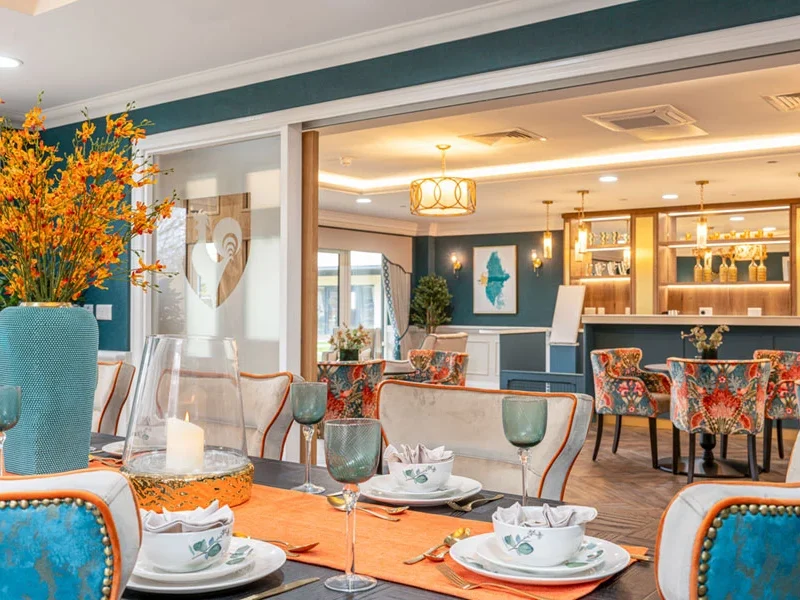
Esmere Gardens brings residential, nursing, dementia and respite care together in Moreton-in-Marsh. Our purpose-built home combines comfortable private accommodation and welcoming shared spaces with care shaped around the individual.
CQC-rated Good
The Care Quality Commission's assessment report, published on 21 January 2026, rates Esmere Gardens Good overall and across all five assessed areas. Read the report through the reference below, then ask us how its findings translate into daily practice.
Dedicated private GP support.
Already included.
Permanent residents and respite guests benefit from dedicated private GP support alongside our nursing team and NHS services. Ask how appointments and access work; this support does not replace urgent or emergency care.
Reassurance as needs change
Your fee will not increase simply because assessed care needs change. Annual reviews, agreement terms and identified exclusions still apply. Continuing care depends on assessment and our ability to meet the person's needs safely.
Comfort with choice and connection
Nutritious meals prepared by our kitchen team, activities, garden spaces and time with family contribute to daily life. Visit to discuss food preferences, familiar routines and the things that help your loved one feel at home.
Look beyond a diagnosis.
Ask how the person will be understood.
A dementia diagnosis alone does not determine whether residential or nursing care is appropriate. The person's health, daily support, communication and safety needs should inform the assessment.
When comparing residential dementia care, ask for practical examples. How would staff respond if your relative felt unsettled in the evening? How would they notice discomfort if words became difficult? What would help someone who had always enjoyed walking, cooking or caring for others keep a sense of purpose?
- Personal history: how are interests, relationships, language and important routines included in care planning?
- Independence: how is the person supported to make everyday choices and do things for themselves?
- Communication: how does the team share changes with the resident and, where appropriate, their family?
- Changing needs: what happens if more nursing or specialist input becomes necessary?
At Esmere Gardens, the starting point is a conversation and assessment of suitability. Explore our dementia care, then speak to us about the person behind your enquiry.
Care close to family in Gloucestershire
and the North Cotswolds.
When comparing residential care homes in Gloucestershire, consider the journey people will make regularly. A home that works for the main visitor, a partner and nearby friends can help make visits part of an ordinary week.
Esmere Gardens is on Stow Road in Moreton-in-Marsh. We welcome enquiries from towns and villages across a roughly 30-mile local area, including the communities below. We have one home in Moreton-in-Marsh; these are places families may be travelling from.
Swipe sideways on a phone to read the local planning notes.
| Area | Towns and villages | Plan around your family |
|---|---|---|
| North Cotswolds, Gloucestershire | Moreton-in-Marsh, Blockley, Bourton-on-the-Hill, Stow-on-the-Wold and Chipping Campden. | Consider familiar connections, local friends and visits at different times of day. |
| Wider Gloucestershire | Bourton-on-the-Water, Northleach, Winchcombe and Cheltenham. | Check the actual route from the main visitor's home, including traffic and onward commitments. |
| Warwickshire and Worcestershire | Shipston-on-Stour, Stratford-upon-Avon, Broadway and Evesham. | A county boundary does not determine which home best suits the resident or their relationships. |
| Oxfordshire | Chipping Norton and nearby communities. | Discuss practical visiting arrangements and how to maintain existing friendships and interests. |
This is a general local catchment, not a promise of a particular driving distance or journey time. Routes vary; check the journey that your visitors will actually use.
For more local detail, explore our Gloucestershire care and nursing home page, our guides for families near Stow-on-the-Wold and families near Chipping Campden, or browse all our location guides.
Visiting a residential care home:
meet the people behind the care.
If you are searching for “nursing care facilities near me”, location is only the first filter. Ask whether a home can meet the person's needs, how care is organised and what life there would feel like. Photographs and descriptions are a starting point; a visit lets you ask questions and notice the everyday atmosphere.
- Tell us what has changed. Share the support needed, relevant health information, preferences and likely timescale.
- Ask about suitability and availability. A reassuring conversation should explain what the home can provide and where further assessment is needed.
- Visit with a short checklist. Notice how staff speak to residents, ask about staffing overnight, and discuss meals, activities and family contact.
- Ask about a gentler introduction. Enquire whether you could join us for lunch, an activity or a forthcoming community event. Arrangements depend on suitability and what is taking place; these are visits, not an offer of a day-care service.
- Take the written detail away. Consider the care proposal and agreement with the person involved. Ask again about anything that remains unclear.
A simple way to start
“We are looking at care for someone who matters to us. These are the things they enjoy, this is the help they need, and these are our main worries. Could you explain whether your home may be suitable, what an assessment involves and what the full weekly fee would cover?”
Moving into care does not remove the importance of choice. Ask how the person can continue their routines, relationships and interests, with support matched to their needs. Feeling heard should begin before admission.
Gloucestershire care homes:
your questions, answered.
What is the difference between a care home and a nursing home?
A nursing home is a care home that also provides registered nursing care. Residential homes provide accommodation and personal support. Some homes, including Esmere Gardens, offer both residential and nursing care, subject to assessment.
How much does residential care cost in Gloucestershire?
Fees vary between homes and depend on the accommodation, care required and package offered. Ask for an individual written quotation showing the full weekly fee, extras and review terms. Contact Esmere Gardens for current fees following a discussion of your circumstances.
Can someone living with dementia receive residential care?
Yes, where residential dementia care can safely meet their assessed needs. Some people also need nursing care. An individual assessment should establish the appropriate support; a diagnosis alone does not decide the care category.
What does private nursing care mean?
In a care-home context, it usually means nursing care arranged with a private provider, often paid for by the resident. It does not automatically include a private GP, one-to-one staffing or every treatment. Confirm the agreed service and any funding arrangements in writing.
What should I check when searching for a care home UK-wide?
Check the regulator and funding arrangements for the UK nation concerned, alongside suitability, fees and family access. Esmere Gardens is in England and is regulated by CQC. A care home's appearance should be considered alongside evidence about its care.
Does Esmere Gardens include private GP support?
Dedicated private GP support is included for permanent residents and respite guests. It works alongside nursing care and NHS services. Ask our team about current access and appointment arrangements.
Will fees rise if my relative needs more care?
At Esmere Gardens, a change in assessed care needs alone does not increase the fee. Annual fee reviews, agreement terms and exclusions still apply. Continuing care depends on whether we can meet the person's needs safely.
Can we visit before making a decision?
Yes. Contact us to arrange a visit, discuss the person's needs and ask about current availability. You can also enquire about a lunch visit, activity or forthcoming event. A visit does not commit you to a placement.
References and further support.
- NHS: understanding care homes and choosing appropriate support — an introduction to care types, assessments and questions to consider.
- Age UK: paying for residential care — an explanation of care fees, financial assessments and possible funding routes.
- CQC: Esmere Gardens' rating and assessment report — the regulator's record for this home, including the assessment published on 21 January 2026.
Reference information checked on 22 October 2026. This guide supports an informed conversation; care suitability and fees are confirmed individually. Funding decisions are made by the relevant public body.
To download our brochure, click below to enter your details and to stay up to date with developments, news and events. During a tour of Esmere Gardens, you will be able to view all that the home has to offer at your leisure, ask any questions you may have and take a tour of this beautiful market town. Click below to arrange a show around.Request a Brochure
Book a tour