
A clear UK care-cost guide for families
Care Costs at Home: The Real Price, Hidden Extras and Long-Term Value
Comparing care can feel like comparing completely different things.
An hourly rate may look manageable, while a weekly care-home fee can
appear larger because it brings care, accommodation, meals, nursing,
medical support and everyday living together. This guide helps you
compare the whole cost—not simply the first number you see.

Families are not just searching for a price
Searches for care costs at home,
care at home costs and
private health care costs often begin when life has
changed unexpectedly.
Mum may have had a fall. Dad may be forgetting medication or struggling
with meals. A hospital discharge may be approaching, or a family carer
may simply have reached the point where continuing alone no longer
feels safe.
Families are not only asking,
“What will care cost?”
They are also asking:
- Will someone be available when my relative needs help?
- What happens during the night or after a fall?
- Who notices if their health or behaviour changes?
- Are meals, drinks and medication being managed?
- Will they still enjoy company and meaningful days?
- Can we understand the cost without worrying about surprises?
These questions matter because the cheapest-looking arrangement is not
always the option offering the strongest value, safety or peace of mind.
£26–£38
Broad hourly home-support range
£34.42
2026/27 sustainable hourly reference rate
15 hours
Time without booked support after nine paid hours each day
How quickly can care at home costs increase?
Home care is normally charged according to time. The total increases
when more visits, longer visits, a second carer or overnight assistance
are required.
MoneyHelper currently gives a broad private home-care range of
approximately £26 to £38 per hour and estimates live-in arrangements at
approximately £900 to £2,000 per week. Families can
review its independent guidance on arranging long-term support
.
| Paid care each day | Hours each week | Estimated weekly cost | Estimated annual cost | Hours without booked care each day |
|---|---|---|---|---|
| 2 hours | 14 | £364–£532 | £18,928–£27,664 | 22 hours |
| 4 hours | 28 | £728–£1,064 | £37,856–£55,328 | 20 hours |
| 6 hours | 42 | £1,092–£1,596 | £56,784–£82,992 | 18 hours |
| 8 hours | 56 | £1,456–£2,128 | £75,712–£110,656 | 16 hours |
| 9 hours | 63 | £1,638–£2,394 | £85,176–£124,488 | 15 hours |
| 10 hours | 70 | £1,820–£2,660 | £94,640–£138,320 | 14 hours |
| 12 hours | 84 | £2,184–£3,192 | £113,568–£165,984 | 12 hours |
These calculations are illustrations, not quotations. Actual charges
can be higher for short visits, complex needs, nights, weekends, bank
holidays or visits requiring two carers.
The Homecare Association’s sustainable-price methodology is intended to
account for lawful employment costs, care-worker travel and the minimum
cost of operating a compliant service. Families can
examine how the sector calculates sustainable provision
.
See how care costs can grow
The graphs below use £34.42 per hour and show paid care only. They do not
include accommodation, meals, household bills, cleaning, laundry,
activities, transport, appointment escorts, private medical services or
additional overnight support.
Weekly cost as home-care hours increase
The weekly care invoice rises directly with the number of paid hours.
At nine hours each day, care alone reaches approximately £2,168 per
week, while fifteen hours each day remain outside the scheduled
support period.
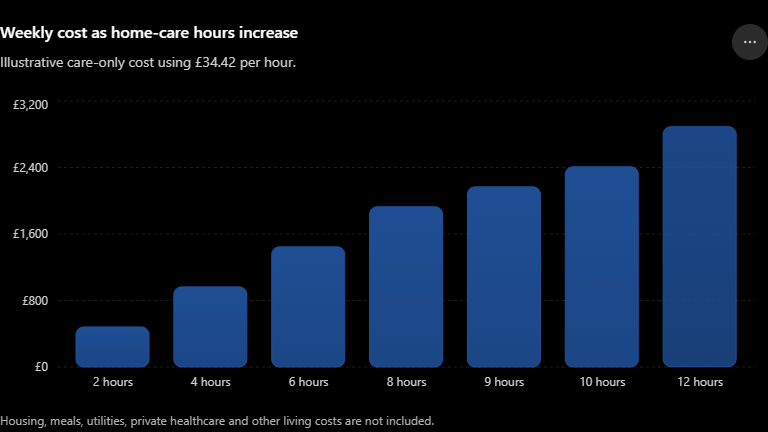
Accommodation, meals, utilities, laundry, activities, transport,
private medical support and other living costs are not included.
View the weekly cost figures as an accessible table
| Paid care each day | Weekly hours | Weekly care-only cost | Annual care-only cost |
|---|---|---|---|
| 2 hours | 14 hours | £482 | £25,058 |
| 4 hours | 28 hours | £964 | £50,116 |
| 6 hours | 42 hours | £1,446 | £75,173 |
| 8 hours | 56 hours | £1,928 | £100,231 |
| 9 hours | 63 hours | £2,168 | £112,760 |
| 10 hours | 70 hours | £2,409 | £125,289 |
| 12 hours | 84 hours | £2,891 | £150,347 |
Projected care at home costs from 2026 to 2036
Nobody can predict future care prices precisely. These lines show
illustrative planning scenarios using annual increases of 3%, 4%
and 5%. They do not represent Esmere Gardens fees or a promise about
the future charges of any provider.
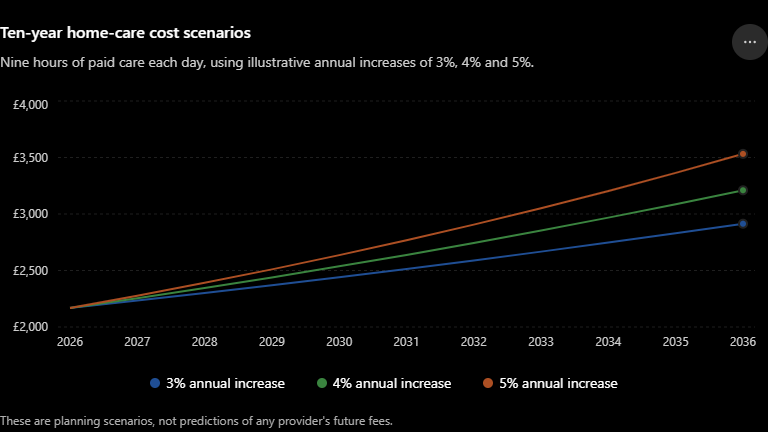
day. The graph assumes annual increases of 3%, 4% and 5%. These
scenarios are not predictions of Esmere Gardens fees or another
provider’s future charges.
View the ten-year cost scenarios as an accessible table
| Year | 3% annual scenario | 4% annual scenario | 5% annual scenario |
|---|---|---|---|
| 2026 | £2,168 | £2,168 | £2,168 |
| 2027 | £2,234 | £2,255 | £2,277 |
| 2028 | £2,301 | £2,345 | £2,391 |
| 2029 | £2,370 | £2,439 | £2,510 |
| 2030 | £2,441 | £2,537 | £2,636 |
| 2031 | £2,514 | £2,638 | £2,768 |
| 2032 | £2,589 | £2,744 | £2,906 |
| 2033 | £2,667 | £2,854 | £3,051 |
| 2034 | £2,747 | £2,968 | £3,204 |
| 2035 | £2,829 | £3,086 | £3,364 |
| 2036 | £2,914 | £3,210 | £3,532 |
The care invoice is only one part of remaining at home
Care at home can be the right choice when someone remains relatively
independent and only needs limited assistance.
However, the hourly invoice does not normally replace the cost of
running the home or arranging other services.
Possible care-agency additions
- Minimum visit lengths
- Evening and weekend premiums
- Bank-holiday charges
- Waking-night or sleeping-night support
- A second carer for safe transfers
- Travel or mileage costs
- Hospital and appointment accompaniment
- Short-notice cancellation charges
- Annual price increases
Household costs that continue
- Mortgage, rent or property costs
- Heating, electricity and water
- Food, snacks and drinks
- Cleaning and laundry
- Gardening and property maintenance
- Security systems and equipment
- Transport and taxis
- Family time spent coordinating services
- Private appointments and medical services
There is also an emotional cost that does not appear on an invoice.
Relatives may spend each day checking cameras, arranging rotas,
preparing meals, managing medication and worrying about what will happen
between visits.
Good value is not simply spending the smallest amount. It is receiving
the right level of care while reducing risk, uncertainty and pressure
across the family.

everyday things that make life comfortable and meaningful: good food,
refreshments, companionship, housekeeping, activities and a welcoming
place to call home.
Is live-in care the same as continuous 24-hour support?
Live-in care can be a valuable option, particularly when someone wants
to remain in familiar surroundings. However, a live-in arrangement is
not automatically the same as having an awake carer continuously
available throughout every hour of the day and night.
Before comparing a live-in quotation with a nursing-home package,
families should confirm:
- How many active care hours are included?
- What breaks and rest periods must the carer receive?
- Who provides cover during those breaks?
- How are waking nights charged?
- What happens after repeated night-time disturbances?
- Is a second carer needed for transfers?
- Who pays for the carer’s meals and accommodation?
- Are registered nursing services included?
- Are private GP appointments included?
- Who organises transport and appointment escorts?
Important comparison:
a weekly live-in care quotation may still sit alongside food, energy,
property maintenance, insurance, equipment, additional night cover and
private medical costs. Ask for every likely cost in writing.
What do private health care costs cover?
The phrase private health care costs can refer to
private GP appointments, diagnostic testing, consultations, treatment
or medical insurance.
These services are different from social care. Social care supports
everyday life, including washing, dressing, eating, drinking, mobility,
medication routines, safety, supervision and companionship.
Private medical insurance does not automatically provide long-term
personal care, accommodation or continuous nursing support. Policy
terms and exclusions should be checked carefully.

Private GP support is included at Esmere Gardens
At Esmere Gardens Nursing Home, dedicated private GP input works
alongside our registered nurses and care team.
This helps provide greater continuity, proactive review and
reassurance when a resident’s health, medication, appetite, mobility
or behaviour changes.
Private GP support is integrated into our wider all-inclusive approach
rather than routinely arriving as another separate medical invoice.
Why Esmere Gardens focuses on complete value
The right comparison is not one hourly rate against one weekly fee.
It is the total cost of keeping someone safe, comfortable, supported and
meaningfully connected.
Esmere Gardens is not positioned around a deliberately low headline
figure followed by a long list of routine additions.
Our all-inclusive approach is designed to provide clear expectations,
no unexpected routine charges within the agreed package and greater
confidence for families making a long-term decision.
Personalised care
Support shaped around assessed needs, preferences and established
routines.
24-hour reassurance
A care team is available throughout the day and night, not only
during booked visits.
Registered nurses
Nursing support for residents with ongoing, complex or changing
health needs.
Private GP support
Dedicated medical input is integrated into the wider care package.
Meals and refreshments
Meals, snacks and drinks form part of comfortable everyday life.
Laundry and housekeeping
Everyday household responsibilities are managed within the home.
Activities and trips
Meaningful experiences, social engagement and organised outings.
Appointment escorts
Practical support when a resident needs help attending an
appointment.
Care that can adapt
Residential, nursing, dementia and short-term support in one home.
Read more about
what sits behind our all-inclusive approach
and
how we explain care fees clearly
.
A fairer way to compare care options
| Need or service | Care arranged at home | Esmere Gardens approach |
|---|---|---|
| Care availability |
Usually limited to booked visits or the agreed live-in arrangement. |
A care team is present throughout the day and night. |
| Registered nursing | May require a separate community, agency or private service. | Nursing support is available within the home. |
| Private GP support | Often arranged and charged separately. | Dedicated private GP input is part of the wider package. |
| Meals and drinks | Food, shopping, preparation and monitoring remain separate. | Meals, snacks and refreshments form part of everyday care. |
| Accommodation and utilities | Housing, energy, insurance and maintenance costs continue. |
Accommodation and normal household running costs are brought into one approach. |
| Laundry and cleaning | Completed by relatives or arranged as an additional service. | Laundry and housekeeping are managed within the home. |
| Activities and companionship | May require separate clubs, transport or family organisation. |
Activities, shared spaces and companionship are part of daily life. |
| Trips and appointments | Transport and accompanying support may be charged separately. |
Organised trips and appointment escorts form part of the agreed approach. |
| Family coordination |
Relatives may coordinate agencies, appointments, food and emergencies. |
The home coordinates care and keeps families informed. |
Individual assessments and contractual terms apply. Families should
request a current written explanation of all inclusions before making a
final decision.
Sometimes the greatest value is becoming a family again
When care is fragmented, relatives often become unpaid coordinators.
They arrange rotas, chase appointments, prepare meals, monitor
medication, manage the home and worry about the hours when nobody is
there.
The right care home can change that relationship.
A daughter can visit as a daughter. A husband can spend time with his
wife without carrying every practical responsibility. Grandchildren can
enjoy a conversation rather than arriving with a list of jobs.
That is part of the value Esmere Gardens provides: professional care for
the resident, with greater certainty and breathing space for the people
who love them.
Discover
what everyday life at Esmere Gardens can feel like
.
How might care costs change over the next ten years?
Nobody can predict the exact future price of care. Staffing, wage
requirements, regulation, food, energy, insurance and individual
clinical needs can all affect costs.
The Office for National Statistics reported annual CPI inflation of
2.8% in May 2026. Care is labour intensive, so its costs may rise at a
different rate from general consumer inflation.
The graph therefore uses 3%, 4% and 5% annual increases as planning
scenarios rather than forecasts. Families can
review the official inflation release
.
The projection also assumes the person continues to need exactly nine
hours of paid assistance each day. In reality, mobility, memory or
clinical needs may change, increasing the number of hours or carers
required.
Care that can adapt without another disruptive move
Esmere Gardens provides several levels of support within the same
Moreton-in-Marsh home. Subject to assessment, this can offer valuable
continuity if someone’s needs increase.
Residential care
Daily support, personal care, meals, medication assistance,
companionship and round-the-clock reassurance.
Nursing care
Registered nursing oversight for people with ongoing, complex or
changing healthcare needs.
Dementia care
Calm routines, thoughtful communication, meaningful engagement and
support shaped around the individual.
Respite care
Short-term reassurance for recovery, family-carer breaks, trial
stays or urgent circumstances.
Questions to ask before agreeing to any care package
Ask each provider the same questions and request written answers. This
makes quotations easier to compare and reduces the risk of unexpected
charges later.
-
What is included in the regular fee?
Ask specifically about meals, snacks, laundry, utilities, activities,
transport, nursing, medical support and personal-care items. -
Which services are charged separately?
Request a complete current price list rather than accepting a general
statement that extras may apply. -
How many active care hours are provided?
This is especially important when comparing visiting care and live-in
arrangements. -
What happens during the night?
Ask who responds, how quickly help is available and whether waking
support creates another charge. -
What happens if two carers become necessary?
Mobility and transfer needs can change, significantly affecting the
cost of remaining at home. -
How are increasing needs reviewed?
Ask who completes the review, how fees may change and how much notice
the family receives. -
Are clinical services included?
Confirm whether nurses, private GP appointments, medication reviews
and appointment escorts form part of the package. -
What happens during a hospital stay?
Check whether the room or care package remains chargeable and for how
long. -
How are annual increases calculated?
Ask when reviews occur and how changes will be explained. -
Can all promises be included in the agreement?
A trustworthy provider should provide clear written information before
admission.
Value also depends on the quality of care
Cost matters, but it should never be separated from safety, leadership,
staffing and the experience of residents.
Esmere Gardens is currently rated Good overall by the
Care Quality Commission, with Good ratings for safe, effective, caring,
responsive and well-led.
Families can
check the latest independent assessment
.
All-inclusive care in Moreton-in-Marsh and the Cotswolds
Esmere Gardens Nursing Home is located on Stow Road in
Moreton-in-Marsh, Gloucestershire.
Our North Cotswolds location is accessible for families travelling from
nearby towns and villages, helping relatives remain involved in everyday
life.
- Moreton-in-Marsh
- Stow-on-the-Wold
- Chipping Campden
- Blockley
- Broadway
- Bourton-on-the-Water
- Bourton-on-the-Hill
- Evesham
- Shipston-on-Stour
- North Gloucestershire
- South Warwickshire
- Worcestershire
Esmere Gardens Nursing Home
Stow Road, Moreton-in-Marsh, Gloucestershire, GL56 0DS
Telephone: 01608 692222
Frequently asked questions about care costs and all-inclusive care
These direct answers address the questions families commonly ask when
comparing home care, live-in support, residential care and nursing care.
Care at home costs
How much does care at home cost in the UK?
Privately arranged support commonly costs approximately £26 to £38
per hour. The amount depends on location, visit length, time of day,
care complexity and whether one or two carers are required.
What affects the cost of care at home?
Costs are affected by the number and length of visits, night support,
weekends, bank holidays, travel, medication needs, clinical
complexity and whether two carers are needed for safe transfers.
How much would two hours of care at home cost each day?
At £34.42 per hour, two hours every day would cost approximately £482
per week or £25,058 per year. Housing, meals, utilities, cleaning and
other living costs remain separate.
How much would four hours of home care cost each day?
Four hours every day would cost approximately £964 per week at
£34.42 per hour. This provides 28 paid hours each week but leaves
twenty hours of every day without scheduled support.
How much would eight hours of home care cost each day?
Eight hours every day would cost approximately £1,928 per week at
£34.42 per hour. Accommodation, meals, bills, laundry, transport,
activities and private medical services remain additional.
How much would nine hours of home care cost each day?
Nine hours every day would cost approximately £2,168 per week or
£112,760 per year at £34.42 per hour. This is a care-only cost and
leaves fifteen hours each day without booked support.
Does visiting home care provide 24-hour support?
No. Visiting home care provides assistance during booked visits.
Continuous support requires additional daytime, live-in or overnight
arrangements, which can significantly increase the total cost.
What household costs continue with care at home?
Mortgage or rent, utilities, food, cleaning, laundry, maintenance,
gardening, insurance, transport, security, equipment and property
adaptations may continue alongside the care invoice.
Live-in care
Is live-in care the same as an awake carer 24 hours a day?
No. Live-in carers require breaks and uninterrupted rest. Repeated
waking-night needs, replacement cover or two-person assistance may
require additional carers and separate charges.
Is live-in care cheaper than a care home?
It can be suitable and cost-effective for some people, but families
must also account for housing, energy, food, maintenance, equipment,
night cover, nursing and medical services before comparing value.
What is normally not included in a live-in care quote?
Arrangements vary, but housing costs, household bills, food,
property maintenance, carer breaks, repeated waking nights,
registered nursing, private GP services and appointment transport
may remain separate.
When might two home carers be required?
Two carers may be needed for certain transfers, repositioning,
personal-care tasks or mobility support. This can substantially
increase the hourly and weekly cost of remaining at home.
Comparing home care and care homes
How should I compare home care with a care-home fee?
Compare the complete cost and level of support. Include paid hours,
night care, housing, meals, bills, cleaning, laundry, activities,
transport, medical support and the time contributed by relatives.
When might a care home offer better overall value?
A care home may offer stronger value when someone needs several
daily visits, night reassurance, nursing oversight, support with
food and medication or regular supervision to remain safe.
Is the lowest advertised care-home fee always best value?
No. A lower starting fee can become more expensive if nursing,
increased support, meals, activities, laundry, transport, escorts or
medical services are charged separately.
What hidden care-home costs should families ask about?
Ask about deposits, administration fees, premium rooms, increased
care needs, one-to-one support, transport, appointment escorts,
activities, laundry, toiletries, hospital absences, annual increases
and notice periods.
How can I avoid unexpected care charges?
Request a written quotation and complete list of inclusions. Ask for
examples of circumstances that could change the fee and ensure
verbal promises are reflected in the agreement.
What should I ask before signing a care-home contract?
Ask about the total fee, all inclusions, possible additions, annual
reviews, hospital absences, increasing needs, notice periods and
arrangements following a resident’s death.
Can care-home fees increase each year?
Providers may review fees to reflect staffing, inflation and
operating costs. The contract should explain when reviews occur, how
changes are calculated and how much notice families receive.
All-inclusive care at Esmere Gardens
What does all-inclusive care mean?
All-inclusive care brings agreed accommodation, care and everyday
services into one clearer fee. Families should still receive a
written list explaining precisely what sits within the package.
What is included at Esmere Gardens Nursing Home?
Esmere Gardens brings accommodation, personalised care, registered
nursing, meals, drinks, laundry, utilities, activities, organised
trips, appointment escorts and dedicated private GP support into its
wider all-inclusive approach.
Does all-inclusive mean there can never be an extra charge?
The aim is to remove unexpected routine charges within the agreed
package. An exceptional third-party service or item outside the
agreement should be explained before a charge is made.
Does Esmere Gardens include private GP support?
Yes. Dedicated private GP input works alongside the nursing and care
teams, helping provide continuity and reassurance when a resident’s
health, medication or needs change.
Does Esmere Gardens provide 24-hour nursing care?
Esmere Gardens provides registered nursing support around the clock
for residents with ongoing, complex or changing healthcare needs.
Are meals, snacks and drinks included?
Meals, snacks and refreshments form part of daily life at Esmere
Gardens. Dietary preferences, nutritional needs and suitable support
with eating and drinking are considered within the care plan.
Are activities and organised trips included?
Meaningful activities, social engagement and organised trips form
part of the wider all-inclusive approach, helping residents maintain
their interests and community connections.
Are residents escorted to appointments?
Appointment escorts form part of the Esmere Gardens approach where
suitable arrangements are required, reducing practical pressure on
residents and their families.
Changing care needs
Can Esmere Gardens support someone if their needs increase?
Esmere Gardens provides residential, nursing, dementia and respite
care within the same home. Subject to assessment, this can provide
continuity as a resident’s needs develop.
Does Esmere Gardens provide dementia care?
Yes. Dementia support is shaped around the individual’s routines,
communication, preferences, safety and emotional wellbeing.
Can a respite stay become a permanent placement?
It may be possible for a temporary stay to become permanent, subject
to assessment, suitability and room availability. A short stay can
also help a family experience the home before deciding.
What happens if someone needs nursing care later?
Because Esmere Gardens provides residential and nursing support
within the same home, an updated assessment may allow the care plan
to change without the resident needing another disruptive move.
Help with paying for care
Can the local council help with care costs?
A local authority may contribute following a care-needs assessment
and financial assessment. The amount depends on eligible needs,
savings, income and local funding arrangements.
What is NHS Continuing Healthcare?
NHS Continuing Healthcare is NHS-funded support for adults whose
primary need is assessed as a health need. Eligibility depends on
the nature, complexity, intensity and unpredictability of needs.
What is NHS-funded nursing care?
NHS-funded nursing care is a contribution paid by the NHS towards
registered nursing supplied within an eligible nursing home. It is
different from full NHS Continuing Healthcare funding.
Do I always have to sell my home to pay for care?
Not necessarily. The answer depends on the type of care, financial
circumstances, property ownership, other residents in the property
and eligibility for support. Specialist financial advice may be
appropriate.
Visiting Esmere Gardens
Where is Esmere Gardens Nursing Home?
Esmere Gardens is on Stow Road in Moreton-in-Marsh,
Gloucestershire, in the heart of the North Cotswolds.
Which local areas are close to Esmere Gardens?
Esmere Gardens is convenient for families travelling from
Stow-on-the-Wold, Chipping Campden, Blockley, Broadway,
Bourton-on-the-Water, Evesham, Shipston-on-Stour and surrounding
Gloucestershire, Warwickshire and Worcestershire communities.
Is Esmere Gardens rated Good by the CQC?
Yes. Esmere Gardens is currently rated Good overall, with Good
ratings for safe, effective, caring, responsive and well-led.
How do I arrange a care assessment or visit?
Contact Esmere Gardens to discuss the person’s circumstances and
arrange a visit. The team can explain the assessment, care options,
availability and inclusions before any decision is made.
Contact the Esmere Gardens team
.
One clear package. Complete care. Greater peace of mind.
You should not need a spreadsheet of hourly visits, household bills,
meals, laundry, activities, transport and private appointments to
understand whether someone you love will be safe.
At Esmere Gardens, our all-inclusive approach brings personalised care,
24-hour reassurance, registered nurses, everyday living and dedicated
private GP support together in one trusted Cotswold home.
Not simply a room. Not simply a weekly fee. Complete long-term value
for the resident and their family.
Calculations are illustrative and based on publicly available UK
guidance reviewed in July 2026. They are not quotations or predictions
of fees from Esmere Gardens or another provider. Individual costs depend
on assessed needs, availability, contractual terms and future economic
conditions. This article provides general information rather than
personalised legal or financial advice.
To download our brochure, click below to enter your details and to stay up to date with developments, news and events. During a tour of Esmere Gardens, you will be able to view all that the home has to offer at your leisure, ask any questions you may have and take a tour of this beautiful market town. Click below to arrange a show around.Request a Brochure
Book a tour