
Compare care home fees by looking beyond the weekly price. Check what each fee includes, which services cost extra and when charges are reviewed. In England, there is no maximum limit on care-home fees, so costs vary with location, facilities and care needs. Choosing a place for someone you love can feel like a lot to manage.
A clear budget helps your family plan, but price is only part of the decision. Consider the person’s daily needs, comfort and dignity, and whether the home offers the right support. A local council assessment can also affect how care is funded. Families looking within about 30 miles of Moreton-in-Marsh may include Esmere Gardens in their search and compare its written fees with those of other local homes.
A written breakdown helps you compare homes on a like-for-like basis.
Key Takeaways
- Check what the weekly fee includes.
- Ask which everyday items cost extra.
- Find out when fees are reviewed.
- Use the same questions for each home.
- Compare care and daily life as well as price.
How to Compare Care Home Fees Fairly
A lower weekly price is only a fair comparison when you know what it covers and whether it changes after an assessment. The headline figure does not show whether meals, outings, personal care or support for changing care needs are included.
Compare inclusions, exclusions and possible fee changes together. Ask for a written breakdown of care home costs, so you can compare similar support and understand the likely cost of care. Check the assessment process and how it affects home fees.
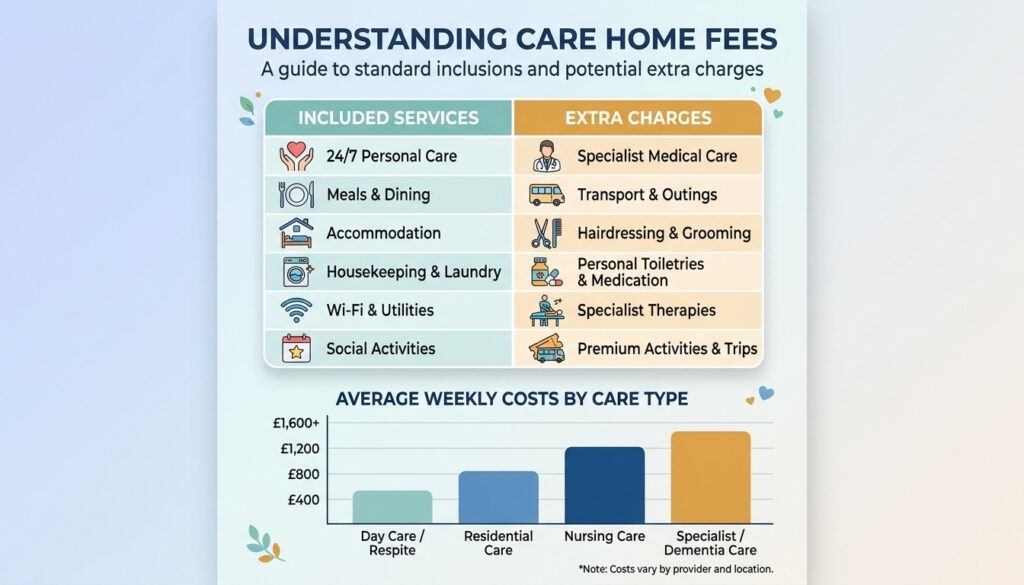
What an all-inclusive label can cover
“All-inclusive” does not mean the same thing at every home. Ask whether the fee includes hairdressing, trips, private dining, telephone calls and other everyday services, or whether they cost extra.
Use a simple tick/X comparison for each service: ✓ Esmere Gardens, included in the written fee; X Another Luxury Care home in the Area 1, not included in the compared fee. Use an X only when the other home’s written terms confirm this; it does not mean the service is unavailable. This helps families compare actual home costs rather than labels.
Ask each care home to list inclusions and extras in writing. These questions for care-home visits can help you compare fees, care and daily life.
When a starting fee depends on assessed needs
A starting fee is not necessarily the final price. Ask what the needs assessment considers and whether changing care needs affect the weekly fee. Treat a starting figure as an estimate, not a promise.
How Esmere Gardens’ fixed fee differs
Esmere Gardens says its weekly fee stays the same between annual reviews. Check the current written terms and how the fee works if needs change. A local council assessment is separate from the home’s fee review.
Read about Esmere Gardens’ all-inclusive care and fees, then compare written terms with other homes.
Compare included services and possible extras, not the phrase “all-inclusive” on its own.
Before comparing care home fees, get each home’s inclusions, exclusions and review terms in writing.
What Does an All-Inclusive Care Home Fee Cover?
An all-inclusive fee is most useful when it covers practical parts of everyday life as well as care. Esmere Gardens says one weekly fee covers services for people with residential, dementia or nursing care needs. Check its current written terms to see exactly what is included.
Included help can reduce the number of arrangements families need to make, from laundry to trips and appointment support. Compare the written fee schedules at Esmere Gardens and Another Luxury Care home in the Area 1. Mark ✓ when a service is included in the fee and X when it is not; confirm each entry before comparing care home fees.
Care and clinical support
Esmere Gardens lists round-the-clock care and supervision, personalised care plans, medication management, physiotherapy support, chiropody or podiatry, and incontinence products among its inclusions. Confirm any limits or exclusions in writing. A service comparison shows what each fee covers; it does not measure staff numbers, care quality or a resident’s income.
Families can discuss how the care plan will respond to changing needs. Ask what nursing care and other healthcare support involve for the resident, and whether additional costs apply.
Daily life, hospitality and personal services
Meals, company and personal routines all shape daily life. Esmere Gardens lists meals, snacks, drinks, private dining, activities and organised trips among its inclusions.
- Care and clinical support: ✓ Esmere Gardens lists 24-hour care, supervision, personalised plans, medication management and clinical support. Mark X for Another Luxury Care home in the Area 1 only if its written fee confirms these are excluded.
- Food and drink: compare meals, snacks and drinks.
- Activities and facilities: check rooms, gardens, activities and visiting arrangements.
- Transport and appointments: confirm what assistance is included.
- Personal services: check hairdressing, laundry, newspapers, telephone and internet access.
- Family communication and approved pet care: confirm updates and any pet-care conditions.
Private dining, activities and trips give relatives ways to spend time together. Transport and appointment support can reduce practical arrangements for family members.
Esmere Gardens will confirm exclusions and additional costs in writing. This guide to private nursing-home costs explains why it is helpful to check common extras.
Ask each home for a written inclusions list before choosing a place.
What Shapes Weekly Fees Across the UK?
Weekly care home fees depend on the type of care, location, facilities and the resident’s assessed needs. The 2026 UK average self-funder fee is £1,318 a week for residential care and £1,568 for nursing care.
Care type matters: the 2026 average is £1,354 for residential dementia care and £1,597 for nursing dementia care. Self-funded care home fees rose by 10% between December 2024 and December 2025.
England has no statutory maximum care home fee. National averages are a guide, not a quote. Actual care home costs vary with the support required, facilities and location. Check the source and date of any figures used for budgeting.
To estimate costs, multiply the weekly fee by 52, then divide by 12 for an average monthly cost. A £1,000 weekly fee equals £52,000 a year, or about £4,333 a month. Compare written quotes from homes within a verified 30-mile radius of Moreton-in-Marsh to understand local home fees and what each includes.
The planned £86,000 lifetime cap on personal care costs was cancelled, along with proposed changes to England’s capital limits. Neither took effect in October 2025.
A care home fees calculator offers a starting estimate, not a final cost of care. Check each home’s written terms to understand its fee, likely costs and value.
Use national averages as one way to plan, then ask each home for its actual weekly price.
Which Funding Routes Can Pay Towards Care?
Care costs may be paid by the person, the local council or the NHS, depending on finances and assessed needs. The four main funding routes are self-funding, council support, NHS Continuing Healthcare and NHS-funded nursing care.
Social care and NHS healthcare funding use different assessments. A needs assessment considers the support required. A separate financial assessment considers income, capital and assets to decide whether the local council contributes.
Self-funding and local council support
With self-funding, the person pays their care home fees. The local council uses care needs and finances to decide whether to contribute; the resident may still pay part of the cost.
This table summarises the routes. Eligibility and payment depend on assessment, not diagnosis alone.
| Funding route — basis for eligibility — what it may pay | ||
| Self-funding | Person pays privately | All or part of the care-home fee |
| Local council support | Needs and financial assessments | Support towards eligible care costs |
| NHS Continuing Healthcare | Assessed health needs | Full care package for eligible people |
| NHS-funded nursing care | Eligible resident of a registered nursing home | Contribution towards registered nursing care |
NHS funding for eligible health needs
NHS Continuing Healthcare eligibility depends on assessed needs, not diagnosis. NHS-funded nursing care contributes to registered nursing care for eligible residents; other fees are paid through the relevant route.
Read how care-home funding routes differ to understand how a home’s support relates to likely funding arrangements.
Ask the local council for a financial assessment and contact the NHS team about continuing healthcare. These questions help clarify who pays. Seek advice from the relevant team about available support.
How the Financial Assessment Sets Your Contribution
In England, a financial assessment considers your capital, income and other finances to work out your contribution towards care costs. The local council uses capital bands to decide whether you pay the full care home cost or qualify for council funding. Income can also affect what you pay.
For 2026 to 2027, the upper capital limit is £23,250 and the lower limit is £14,250. These rules apply in England, not across the whole UK. Pension income may count towards care costs. The council also checks which assets and savings count in your assessment.
Capital above the upper limit
If your capital is above £23,250, you are responsible for the full care-home cost under this capital test. The council does not contribute, but your income remains relevant to your finances and contribution.
Capital at or below the lower limit
At or below £14,250, you contribute what you can afford from income. Between the limits, the council adds £1 a week in tariff income for every £250 of capital. Property disregards and individual circumstances can affect the assessment. Deliberate deprivation is considered separately.
| Capital band — contribution rule — tariff income | ||
| Above £23,250 | Person pays full care-home cost | Does not apply |
| £14,250 to £23,250 | Affordable income contribution plus tariff income | £1 weekly for each £250 between limits |
| Below £14,250 | Person contributes what they can afford from income | Does not apply |
For 2026 to 2027, the local council must leave a Personal Expenses Allowance of £31.80 a week for people receiving council-arranged care-home support in England. This money is for personal use, not social care contracted by the council or assessed as necessary to meet eligible needs.
The allowance does not cover needs met by the NHS. The 2026 to 2027 local authority circular explains these charging rules.
Ask the local council for a written explanation of how it assessed your income and capital. Independent advice can help you understand the rules, your contribution and the value of any support available.
How Your Home, Savings and Gifts Affect the Assessment
Moving into permanent care does not automatically mean selling your home. Depending on the circumstances, the property’s value may be disregarded or payment delayed, affecting how the local council assesses finances and care home costs.
There is no fixed seven-year rule for deciding whether a transfer of assets was deliberate deprivation. The council considers the circumstances, including what the person knew about their future care needs when they transferred property or savings.
When the value of a home is disregarded
In England, the council disregards a home’s value for the first 12 weeks after a permanent move into a care home. It also disregards the property in specified circumstances, such as when a spouse, partner or civil partner remains there.
Other relatives, including a dependent child, may qualify in some circumstances. Ask the local council how the rules apply to the people living in the property.
- A permanent move into care and the first 12 weeks of the property disregard.
- A spouse, partner, civil partner, dependent child or other qualifying close relative remaining in the home.
- A possible deferred payment agreement if the property’s value cannot readily meet the assessed contribution.
Asset transfers and deferred payment agreements
The council considers the facts before deciding whether transferred assets count as deliberate deprivation. It looks at what the person knew when they gave away or sold property or savings; there is no automatic seven-year cutoff.
A deferred payment agreement may be available if the person has eligible care needs, less than £23,250 in non-property capital, a home that is not disregarded and insufficient income to meet their assessed contribution. Ask the council about eligibility, payment terms and how this funding support works.
Giving away assets to avoid care home costs is not a safe plan. For wider care choices, see this care-home or assisted-living comparison guide.
Seek advice from the local council before transferring assets or making decisions about a property.
When Can the NHS Pay for Care?
NHS Continuing Healthcare may fund a full care-home package for someone who meets the eligibility criteria. Eligibility depends on assessed needs, including their nature, complexity, intensity and unpredictability, not a diagnosis alone. The NHS team decides whether a person qualifies for continuing healthcare.
A multidisciplinary team assesses the person’s needs. No single need automatically guarantees NHS Continuing Healthcare funding. The decision follows the relevant assessment framework.
NHS Continuing Healthcare eligibility
An eligibility decision should usually be made within 28 days of an initial assessment or request for a full assessment, though the timing is not guaranteed. Reviews normally take place within three months of eligibility and at least annually after that.
Fast-track NHS Continuing Healthcare should be considered if someone’s health is deteriorating rapidly and they may be nearing the end of life. The NHS team can provide advice about assessment and care arrangements.
NHS-funded nursing care and assessment times
NHS-funded nursing care contributes towards registered nursing care for eligible residents who are not eligible for NHS Continuing Healthcare. Dementia alone does not determine whether a person pays, receives local council support or qualifies for NHS funding.
Esmere Gardens states that private GP access is included in its fee. Ask the home what this covers and how nursing and healthcare needs are supported. Questions about medical-led care and family support can help you consider how a home communicates with people and families.
Ask the relevant NHS team how its assessment reflects the person’s needs and what funding is available.
What If You Can No Longer Afford the Fees?
If your finances change, contact the local council promptly and request a new financial assessment. Changes to income, savings, capital or other assets can affect your contribution and the funding or support available to pay care home fees.
Next of kin are not automatically responsible for care-home fees. A relative who signs a top-up agreement is responsible for the payment terms they accept. Read the agreement carefully before committing money.
If a council-funded place costs more than the council’s personal budget, a third party may agree to pay the difference. Ask the council for the terms in writing, including how it handles changing circumstances and care costs.
A third-party top-up should not be required when a more expensive home is needed to meet a person’s care needs. Rules on residents paying their own top-up include exceptions for a 12-week property disregard, a deferred payment agreement or Mental Health Act 1983 section 117 after-care.
Tell the local council, or HSCNI in Northern Ireland, if your finances change. Seek advice before accepting payment responsibilities.
Questions to Ask Before Choosing a Home
Ask the same questions at every visit to compare homes fairly. Families within about 30 miles of Moreton-in-Marsh can consider Esmere Gardens alongside other homes that meet their needs.
Compare care, fees and daily life. Ask each home for written fee details, including inclusions, extra costs and how an assessment could affect the fee. Compare the same services at Esmere Gardens and Another Luxury Care home in the Area 1.

- Which care and everyday services does the weekly fee include?
- What costs extra, and when do charges apply?
- When are home fees reviewed?
- How could changing care needs affect the fee?
- What activities, visiting and transport are available?
- How does the home support residents and keep family informed?
Use the answers to compare care home fees and daily life. The guide to selecting the best care home also covers care, setting and quality of life.
Consider costs, comfort and the right place for the person. This is a practical way to make an informed choice.
Conclusion
Choosing a care home means weighing fees and cost alongside the person’s care needs, comfort and daily life. Clear written information helps you compare what each home includes and understand the support provided.
Esmere Gardens is in Moreton-in-Marsh, Gloucestershire, GL56 0DS. Ask the team for its written fees and inclusions to help you make an informed comparison.
For more information, call 01608 692222, email hello@esmeregardens.co.uk, or visit esmeregardens.care.
FAQ
Is there a 7 year rule for care home fees?
What assets are exempt from care home fees?
Will care home fees wipe out your children’s inheritance?
What happens if I can no longer afford my care home fees?
Do I lose my state pension if I go into a care home?
How much money are you allowed to have before paying care home fees?
What does the £86,000 cap on care costs mean?
Do people with dementia have to pay for their own care home?
To download our brochure, click below to enter your details and to stay up to date with developments, news and events. During a tour of Esmere Gardens, you will be able to view all that the home has to offer at your leisure, ask any questions you may have and take a tour of this beautiful market town. Click below to arrange a show around.Request a Brochure
Book a tour