
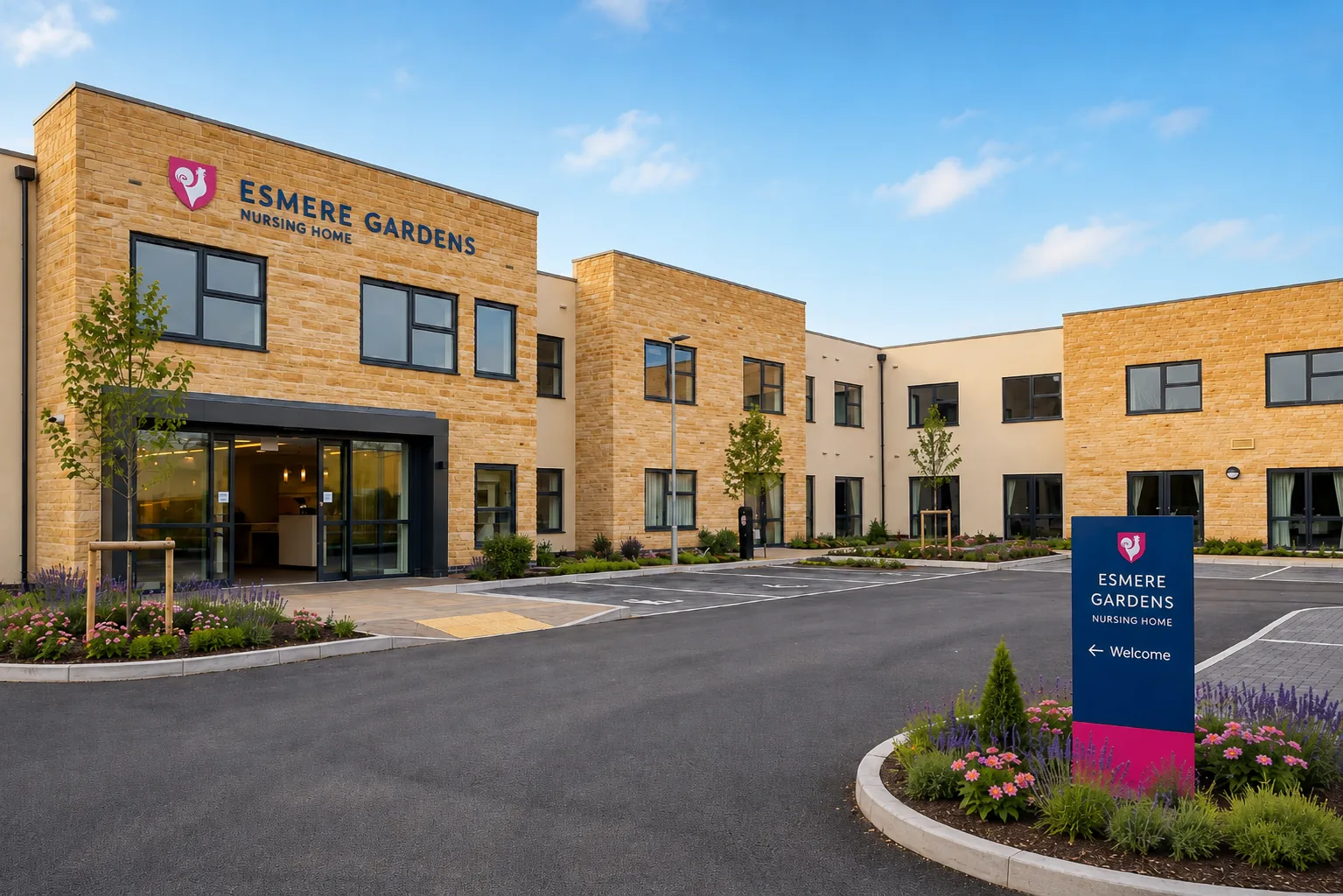
Moving into a Care Home: Advice for Families
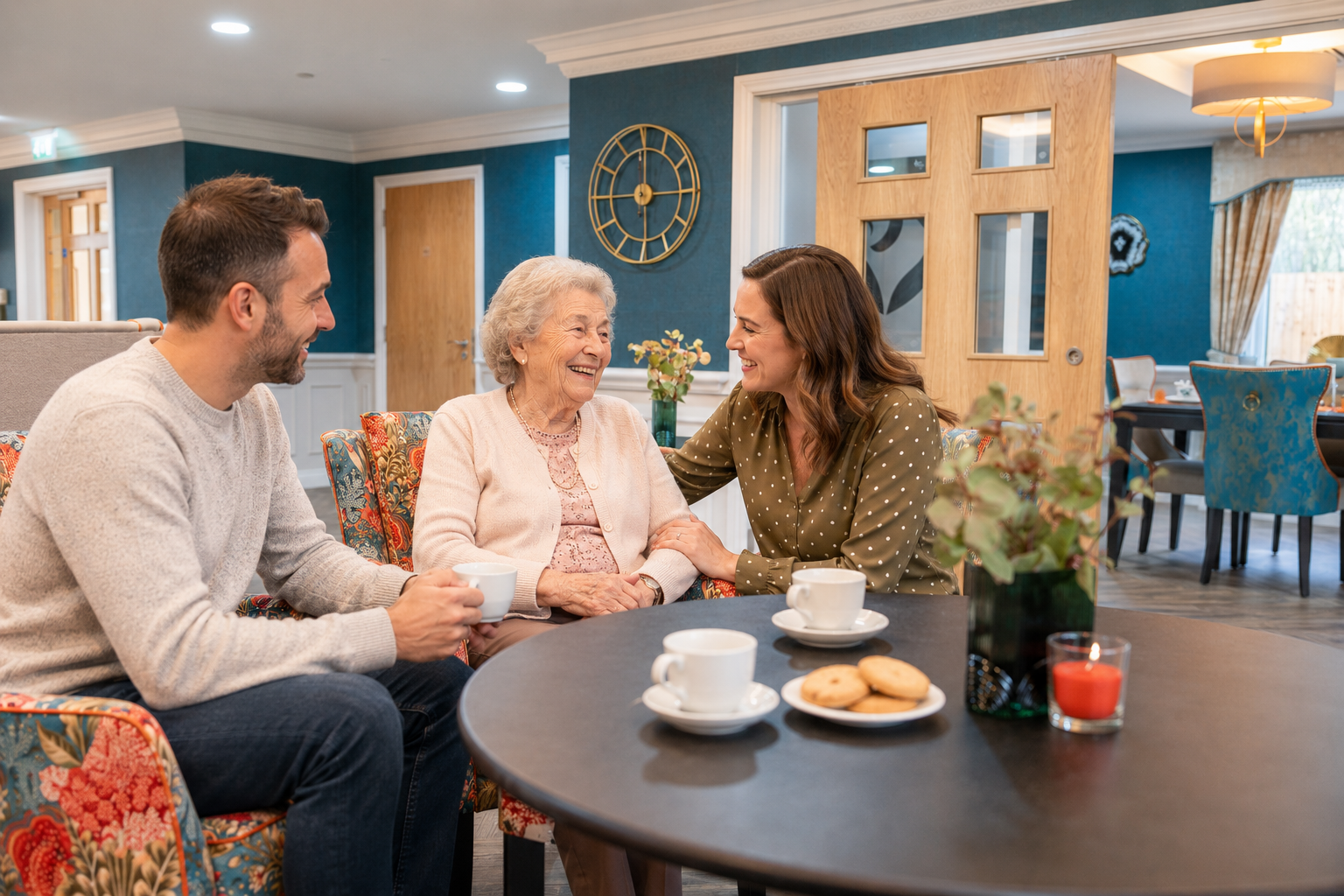
Moving into a care home: the essential handover guide
A calm, clear guide to the information, documents and personal details that help create a safer and more personalised welcome.
Moving into a care home can feel overwhelming.
Whether the move is carefully planned or follows a hospital stay, many families worry about forgetting something important. Questions quickly arise:
- What paperwork will be needed?
- What information should I give the care team?
- What should I pack?
- What if I cannot find everything?
- How can I help Mum or Dad feel more settled?
This practical guide explains the information, documents and personal details that can help create a safer, calmer and more personalised welcome when moving into a care home.
Know exactly what information is helpful.
Help care teams understand needs from day one.
Share the details that make somebody unique.
Useful whether the move is urgent or carefully planned.
Quick Answer: What Should Families Bring?
Families should ideally provide:
- Medication information
- Current health details
- Emergency contacts
- Daily routines and preferences
- Important documents
- Personal belongings
- Life history and interests
The exact information required will vary depending on the person’s individual circumstances, medical needs and admission pathway.
Why a Good Handover Matters
Most families focus on packing bags and collecting paperwork when preparing for a move into care.
In reality, one of the most valuable things you can share is information about the person themselves.
Their routines.
Their habits.
Their favourite drink.
Their favourite music.
The things that comfort them.
The things that worry them.
The more a care team understands from the beginning, the easier it becomes to create a personalised welcome and support familiar routines.
Family involvement
Daily routines
Personal preferences
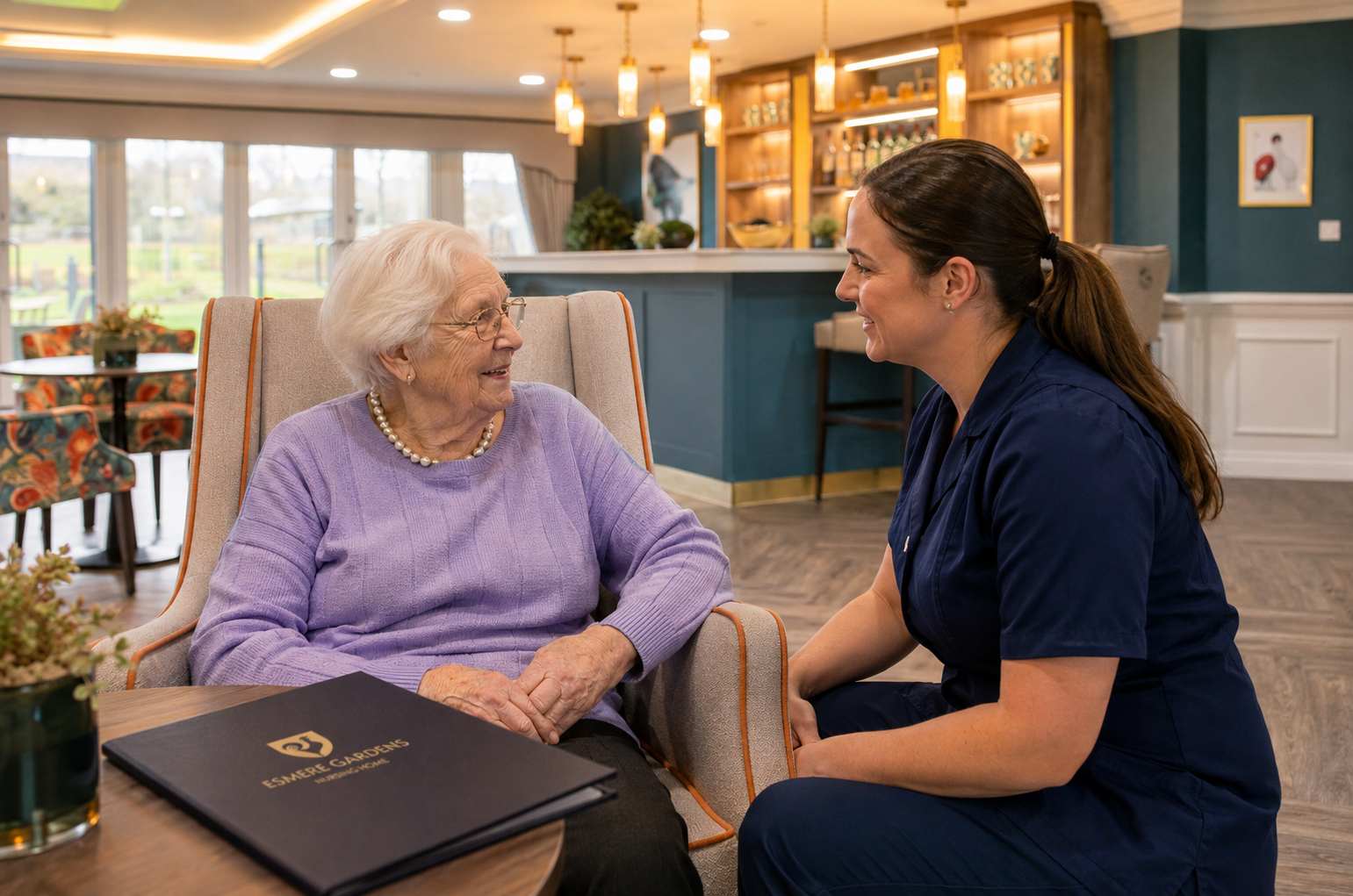
Essential Health Information
Good information helps the care team understand a person’s needs from the start and supports safer care planning.
Medication Information
Current medications, dosages, administration instructions and any recent medication changes.
Medical History
Health conditions, diagnoses, allergies, long-term illnesses and recent hospital admissions.
Mobility & Safety
Mobility aids, walking ability, falls history and support requirements.
Additional Information That Can Help
- Dietary requirements
- Food preferences
- Swallowing concerns
- Hydration support needs
- Hearing or sight support requirements
- Communication preferences
The Details That Help Someone Feel Known
The information that often makes the biggest difference is rarely found in medical paperwork.
Understanding a person’s history, preferences and routines can help them feel more comfortable and better understood.
Favourite Routines
Morning habits, preferred wake-up times, favourite drinks and evening routines.
What Brings Comfort
Music, books, television programmes, photographs and familiar possessions.
Important Relationships
Family members, friends, pets, community groups and significant people.
Life Story Information
- Previous occupations and careers
- Hobbies and interests
- Military service
- Community involvement
- Favourite memories and achievements
- Cultural and religious preferences
Documents & Important Contacts
Important information may include:
- GP contact details
- Pharmacy information
- Emergency contacts
- Next of kin details
- Hospital discharge information (if applicable)
- Relevant legal paperwork
- Healthcare specialist contacts
If you’re exploring care options, you may also find it helpful to understand the different types of support available, including
Residential Care,
Nursing Care,
Dementia Care and
Respite Care.
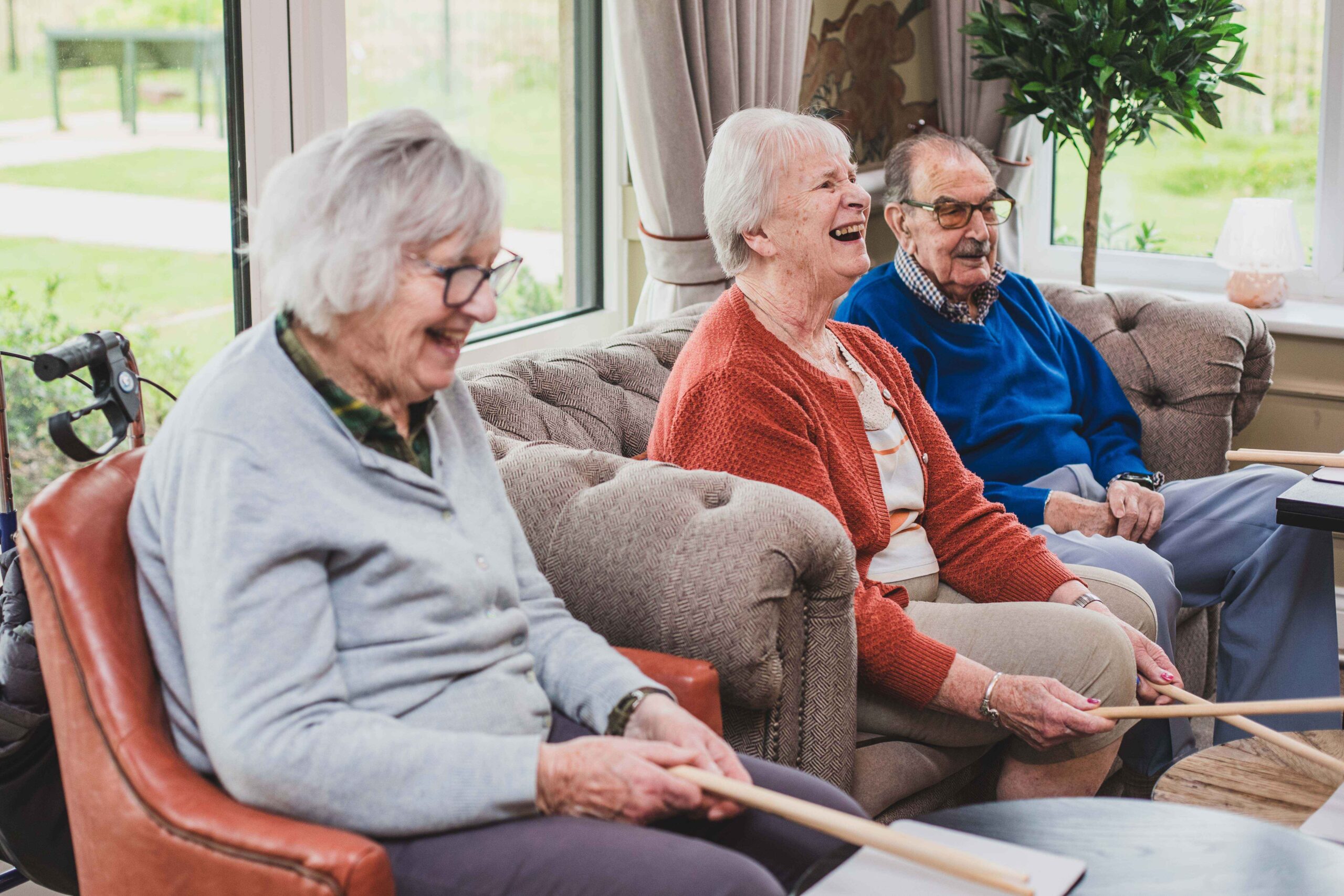
What To Pack On Moving Day
Familiar items can make a new room feel far more comfortable and personal.
- Clearly labelled clothing
- Comfortable footwear
- Toiletries
- Family photographs
- Favourite blanket or cushion
- Books and magazines
- Music and personal hobbies
- Glasses and hearing aids
- Mobile phone or tablet
- Chargers and accessories
Moving Into Care After Hospital Discharge
Hospital discharges can happen quickly, leaving families feeling under pressure to organise information and make important decisions.
If records are still being gathered, simply explain:
- What information you already have
- What information is outstanding
- Who may hold the missing information
The goal is understanding individual needs safely, not achieving perfect paperwork on day one.
Additional guidance can be found from
Age UK
and the
NHS Social Care Guide.
What If Information Is Missing?
Do not delay asking for help because you feel unprepared.
Many families begin the admission process while gathering information from hospitals, pharmacies, healthcare professionals and relatives.
Bring what you have.
Explain what is missing.
The care team can advise what is essential and what can usually be obtained later.
The aim is understanding the person, not perfection.
Printable Care Home Handover Checklist
About Me
Preferred name
Date of birth
Important contacts
My Health
Medication
Allergies
Health conditions
My Daily Routine
Wake-up times
Meals
Evening routine
My Story
Career
Achievements
Interests
What Comforts Me
Music
Photos
Favourite activities
Things I Find Difficult
Communication needs
Sensory difficulties
Things that cause anxiety
Reviewed by Kimberly Mae M. Pascual
Home Manager, Esmere Gardens Nursing Home
This guide reflects the questions families most commonly ask when preparing for a move into residential care, nursing care, dementia care or respite care at Esmere Gardens.
Visit Esmere Gardens Nursing Home in Moreton-in-Marsh
Esmere Gardens Nursing Home is located on Stow Road, Moreton-in-Marsh, Gloucestershire GL56 0DS.
We welcome conversations with families who would like to understand their options, ask questions and explore whether Esmere Gardens may be suitable for somebody they love.
Frequently Asked Questions
What documents are needed when moving into a care home?
What should I pack when moving into a care home?
Can I bring furniture and personal belongings?
What information helps somebody settle more quickly?
What if I cannot find all the paperwork?
Is this checklist useful after a hospital discharge?
Does Esmere Gardens provide nursing care?
How can I arrange a visit?

Emergency Care Home Placements: What Families Need to Know in 2026
Emergency care home placements: what families need to know in 2026
When a loved one needs care urgently after a fall, hospital discharge or sudden change at home, speed matters — but so does safety, oversight and clear assessment.
Emergency placements in care homes can be a lifeline, but they also bring understandable worries about safety, oversight and whether the setting can truly meet complex needs.
Across the UK we have our own regulatory landscape. Recent policy direction from the Prime Minister’s renewed focus on adult social care, ongoing Care Quality Commission (CQC) developments, and the continuing pressure of hospital discharges are all reshaping what a safe emergency admission looks like in practice.
This guide explains the current direction of travel and, most importantly, what families in Gloucestershire and the Cotswolds should look for when arranging urgent care.
Regulators are focusing more attention where risk is highest.
Emergency admissions still require clear assessment and documentation.
Preparedness, escalation pathways and night-time checks matter.
Clear processes help families feel more confident in urgent situations.
What families should expect from a safe emergency placement
A well-managed urgent admission should include:
- A prompt but thorough assessment of needs and risks
- Clear documentation that supports continuity of care
- Visible emergency and escalation procedures
- Evidence that the home can safely support the person’s needs
- Open communication with the family throughout the process
Speed is important. Thoroughness is essential. The best providers manage both.
The current UK policy direction
Adult social care has returned to the centre of national attention. The Prime Minister’s recent emphasis on reforming and strengthening adult social care reflects growing recognition that hospital pressures, delayed discharges and rising complexity of need cannot be solved by the NHS alone.
At the same time, the Care Quality Commission continues to refine its approach under the Single Assessment Framework. The direction of travel is clear: more attention on risk, outcomes and the lived experience of people using services, alongside greater expectations around preparedness and continuous improvement.
For families arranging an emergency placement, this means providers are under clearer expectations to demonstrate that they can respond safely at short notice.
CQC Single Assessment Framework
Hospital discharge pressures
Risk-based regulation
From routine inspection to risk-based oversight
Regulators across health and social care systems are moving toward more risk-based models of oversight. In the UK, this is visible in the CQC’s focus on targeting inspection and monitoring where the risk of harm, poor outcomes or persistent concerns is higher.
Rather than treating every service as requiring the same intensity of routine scrutiny, the emphasis is increasingly on identifying higher-risk providers earlier and maintaining sustained attention where problems persist.
Concentrated attention
Greater focus on homes with higher risk of harm, repeated concerns or complex needs.
Faster response to concerns
Serious complaints and safety signals can trigger more rapid regulatory attention.
Higher expectations of providers
Homes are expected to demonstrate clear processes even during busy or urgent periods.
What this means for families
A risk-based approach can improve safety if it leads to earlier identification of problems. It also raises the bar on what good providers must show at short notice: clear assessments, auditable decisions, and robust emergency procedures that stand up to scrutiny.
Risk assessment as a baseline expectation
Risk assessment is no longer treated as a “nice to have.” It is a core expectation of safe care, particularly when someone is admitted urgently.
This goes far beyond fire or flood planning. It includes the practical realities of keeping residents safe if circumstances change suddenly — staffing disruption, clinical deterioration, access to medicines, or the need to coordinate rapidly with external health services.
- Clear lines of clinical responsibility
- Contingency plans for deterioration
- Ability to coordinate with GPs, community nursing and hospitals
- Preparedness for overnight needs and unexpected events
In an urgent admission, these “behind the scenes” systems are often what prevent a crisis from turning into avoidable harm.
Faster assessments and tighter documentation
Emergency admissions compress the usual timescales for assessment and care planning. That does not remove the need for a structured process.
A safe urgent placement still requires rapid confirmation of needs and risks — particularly around mobility, cognition, swallowing, skin integrity, medication management and any behaviour changes linked to dementia or delirium.
Good documentation supports continuity. It helps staff across shifts understand the person’s baseline, identifies what must be monitored, and provides evidence that the placement decision was appropriate, not simply convenient.
Speed should not replace thoroughness
Even when a move needs to happen quickly, families should expect (and welcome) a clear paper trail. Structured assessment and transparent records are a sign of a provider that takes responsibility seriously.
Post-incident reforms and everyday safety
Regulation often tightens after serious incidents. Across the care sector there is growing emphasis on overnight safety checks, clearer emergency-response standards, improved incident tracking and visible evacuation procedures.
These expectations are especially important during emergency admissions. A person who is new to the home, disoriented, or unable to follow instructions needs systems that protect them from the first night.
Overnight safety
Who checks residents, how often, and what is recorded?
Incident tracking
How are concerns reported, reviewed and acted upon?
Evacuation readiness
Are procedures clear, practised and suitable for people with complex needs?
Funding, capacity and clearer boundaries
National conversations about adult social care funding and capacity continue to influence what can be delivered safely in different settings. As expectations around on-site health support become clearer, the boundaries between residential, nursing and more specialist care also become more important.
For families arranging urgent care, this can mean sharper questions about suitability: which needs can be met safely in a particular home, what would trigger a move to a higher-acuity setting, and what evidence supports that decision.
Clarity reduces the risk of repeated moves — something that is particularly distressing for older people.
Data-driven improvement and family conversations
Care systems are becoming more data-informed. Patterns around falls, medication incidents, delayed responses or repeated hospital transfers can help identify risk earlier.
For emergency placements, better use of information can support more structured conversations at admission: why the crisis occurred, what resources the person had at home, and what needs to change to reduce the chance of another emergency.
Practical questions families should ask
When arranging an urgent placement, these questions can help you assess whether a home is ready to support your relative safely:
- How quickly can a full assessment of needs and risks be completed?
- What information do you need from us, the hospital or the GP?
- How are overnight checks carried out and recorded?
- What happens if someone’s condition deteriorates suddenly?
- How do you coordinate with external health professionals?
- Can we see examples of how emergency procedures work in practice?
The fundamentals still matter most
For families in Gloucestershire and the Cotswolds seeking a calm, well-supported move, the strongest reassurance comes from the basics: prompt assessment, transparent documentation, clear escalation pathways and practised emergency procedures.
When those pieces are in place, an urgent admission can feel less like a crisis and more like the first step toward stability and dignity.
Visit Esmere Gardens Nursing Home in Moreton-in-Marsh
Esmere Gardens Nursing Home is located on Stow Road, Moreton-in-Marsh, Gloucestershire GL56 0DS. We support families facing both planned and urgent care decisions and welcome conversations at short notice.
Frequently asked questions
Can a care home accept an emergency admission at short notice?
Yes, many homes can consider urgent placements, subject to assessment, suitability and available capacity. A structured assessment is still required even when the move needs to happen quickly.
What information is needed for an urgent placement?
Key information usually includes current health needs, medication, mobility, cognition, any recent hospital information, and details of risks such as falls or swallowing difficulties.
How does the CQC approach risk in care homes?
The CQC uses a risk-based approach under its Single Assessment Framework, focusing greater attention on services where the risk of harm or poor outcomes is higher.
What should families ask about night-time safety?
Ask how often residents are checked overnight, who carries out the checks, what is recorded, and how concerns are escalated if someone deteriorates.
Is emergency placement only for hospital discharges?
No. Urgent placements can also be needed after a fall at home, a sudden decline in health, carer breakdown, or other crises that make remaining at home unsafe.
Does Esmere Gardens consider urgent admissions?
Yes. Esmere Gardens can discuss both planned and urgent placements, subject to individual assessment, clinical suitability and room availability.
How can I start a conversation about an urgent placement?
Call 01608 692222 or contact the team through the Esmere Gardens website. We will listen carefully and advise on the next practical steps.

When Mum’s Memory Is Getting Worse: Dementia Assessment, Support & Care in Gloucestershire
When Mum’s memory is getting worse: where to turn, what to ask, and when care may be the kindest next step
A clear, compassionate guide for families navigating memory concerns, dementia assessment waiting times, specialist support and dementia care in the Cotswolds.
“Where do we turn for specialist help when Mum’s memory is getting worse, and how long will we wait?”
If you are asking that question, you are not alone. Many families across Gloucestershire and the Cotswolds find themselves juggling GP appointments, memory worries, referral pathways and the day-to-day reality of supporting someone who is becoming more forgetful, anxious or confused.
The hardest part is often not the memory loss itself. It is the uncertainty. Is this normal ageing? Is it dementia? Should we wait for a diagnosis before arranging more support? What happens if Mum starts wandering, Dad misses medication, or the family carer is exhausted?
This guide explains how dementia assessment works in Gloucestershire, what families can do while waiting, and when residential, nursing or dementia care may become a practical, compassionate step.
The quick answer
If memory problems are affecting day-to-day life, speak to a GP and keep a written record of what has changed. In Gloucestershire, Managing Memory Together provides memory assessment, community dementia nurses, and information and education support for people worried about memory, people living with dementia and carers.
Waiting times vary. Some people move through assessment quickly; others may wait longer, especially if further tests are needed. If home life is becoming unsafe or unsustainable, do not wait silently for a formal diagnosis. Practical support, respite care, dementia care or nursing care may need to be explored while assessment is underway.
A diagnosis helps explain what is happening. Support helps families cope with what is happening now.
Why specialist dementia support matters early, before a crisis
Memory changes can have many causes. Stress, anxiety, depression, medication side effects, infection, sleep problems, delirium and other health conditions can all affect memory and thinking. Dementia is one possible cause, but it should not be assumed without proper assessment.
Early specialist input can help separate what may be reversible from what needs longer-term planning. It can also reduce the fear that builds when a family knows something is wrong but does not yet have language, advice or a plan.
For many families, specialist support means more than a diagnosis. It may include advice around routines, communication, safety, sleep, medication, carer strain, legal planning and what support may be needed as symptoms change.
Useful trusted reading: NHS guidance on memory loss and NHS guidance on dementia symptoms.
The three routes families often need to understand
When someone’s memory is getting worse, families often need three things at the same time: medical assessment, practical dementia support and a realistic care plan if home becomes unsafe.
1. Medical assessment
Speak to the GP first where possible. The GP can check for treatable causes, arrange initial tests and refer to a memory assessment service where appropriate.
Read Alzheimer’s Society diagnosis guidance2. Practical support
Families may need help with routines, medication, safety, communication, benefits, carer pressure and local support while assessment is underway.
View Managing Memory Together3. Care planning
If the person is unsafe, distressed or no longer coping at home, residential, nursing or dementia care may need to be considered before a crisis occurs.
Explore Esmere Gardens dementia careSigns that memory changes need action
Occasional forgetfulness is common. The concern increases when memory problems begin to affect safety, independence, relationships or daily life.
| What families may notice | Why it matters | Practical next step |
|---|---|---|
| Repeating the same questions | May suggest recent memory is becoming harder to retain. | Keep a simple dated record to share with the GP or memory service. |
| Missed medication | Can create immediate health risks, especially with complex medicines. | Ask for a medication review and consider supervised support. |
| Getting lost or disorientated | Can increase risk when someone leaves home alone or becomes confused outdoors. | Discuss safety urgently with the GP, memory service or social care. |
| Falls, infections or sudden confusion | Sudden changes may have medical causes and should not be dismissed as dementia. | Seek medical advice promptly, especially if the change is rapid. |
| Anxiety, agitation or sleep disruption | May suggest the person is finding daily life harder to understand or manage. | Ask about dementia support, routines and carer advice. |
| Family carer exhaustion | When the carer is at breaking point, the whole support arrangement becomes fragile. | Explore respite, home care, nursing care or residential dementia care options. |
Dementia assessment in Gloucestershire: where families can turn
In Gloucestershire, Managing Memory Together provides a memory assessment service, community dementia nurses, and information and education support for people who are worried about memory, people living with dementia and carers.
The service advises people who are worried about memory to visit their GP first where possible, so other causes can be considered. The GP may carry out a physical health check, arrange blood tests and refer to the Memory Assessment Service if appropriate.
Where someone feels unable to talk to a GP about their own memory problems, or the memory problems of a family member, the service information says people can contact Managing Memory Together directly.
Helpful Gloucestershire and national resources
How long does it take to get a dementia assessment?
There is no single waiting time that applies to every person or every area. Waiting times can vary depending on local capacity, urgency, complexity, appointment options and whether additional tests, such as scans, are needed.
The Alzheimer’s Society explains that if a GP refers someone to a dementia specialist, they may wait a few weeks or several months for an appointment. It also explains that the overall diagnosis process can vary. For many people it may take a few weeks, while for others it can take much longer.
This is why families should separate two questions:
- How do we get a diagnosis? This usually begins with the GP and, where appropriate, a memory service or specialist assessment.
- How do we keep Mum or Dad safe while we wait? This may involve medication support, home care, respite care, nursing advice, dementia support or considering a care home.
The family question beneath the waiting-time question
Families rarely ask about waiting times out of curiosity. They ask because something is becoming harder to manage.
If the situation feels unsafe, unpredictable or unsustainable, ask for practical support now. You do not have to wait for every answer before improving safety and reducing stress.
What families can do while waiting for dementia assessment or diagnosis
Waiting can feel passive, but there are practical steps families can take while assessment is underway. The aim is to reduce risk, preserve dignity and make life easier without making the person feel that every choice has been taken away.
Make risks visible
Write down falls, missed medication, confusion, wandering, weight loss, distress, sleep disruption and changes in personal care. Dates and examples help professionals understand urgency.
Review daily support
Look honestly at meals, hydration, medication, washing, dressing, mobility, night-time safety and family carer strain. Small gaps can quickly become serious risks.
Explore care before crisis
A private care-home visit can be a fact-finding step, not a commitment. It helps families understand what dementia, nursing or respite support could look like if home becomes unsafe.
Families may also wish to explore respite care at Esmere Gardens if a short stay would help with recovery, carer rest or understanding whether a care-home environment may be suitable.
When does dementia care at home become unsafe or unsustainable?
Many families want to keep a loved one at home for as long as possible. That is understandable. Home can represent memory, marriage, identity, independence and control.
But there can come a point where staying at home no longer protects the life the person values. If someone is frightened at night, missing medication, falling, not eating, wandering, becoming distressed or relying on an exhausted relative, more structured support may become the kinder option.
- Memory loss is affecting safety at home.
- Medication needs have become difficult to manage.
- There are repeated falls, infections or hospital visits.
- Night-time confusion is affecting safety and sleep.
- A family carer is becoming exhausted or unwell.
- The person needs nursing oversight as well as dementia support.
Care is not giving up
Choosing residential, nursing or dementia care is often a proactive decision to stabilise health, reduce risk and restore family relationships. It can allow relatives to stop acting as crisis managers and return to being daughters, sons, partners and grandchildren.
Arrange a Private VisitWhy families consider Esmere Gardens for dementia care in the Cotswolds
At Esmere Gardens in Moreton-in-Marsh, families often ask how we support residents who are living with memory loss alongside everyday medical needs. This matters because dementia rarely exists in isolation. A person may also be managing frailty, falls risk, pain, diabetes, heart conditions, medication changes or reduced mobility.
Esmere Gardens provides dementia care, residential care, nursing care and respite care, subject to assessment, suitability and room availability.
Known as a person
Good dementia care starts with understanding routines, relationships, likes, dislikes, anxieties, strengths and the small details that help life feel familiar.
Clinical reassurance
Nurses onsite 24 hours a day can support residents whose needs are more complex or changing, alongside appropriate external healthcare services.
Private GP support
Dedicated private GP support is included within the all-inclusive approach, helping families feel more confident when health needs change.
One calm conversation can make the next step clearer
Tell us what has changed, what your loved one is finding difficult and what worries the family most. We will explain whether Esmere Gardens may be suitable and what assessment, availability and next steps could look like.
Questions to ask your GP, memory service or dementia care home
Ask the GP
- Could anything treatable be causing the memory changes?
- Are blood tests or medication reviews needed?
- Is referral to a memory assessment service appropriate?
- What should we do if symptoms worsen while waiting?
Ask the memory service
- Where will the assessment take place?
- Can a family member attend?
- What information should we prepare?
- What support is available after diagnosis?
Ask the care home
- How do you assess dementia care needs?
- What nursing support is available overnight?
- How does private GP support work?
- What happens if needs increase?
Visit Esmere Gardens Nursing Home in Moreton-in-Marsh
Esmere Gardens Nursing Home is located at Stow Road, Moreton-in-Marsh, Gloucestershire GL56 0DS. Families visit from Moreton-in-Marsh, Stow-on-the-Wold, Chipping Campden, Broadway, Bourton-on-the-Hill, Blockley, Kingham, Oxfordshire, Warwickshire, Gloucestershire and London.
Frequently asked questions about dementia assessment and care in Gloucestershire
How long does it take to get a dementia assessment in Gloucestershire?
Waiting times vary depending on local demand, complexity and the type of appointment needed. Families usually begin by speaking with a GP, who may carry out checks and refer to a memory assessment service where appropriate. If safety is becoming a concern, ask for practical support while waiting.
What is Managing Memory Together in Gloucestershire?
Managing Memory Together is a Gloucestershire Health and Care NHS Foundation Trust service for people worried about memory, people with dementia and carers. It provides a memory assessment service, community dementia nurses, and information and education support.
Should we speak to the GP first about memory problems?
Yes. If you are worried about your own memory or someone else’s memory, speaking to a GP is usually the first step. A GP can check for possible treatable causes and decide whether referral to a memory assessment service is appropriate.
Can dementia support begin before a formal diagnosis?
Yes. Families can still take practical steps before diagnosis, such as reviewing medication, improving routines, reducing falls risk, seeking carer support and exploring respite or care options if home life is becoming unsafe or unsustainable.
What are common signs that dementia may be getting worse?
Signs may include increasing confusion, repeated questions, missed medication, getting lost, difficulty managing money or appointments, changes in mood, reduced personal care, night-time restlessness, falls, wandering or family carer exhaustion.
When should someone with dementia consider a care home?
A care home may be worth considering when support at home no longer feels safe, predictable or sustainable. This may be due to falls, wandering, medication risk, night-time confusion, distress, isolation, carer exhaustion or increasing nursing needs.
Can Esmere Gardens support someone with dementia and nursing needs?
Esmere Gardens provides dementia care and nursing care, subject to assessment, suitability and room availability. This can be helpful when someone has memory loss alongside frailty, medication needs, physical health concerns or changing clinical needs.
Does Esmere Gardens have private GP support?
Yes. Esmere Gardens includes dedicated private GP support for residents within its all-inclusive approach, alongside nursing care and appropriate external healthcare services where needed.
Is Esmere Gardens CQC-rated Good?
Yes. Esmere Gardens is rated Good overall by the Care Quality Commission, with Good ratings across Safe, Effective, Caring, Responsive and Well-led.
How do I arrange a dementia care visit at Esmere Gardens?
Call 01608 692222 or use the website contact form. It helps to share what has changed, what support is currently in place, any diagnosis or assessment status, and what worries the family most.

Families choosing countryside care: why in-house GP services and specialist memory support matter in the Cotswolds
“How do I ask Mum to tour a care home without making her feel that the decision has already been made?”
That question comes from love, not failure. You may be noticing falls, missed medication, loneliness, memory changes or increasing frailty. Perhaps you are trying to coordinate care from London, or each visit ends with the same worry: is Mum or Dad still safe here alone?
The first goal is not to “win” an argument. It is to help your parent feel heard, preserve their choices and make the next step small enough to consider. A private care-home tour is not a commitment to move. It is a chance to meet people, see daily life and replace frightening assumptions with real information.
This guide explains how to talk to an elderly parent about a care home, what to look for when touring a long-term care facility, and how UK care can progress from independent living to residential, nursing or dementia support. It also explores why London families consider Esmere Gardens in the historic Cotswold market town of Moreton-in-Marsh for a reassuring long-term home.
The quick answer: invite, do not pressure
Begin with what matters to your parent: independence, familiar routines, safety, company or relief from managing the house. Speak about a visit, not a move. Offer two possible dates, agree that no decision is required on the day and ask the home to shape the tour around your parent’s interests.
During the visit, notice how staff speak to residents, whether the atmosphere feels calm and genuine, how health changes are handled, and whether the home could support your parent if their needs increase.
The best outcome is not simply that your parent agrees with you. It is that they remain part of a careful, informed and respectful decision.
Why families put Esmere Gardens on their tour list
- CQC-rated Good overall and Good across Safe, Effective, Caring, Responsive and Well-led.
- Several care pathways in one home: residential, nursing, dementia, respite and urgent care, subject to assessment.
- 24-hour nursing capability for residents who require nursing support.
- Dedicated onsite private GP support alongside nursing, NHS and specialist services where appropriate.
- All-inclusive care designed to give private, self-funding families greater clarity about regular services and costs.
- A connected Cotswold location in Moreton-in-Marsh, a historic market town with direct rail access from London.
Before you start the conversation: understand what the “no” may mean
When a parent says, “I am not going into a home,” they may not be rejecting care itself. They may be protecting everything the word home represents: privacy, identity, marriage, memories, neighbours, pets and the right to decide what happens next.
A refusal may also mean:
- “I am frightened that I will lose control.”
- “I think you want to get rid of me.”
- “I remember care homes from decades ago.”
- “I do not want to admit that daily life has become difficult.”
- “I worry I will never see my family or community again.”
- “I do not know how we will pay for it.”
Listen for the fear beneath the objection. If you answer only the words—by listing falls, forgotten tablets and unpaid bills—you may unintentionally make your parent defend their independence more fiercely. Begin by acknowledging what they could lose, then explore what the right support might help them keep.
A more helpful starting sentence
“Mum, I know staying in control matters to you. I’m worried that managing the house is taking more energy and that you’re spending too much time alone. Would you visit one place with me—not to decide anything, but so we both understand what the options really are?”
Lead with the life your parent wants, not a list of everything they can no longer do.
How to help a parent agree to tour a nursing or residential care home
1. Choose a calm moment—not the middle of a crisis
A rushed conversation after a fall, during an argument or while leaving hospital can feel like an ultimatum. If it is safe to do so, choose a quieter time when your parent is rested and able to engage. For someone living with dementia, that may mean the time of day when they are usually most alert and settled.
2. Use “we” and “I,” not “you must”
Try: “I am worried, and I want us to understand the choices.” Avoid: “You cannot cope anymore.” One opens a shared problem; the other can sound like a verdict.
3. Make the first decision smaller
You are asking for a tour, not permission to pack the house. Say clearly that visiting does not create an obligation. A cup of tea, lunch or a short look around may feel far more manageable than a formal “assessment visit.”
4. Connect the visit to your parent’s priorities
If your father misses company, ask to see the dining room and activities. If your mother loves gardening, arrange time in the garden. If health worries dominate, ask how nursing support, medicines and GP access work. The tour should answer their questions, not only yours.
5. Offer genuine choices
Would they prefer a morning or afternoon visit? Would they like a sibling, trusted friend or adviser to come? What are their non-negotiables? Choice restores agency even when the wider situation feels uncertain.
6. Be honest about concerns without using fear
You do not need to hide a pattern of falls, night-time confusion or carer exhaustion. Describe specific facts calmly: “There have been three falls this month, and I’m worried about what would happen overnight.” Then ask what solution would feel acceptable to them.
7. Expect more than one conversation
People rarely change their view about a major life decision in a single discussion. Give your parent time to absorb information. Return to the subject respectfully rather than treating the first “no” as either final or irrelevant.
8. Ask a trusted professional to help explain the options
A GP, social worker, occupational therapist, hospital discharge professional or care-home assessor may help separate clinical needs from family tension. The NHS recommends a needs assessment when considering whether a care home is suitable.
9. Respect capacity, wishes and legal safeguards
An adult should be assumed to have capacity unless it is established otherwise. A diagnosis of dementia does not automatically remove the right to decide. People should receive appropriate help to understand and communicate their choice. If a person cannot make the specific decision, any decision made for them must be in their best interests, take account of their wishes and use the least restrictive reasonable option.
For independent guidance, see the GOV.UK guidance on supporting decisions and best interests. Seek professional advice where capacity, safety, legal authority or family disagreement is uncertain.
Let us make the first visit feel less formal
Tell the Esmere Gardens team what your parent enjoys, what they are worried about and what would make the visit easier. The tour can focus on the questions that matter to your family.
What to look for when touring a long-term care facility
Beautiful rooms matter, but they are not the whole decision. Look at how the home feels when nobody appears to be performing for visitors. The strongest evidence is often found in ordinary moments.
| What to notice | Reassuring signs | Questions to ask |
|---|---|---|
| Welcome and atmosphere | Residents look comfortable; staff greet people by name; the pace feels calm rather than controlled. | How do you help a new resident settle during the first week? |
| Staff relationships | Conversations are warm, unhurried and respectful. Staff knock before entering private spaces. | How do you learn each resident’s history, routines and preferences? |
| Care and nursing | The team can clearly explain assessment, care planning, escalation and support at night. | What happens if mobility, health or medication needs change? |
| Dementia support | Routines, communication and surroundings support familiarity, dignity and reduced distress. | How do you respond when someone is anxious, restless or trying to leave? |
| Food and hydration | There is choice, flexible support and a plan for changing appetite or swallowing needs. | Can families join a meal, and how are special diets supported? |
| Daily life | Residents can join meaningful activities, enjoy quieter choices or continue personal interests. | What would an ordinary day look like for my parent? |
| Family involvement | The home explains communication, consent and how relatives can remain part of daily life. | Who contacts us after a health change, and how quickly? |
| Fees and continuity | Written inclusions, exclusions and possible changes are explained before admission. | Could my parent stay here if their assessed needs increase? |
Look beyond what you can photograph
Fresh décor can make a strong first impression. So can a garden, café or salon. But long-term confidence comes from less visible systems: staff knowledge, medicines management, clinical oversight, communication, safeguarding, emergency planning and whether changes are noticed early.
Read the latest inspection evidence
The Care Quality Commission regulates care homes in England. Read the current report rather than relying on an old brochure or a single headline rating. Esmere Gardens is currently rated Good overall and Good in all five assessed areas. You can verify this on the official Esmere Gardens CQC page.
Imagine an ordinary Tuesday—not only moving day
Could your parent choose when to get up? Would staff know how they take their tea? Is there somewhere peaceful to sit with family? What happens after a difficult night? The right home should support a meaningful life after the welcome flowers have gone.
Independent living to assisted living: progressive care options in the UK
“Assisted living” is widely searched online, but UK families may encounter different terms. The important question is not the label—it is what support the person needs today and what could be required later.
Independent living or retirement housing
Suitable for someone who can manage personal care and most daily tasks but wants a smaller home, community or easier maintenance. Support and staffing vary considerably, so check exactly what is available.
Home care
Carers visit the person’s own home for agreed tasks such as personal care, meals or medication prompts. This can preserve familiar surroundings, but it may become difficult when someone needs frequent help, overnight supervision, nursing support or more company than scheduled visits provide.
Extra-care or assisted-living housing
Usually combines a self-contained home with access to onsite care. Availability and service models differ. It may suit someone who values a private front door but needs planned support.
Residential care
Residential care at Esmere Gardens supports daily living, personal care, meals, medication routines, safety and companionship. It may be right when living alone has become unsafe or isolating but regular nursing intervention is not the primary need.
Nursing care
Nursing care at Esmere Gardens includes personal care alongside support from registered nurses for people with complex or changing health needs. The NHS describes nursing homes as providing personal care plus 24-hour care from qualified nurses.
Dementia care
Dementia care at Esmere Gardens is shaped around memory, communication, safety, familiarity and dignity. Depending on assessment, a person may need residential dementia care or dementia nursing care.
Respite care
Respite care may support recovery, give a family carer a break or allow someone to experience a care home before considering a permanent stay. It is not a disguised promise of long-term admission; any next step should remain subject to assessment, consent, suitability and availability.
Why progressive care matters
Moving home can be exhausting at any age and especially unsettling for someone living with dementia. A home that offers residential, nursing and dementia pathways may be able to review and adapt care as needs change, reducing the risk of another move.
This is always individual: no home should promise in advance that it can meet every future need. Ask how reassessment works and under what circumstances another setting might become necessary.
For independent guidance, read the NHS guide to care homes and the NHS guide to dementia and care homes.
Moving from London to a care home in the Cotswolds
For London families, choosing care can feel like choosing between closeness and quality of life. A Cotswolds home may offer more space, quieter surroundings and a different pace—but relatives still need to know that visits can remain part of ordinary family life.
Some families already have Cotswold connections. Others are moving an older parent closer to adult children who left London, choosing a midpoint between relatives, or looking for a long-term home outside the capital without becoming disconnected from it.
Ask practical questions before choosing distance
- Can close relatives visit by both rail and road?
- Is the home in a living community rather than an isolated setting?
- Can family join meals, celebrations or time in the garden?
- How will relatives receive updates when they cannot visit?
- Can care adapt, reducing the chance of another relocation?
- Does the location feel like somewhere your parent could belong—not somewhere they have been sent?
A move from London should not mean losing family connection. It should create a safer everyday life for your parent while helping visits become relaxed time together again—not hurried inspections of the fridge, medication and post.
Moreton-in-Marsh: a historic Cotswold town that remains connected
Moreton-in-Marsh offers something valuable to families considering countryside care: Cotswold character without complete isolation. It is a historic North Cotswold market town shaped by the Roman Fosse Way, known for its broad High Street, honey-coloured buildings and long market tradition.
It is also served by direct rail services from London. That connection can make regular visits more realistic for children, grandchildren and old friends who remain in the capital. The town’s shops, cafés, community life and surrounding countryside can help a care-home move feel connected to a recognisable place rather than removed from everyday life.
Learn more through the official Cotswolds tourism guide to Moreton-in-Marsh.
Esmere Gardens is on Stow Road, within reach of Moreton-in-Marsh, Chipping Campden, Stow-on-the-Wold, Broadway, Kingham, Daylesford, Bourton-on-the-Hill, Blockley and other North Cotswold communities.
Why tour Esmere Gardens for long-term residential care?
A website can tell you what a home provides. Only a visit can help you judge whether your parent might feel known there.
- Care that can be reviewed: residential, nursing and dementia pathways within one home, subject to ongoing assessment.
- Clinical reassurance: 24-hour nursing capability and dedicated onsite private GP support working alongside appropriate NHS and specialist services.
- Clearer private-care planning: an all-inclusive approach to care fees, with current inclusions, exclusions and terms explained before admission.
- Daily life beyond care tasks: comfortable living spaces, gardens, dining, activities and choices designed to help residents continue familiar routines.
- Family connection: relatives are encouraged to remain involved, subject to the resident’s wishes and appropriate care considerations.
- Independent evidence: a current CQC Good rating that families can check directly.
- A connected Cotswold setting: Moreton-in-Marsh combines countryside surroundings, a historic town and direct London rail access.
Explore life at Esmere Gardens, learn about the home, or arrange a private visit to see how the written promises feel in person.
You do not have to decide today
A private tour is simply the next piece of information. Bring Mum or Dad, bring your questions and take the time to notice how the home feels.
Care-home tour checklist: 20 questions to take with you
- How will you assess what care my parent needs now?
- How will my parent be involved in their care plan and everyday choices?
- What would their first day and first week look like?
- How do staff learn residents’ histories, preferences and routines?
- What staffing and nursing support is available overnight?
- How are falls, infections, pain and sudden confusion handled?
- How does onsite private GP support work in practice?
- How do you work with NHS services and external specialists?
- How are medicines reviewed, administered and monitored?
- How do you support anxiety, distress, wandering or changes linked with dementia?
- What activities are available, and can residents choose not to join?
- Can residents continue hobbies, religious practices and community connections?
- How flexible are waking, bathing, dining and bedtime routines?
- Can families visit, share meals or celebrate special occasions?
- Who keeps relatives informed, subject to consent and confidentiality?
- What is included in the fee, and what could cost extra?
- How and when can fees change?
- What happens if my parent’s mobility, memory or health needs increase?
- Could respite provide a gentle introduction before permanent care?
- Do you currently have a suitable room, and what are the next assessment steps?
One final question to ask yourself: after meeting the team, do you feel more informed and reassured—or more rushed and uncertain?
Visit Esmere Gardens Nursing Home in Moreton-in-Marsh
Esmere Gardens Nursing Home is located at Stow Road, Moreton-in-Marsh, Gloucestershire GL56 0DS.
Frequently asked questions about helping a parent consider a care home
How do I convince my parent to tour a nursing home?
Do not begin by trying to win an argument. Listen to what your parent fears losing, connect the visit to what matters to them and make the first step small. Explain that a tour is not a commitment, offer genuine choices about when and how to visit, and allow time for more than one conversation.
What if my parent refuses to discuss a care home?
Pause and try to understand the reason for the refusal. Use specific, calm examples of your concerns and explore alternatives together. A GP, social worker or other trusted professional may help. If safety or mental capacity is in question, seek appropriate professional advice rather than attempting to force a move.
Can someone with dementia decide whether to move into a care home?
A dementia diagnosis does not automatically mean a person lacks capacity. Capacity is decision-specific and may fluctuate. The person should be supported to understand and communicate their choice. If they cannot make the decision, the relevant decision-maker must follow the Mental Capacity Act and act in the person’s best interests.
What should I look for when touring a care home?
Observe how staff speak to residents, the everyday atmosphere, cleanliness, food, meaningful activity, privacy, family communication and clinical support. Ask how the home assesses needs, manages health changes, supports dementia, explains fees and adapts care over time. Check the latest CQC report.
What is the difference between residential care and nursing care?
Residential care provides accommodation, personal care, meals, support and companionship. Nursing care provides these services plus 24-hour support from qualified nurses for people with more complex health needs.
What does progressive care mean?
Progressive care means support can be reviewed and adjusted as a person’s needs change. A home offering residential, nursing and dementia pathways may reduce the need for another move, although continued suitability must always depend on individual assessment.
Can respite care help a parent try a care home?
Sometimes. Subject to assessment and availability, respite may provide short-term recovery, a family-carer break or an opportunity to experience daily life in the home. It should not be presented deceptively, and any permanent move requires a separate, careful decision.
Why might London families consider a care home in Moreton-in-Marsh?
Moreton-in-Marsh offers a Cotswold setting within a historic working market town and has direct rail access from London. For some families, this provides quieter surroundings for the resident while helping relatives and friends maintain regular contact.
Is Esmere Gardens a long-term nursing and residential care home?
Yes. Esmere Gardens provides permanent residential, nursing and dementia care as well as respite and urgent care, subject to assessment, suitability and room availability.
How do I arrange a tour of Esmere Gardens?
Call 01608 692222 or use the website contact form. Tell the team about your parent’s needs, interests and concerns so the visit can focus on what matters most to your family.
Long-Term Care Home in the Cotswolds
“Mum is no longer safe at home, but we do not know whether she needs residential care, nursing care or dementia care.”
Choosing long-term care for someone you love is one of the most emotional decisions a family can make. It often begins after a fall, a hospital stay, a change in memory, increasing frailty, carer exhaustion or the realisation that short visits and home support are no longer enough.
This guide explains how to choose a long-term care home in the Cotswolds, what the difference is between residential care, nursing care and dementia care, and what to check before arranging a visit.
Esmere Gardens is a CQC-rated Good residential, nursing, dementia and respite care home in Moreton-in-Marsh, Gloucestershire. We support families from Moreton-in-Marsh, Chipping Campden, Stow-on-the-Wold, Broadway, Kingham, Daylesford, Bourton-on-the-Water and the surrounding Cotswolds.
The quick answer
Residential care may be right when someone needs support with daily life, personal care, meals, routines, companionship and safety.
Nursing care may be right when someone has more complex health needs and requires care from qualified nurses as well as day-to-day personal support.
Dementia care may be right when memory loss, confusion, anxiety, wandering, unsafe routines or changing behaviour mean the person needs more structure, reassurance and support.
Permanent care may be right when short-term help is no longer enough and the safest, kindest option is a settled home where the person can be known, supported and cared for over time.
At Esmere Gardens, families can discuss residential, nursing, dementia, respite and urgent care with one team in one calm Moreton-in-Marsh home.
Trusted long-term care in the North Cotswolds
- CQC-rated Good overall, including Safe, Effective, Caring, Responsive and Well-led.
- 9.9 carehome.co.uk review score from 24 reviews.
- Permanent and respite care listed for residential, nursing, dementia residential and dementia nursing care.
- All-inclusive care, 24-hour nursing support and dedicated onsite/private GP support.
When should families consider long-term care?
Long-term care becomes worth considering when daily life at home no longer feels safe, settled or manageable. This may happen gradually, or it may happen quickly after a fall, infection, hospital discharge, bereavement, carer illness or a sudden change in mobility or memory.
Families often start searching for a care home when they notice:
- increasing falls, confusion or night-time wandering
- missed medication, poor nutrition or dehydration
- difficulty washing, dressing, eating or moving safely
- carer burnout or family support becoming unsustainable
- hospital discharge plans that require more support than home can provide
- dementia symptoms that make the person unsafe or distressed at home
A good long-term care decision should not feel like giving up. It should feel like choosing safety, dignity, companionship and clinical reassurance around the person you love.
Not sure what type of care is needed?
Our team can talk through what has changed, what support is needed now, and whether residential, nursing or dementia care may be suitable following assessment.
Residential care, nursing care and dementia care explained
Residential care
Residential care at Esmere Gardens supports people who need help with daily life, personal care, meals, medication routines, companionship and gentle reassurance. It may be suitable when someone does not require regular nursing care but would benefit from a safe, sociable and supportive home.
Nursing care
Nursing care at Esmere Gardens is for people with more complex or ongoing health needs. This may include clinical monitoring, mobility concerns, recovery after illness, medication support, frailty, wounds, long-term conditions or changing needs that require qualified nursing oversight.
Dementia care
Dementia care at Esmere Gardens focuses on safety, calm routines, dignity, familiarity and meaningful daily life. Dementia care may be appropriate when memory changes, confusion, anxiety, wandering or altered behaviour mean the person needs more structure and reassurance.
Respite that may lead to permanent care
Respite care can help after illness, surgery, hospital discharge or carer exhaustion. In some cases, a short stay helps families understand whether a longer-term move would be safer and kinder.
What to check when choosing a Cotswolds care home
When comparing care homes near Moreton-in-Marsh, Chipping Campden, Stow-on-the-Wold, Broadway, Kingham, Daylesford and Bourton-on-the-Water, look beyond the building. A beautiful home matters, but trust comes from care quality, communication, safety, staff knowledge and whether the person will be known as an individual.
1. Check the CQC rating
The Care Quality Commission regulates care homes in England. Esmere Gardens is rated Good overall by the CQC. You can check the public CQC profile here: Esmere Gardens CQC profile.
2. Read independent reviews
Reviews help families understand what daily life feels like from the perspective of residents, relatives and visitors. Esmere Gardens has a 9.9 carehome.co.uk review score from 24 reviews. Read the profile here: Esmere Gardens carehome.co.uk reviews.
3. Ask what happens if needs change
A care home should assess whether it can meet a person’s needs now and whether support can adapt if health, mobility, memory or personal-care needs increase. Esmere Gardens provides residential, nursing, dementia, respite and urgent care, subject to assessment and suitability.
4. Understand fees and what is included
Families should ask what is included, what may be charged separately, and how fees may change if care needs increase. Esmere Gardens provides an all-inclusive approach to care fees designed to make regular costs clearer from the beginning.
5. Use trusted external guidance
For additional independent advice, families may find the NHS guide to care homes, NHS dementia and care homes guidance and Age UK care home checklist helpful before visiting.
Why families choose Esmere Gardens for long-term care
Esmere Gardens is designed for families who want more than a bed in a care home. They want reassurance that Mum, Dad or a loved one will be safe, noticed, comfortable and supported by people who understand them.
- One home with several care pathways: residential, nursing, dementia, respite and urgent care.
- 24-hour nursing reassurance: support for residents whose health needs are more complex.
- Dedicated onsite/private GP support: added reassurance for families who worry about delays in medical review.
- All-inclusive care: clearer expectations around regular care, meals, activities and everyday support.
- Strong independent proof: CQC Good rating and high carehome.co.uk review score.
- Cotswold location: easy for families visiting from Moreton-in-Marsh, Stow-on-the-Wold, Chipping Campden, Broadway, Kingham, Daylesford and surrounding villages.
The best way to decide is to visit
Online research helps, but a private visit lets you see the atmosphere, meet the team, ask direct questions and picture whether your loved one could feel settled here.
Long-term care near Moreton-in-Marsh and the Cotswolds
Esmere Gardens is located on Stow Road in Moreton-in-Marsh, Gloucestershire, supporting families across the North Cotswolds and surrounding areas.
Our location is convenient for families looking for residential care, nursing care, dementia care or permanent care near:
- Moreton-in-Marsh
- Chipping Campden
- Stow-on-the-Wold
- Broadway
- Kingham
- Daylesford
- Bourton-on-the-Water
- Blockley, Bledington, Evesham, Chipping Norton and nearby Cotswold villages
A manageable distance helps families stay involved. They can visit for lunch, attend care discussions, enjoy time in the garden and remain part of everyday life.
Visit Esmere Gardens Nursing Home in Moreton-in-Marsh
Esmere Gardens Nursing Home is located at Stow Road, Moreton-in-Marsh, Gloucestershire GL56 0DS.
Questions to ask when visiting a long-term care home
Before choosing a permanent placement, take a written list of questions. The right home should welcome thoughtful questions and answer them clearly.
- What care does my loved one need now, and could that change?
- How are residents assessed before admission?
- How are families kept informed about health, mood and care changes?
- What nursing support is available day and night?
- How do you support people living with dementia?
- What is included in the weekly fee?
- Can families visit for meals, activities or time in the garden?
- How do you learn about a resident’s routines, preferences and life story?
- What happens if someone’s mobility, memory or health needs increase?
- What would the first week after moving in look like?
Bring your questions to Esmere Gardens
We will talk through care needs, fees, rooms, routines, nursing support, dementia care, family visits and the next steps calmly and clearly.
Frequently asked questions about long-term care at Esmere Gardens
What is the difference between residential care and nursing care?
Residential care supports people with daily living, personal care, meals, routines and companionship. Nursing care includes personal care, but also provides support from qualified nurses for people with more complex health needs.
Does Esmere Gardens offer permanent long-term care?
Yes. Esmere Gardens supports permanent and long-term placements, subject to assessment, availability and suitability. Care types include residential care, nursing care, dementia residential care and dementia nursing care.
Does Esmere Gardens provide dementia care?
Yes. Esmere Gardens supports people living with dementia, including those who may need residential dementia care or nursing dementia care, depending on their assessed needs.
Is Esmere Gardens a nursing home?
Yes. Esmere Gardens is a nursing home in Moreton-in-Marsh and provides 24-hour nursing support for residents who require nursing care.
What is Esmere Gardens’ CQC rating?
Esmere Gardens is rated Good overall by the Care Quality Commission, with Good ratings across Safe, Effective, Caring, Responsive and Well-led.
How much does care at Esmere Gardens cost?
Fees depend on the type of care, assessment outcome and current terms. carehome.co.uk lists guide weekly fees for Esmere Gardens, but families should always contact the home directly for current availability, personalised costs and what is included.
Can respite care become permanent care?
Sometimes. A respite stay can help a person experience the home, meet the team and understand daily life before a longer-term decision is made. Any move from respite to permanent care depends on assessment, consent, suitability and room availability.
Which areas does Esmere Gardens serve?
Esmere Gardens supports families from Moreton-in-Marsh, Chipping Campden, Stow-on-the-Wold, Broadway, Kingham, Daylesford, Bourton-on-the-Water and surrounding Cotswold communities.
How do I arrange a visit?
Call Esmere Gardens on 01608 692222 or use the website contact form to book a visit. The team can discuss care needs, availability, fees, assessment and next steps.

How connected medical teams and smart monitoring are improving safety in country residential settings
“If Mum moves to a care home in a country town, will somebody notice quickly if her health or mobility suddenly changes?”
It is one of the most important questions families ask when considering a care home in Gloucestershire or the Cotswolds.
Rural surroundings can offer peace, space and a calmer quality of life. However, families may worry about distance from hospitals, access to clinicians and what would happen if their relative fell, became unwell during the night or showed a subtle change that required attention.
At Esmere Gardens Nursing Home in Moreton-in-Marsh, safety does not depend on one device or one person.
It comes from several layers working together:
- attentive carers who get to know each resident
- registered nursing support available 24 hours a day
- dedicated private GP support included within the care package
- structured care planning and clinical escalation
- modern fall-detection and movement-sensing technology
- circadian lighting designed to support healthier day-and-night routines
- a connected wireless nurse-call system
- continued investigation and investment in technology that may improve residents’ safety, comfort and wellbeing
The result is a care environment designed to feel warm and homely while being supported by modern systems behind the scenes.
The quick answer
A rural care home can provide safe and responsive care when it combines strong staffing, clear clinical pathways, reliable communication and technology that supports—not replaces—human judgement.
At Esmere Gardens, carers and registered nurses remain at the centre of care. They are supported by:
- Cogvis movement and fall-sensing technology in suitable resident rooms
- Circadacare lighting designed around the body’s natural day-and-night rhythm
- a Prestige wireless nurse-call system
- 24-hour nursing oversight
- dedicated private GP support
- personalised care plans and regular review
Technology cannot prevent every fall, illness or hospital admission. Its value is in giving the team additional information, enabling quicker alerts and helping staff direct their attention where it may be needed most.
For families, that creates an extra layer of reassurance without turning the home into a clinical or intrusive environment.
Why do families worry about safety in rural care homes?
Choosing a country care home can create conflicting emotions.
Families may value the quieter surroundings, gardens, fresh air and sense of community. At the same time, they may wonder whether a rural location means slower access to healthcare or fewer resources when somebody becomes unwell.
Common questions include:
- What happens if Mum falls during the night?
- How quickly will somebody know that Dad has left his bed?
- Are registered nurses available in the home?
- How are gradual changes in health identified?
- Can a GP review a resident without the family arranging everything?
- How does the team respond outside normal surgery hours?
- Will the home tell us quickly if something changes?
- Can the home support increasing needs without another move?
These are not negative questions. They are exactly the questions families should ask when comparing long-term residential care, nursing care or dementia care.
A beautiful building and peaceful location matter, but they must be supported by clear systems for observation, communication, clinical review and escalation.
What does safety really mean in a residential or nursing home?
Care-home safety is sometimes reduced to preventing visible accidents. In reality, it is much broader.
Safe care includes:
- knowing each resident’s usual routines and abilities
- recognising when something has changed
- helping people move safely without unnecessarily restricting them
- managing medication correctly
- monitoring nutrition and hydration
- reducing avoidable falls and pressure damage
- supporting restful sleep and daytime engagement
- responding promptly when a resident requests help
- knowing when nursing or medical advice is needed
- communicating clearly with relatives
- respecting dignity, consent, choice and privacy
The strongest care homes do not rely on a single protective measure.
They create several connected layers of reassurance so that if one concern develops, staff have more than one way to notice it and respond.
At Esmere Gardens, this means combining human observation, 24-hour nursing care, private GP support, personal alarm systems and carefully selected care technology.
Technology should support carers—not replace human care
No sensor understands a resident in the same way as a carer who knows them well.
A device may detect movement, but it cannot fully understand why a resident is restless. It cannot know whether someone is missing their family, experiencing pain, looking for the bathroom or following a lifelong routine.
That understanding comes from relationships.
Care staff may notice that a resident:
- is quieter than usual
- has stopped enjoying a favourite meal
- appears more anxious in the evening
- is walking less confidently
- is sleeping more during the day
- has begun visiting the bathroom more frequently
- seems unusually confused
- is reluctant to join activities
These small observations can be clinically important.
Technology adds another layer of information, but trained staff remain responsible for interpreting what is happening, speaking with the resident and deciding what action is appropriate.
Our principle at Esmere Gardens: technology should give carers more opportunity to provide personal care, reassurance and companionship—not create distance between staff and residents.
Connected medical teams: the safety network behind everyday care
A connected care team is much more than having access to a telephone or occasional video appointment.
It means that carers, registered nurses, GPs, pharmacists, community clinicians and other professionals can contribute to one coordinated understanding of the resident’s needs.
The NHS Enhanced Health in Care Homes framework supports this proactive and multidisciplinary approach.
The framework is designed to move care away from waiting for a crisis and towards:
- personalised assessment
- shared care planning
- regular clinical review
- structured medication review
- better information sharing
- earlier recognition of deterioration
- coordination between care homes and wider health services
At Esmere Gardens, this connected approach is strengthened by registered nurses in the home and dedicated private GP support.
When somebody’s health changes, the team can provide clear observations about what has happened in the place where the resident lives.
This may include:
- changes in mobility or balance
- temperature, blood pressure or oxygen readings where clinically appropriate
- changes in appetite and fluid intake
- sleep disruption
- pain or discomfort
- skin concerns
- changes in behaviour or cognition
- the circumstances surrounding a fall
Better information supports better clinical decisions.
How do fall sensors support safer care at Esmere Gardens?
Falls are a major concern for older people and their families.
The risk can increase through frailty, reduced balance, medication effects, poor vision, dementia, infection or a sudden decline following hospital treatment.
Traditional alarms may only activate after a resident has pressed a button or when a basic mat detects pressure.
Esmere Gardens has invested in technology from Cogvis to provide more intelligent movement and fall-related monitoring for suitable residents.
The Cogvis system uses a 3D infrared sensor and software designed to recognise defined movements and critical events.
Depending on how an individual system is configured, functions may include:
- fall detection
- fall-event analysis
- bed-exit or room-exit alerts
- absence detection
- sit-to-stand detection
- movement and activity analysis
- restlessness or inactivity information
- support for personalised fall-prevention planning
Read more about the Cogvis monitoring solution for hospitals and care facilities.
The purpose is not to stop residents moving freely.
It is to help the care team understand individual risk and receive a timely alert when a movement may require support.
From responding to falls to understanding risk
Fall prevention is not simply about reacting after someone reaches the floor.
The team also needs to understand:
- when the resident is most likely to become unsteady
- whether they frequently attempt to stand without support
- whether sleep disruption is increasing movement at night
- whether the room layout contributes to risk
- whether medication or illness may have changed their mobility
- whether their current mobility plan remains appropriate
Technology can contribute additional information to these discussions.
It does not guarantee that every fall will be prevented. It can, however, support more personalised assessment and help staff respond to some events more quickly.
Can monitoring technology protect safety without compromising privacy?
Families may understandably feel uncomfortable with the idea of a camera inside a resident’s bedroom.
Cogvis states that its system does not use an ordinary video camera. It uses infrared depth information to interpret movement and critical situations.
According to the manufacturer:
- the sensor does not record conventional identifiable video footage
- information is processed on the device
- the system uses depth data to represent relevant events
- settings can be personalised for individual rooms and residents
This distinction is important.
A good safety system must balance several responsibilities:
- protecting a resident from avoidable harm
- supporting freedom of movement
- respecting privacy
- considering mental capacity and consent
- avoiding unnecessary or excessive monitoring
- reviewing whether the technology remains appropriate
Technology should be used in a personalised and proportionate way, based on the resident’s circumstances and care plan.
It should never become an excuse for reducing meaningful contact or routine care.
Why does Esmere Gardens use circadian lighting?
Lighting affects much more than whether a room appears bright enough.
Natural daylight changes throughout the day. Those changes help the body regulate its circadian rhythm—the internal cycle influencing sleep, alertness and patterns of activity.
Older people may spend more time indoors and receive less exposure to strong natural daylight. Dementia, reduced mobility and disrupted routines can make this more significant.
Esmere Gardens has invested in lighting technology from Circadacare.
The system is designed to vary aspects of light through the day, helping imitate the pattern of natural daylight:
- brighter, more stimulating light earlier in the day
- warmer and less stimulating light towards the evening
- lighting intended to support clearer distinctions between daytime and night-time
Circadacare explains that circadian lighting uses LED technology to adjust the intensity and wavelength of light in ways intended to support the body’s natural rhythm.
You can explore the science behind Circadacare’s circadian lighting.
How may circadian lighting support residents?
Appropriately designed lighting may support:
- healthier sleep-and-wake patterns
- greater daytime alertness
- improved engagement in activities
- a calmer evening environment
- safer visibility and movement
- wellbeing for residents living with dementia
- reduced disruption caused by harsh or unsuitable lighting
Lighting is not a medical treatment and will not resolve every sleep or dementia-related difficulty.
It forms part of a wider approach that includes meaningful activity, comfortable routines, pain management, nutrition, medication review and personalised dementia support.
How does the nurse-call system support residents day and night?
Residents need a simple and dependable way to ask for help.
A nurse-call system may appear basic compared with newer artificial-intelligence technology, but it remains one of the most important safety systems in a care home.
Esmere Gardens uses a wireless nurse-call solution supported by Prestige Nursecall.
Prestige describes its systems as using long-range wireless radio technology, rechargeable components and durable equipment designed for care environments.
A connected nurse-call system can support:
- resident call points in bedrooms
- requests for assistance from bathrooms and shared areas
- alerts reaching relevant members of staff
- visibility of where assistance has been requested
- faster prioritisation when several calls occur
- integration with appropriate falls and safety equipment
Technology still depends on people.
The important questions are not only whether the home has call bells, but also:
- how staff receive alerts
- how calls are prioritised
- what happens when a resident cannot press a button
- how the system is checked and maintained
- how faults are escalated
- how response patterns are monitored
At Esmere Gardens, the nurse-call system forms part of a wider safety process rather than operating as a stand-alone piece of equipment.
How can connected care identify changes before they become an emergency?
Serious health deterioration does not always begin with an obvious emergency.
It may start with subtle signs:
- a resident walking more slowly
- unusual tiredness
- reduced appetite
- drinking less
- increased confusion
- restlessness during the night
- a change in continence
- avoiding social activity
- breathing appearing slightly different
- requiring more help to stand
The NHS Enhanced Health in Care Homes framework refers to these kinds of observations as potential “soft signs” of deterioration.
They matter because changes may be noticed before traditional clinical measurements become clearly abnormal.
At Esmere Gardens, early recognition depends on bringing several pieces of information together:
- staff knowledge of the resident
- daily care records
- nursing assessment
- medication information
- nutrition and hydration records
- mobility and fall-risk information
- appropriate sensor or alert information
- input from relatives
- GP or wider clinical review
A sensor may show that someone is getting out of bed more frequently. A carer may know they are also eating less. A nurse may recognise that their confusion has increased.
Together, those details create a clearer reason to investigate.
How can technology support people living with dementia?
People living with dementia may experience changes in memory, spatial awareness, sleep, communication and judgement.
They may also become distressed by intrusive checks, unfamiliar equipment or environments that feel overly clinical.
The right technology should therefore be discreet and personalised.
At Esmere Gardens, technology may support dementia care by helping the team:
- recognise changes in night-time movement
- identify increasing restlessness
- support safer bed exits and movement
- reduce the need for unnecessarily disruptive checks
- create a clearer day-and-night lighting pattern
- respond more quickly when assistance may be needed
- review patterns alongside the resident’s wider care plan
However, technology is only one part of personalised dementia care.
Residents also need:
- familiar routines
- consistent and reassuring communication
- meaningful activity
- comfortable surroundings
- support with nutrition and hydration
- appropriate pain assessment
- understanding of their life history
- patient staff who recognise what individual behaviour may mean
Technology works best when it helps staff understand and respond to the person—not merely manage symptoms or movement.
What difference does private GP support make at Esmere Gardens?
Technology can identify a possible concern, but it cannot diagnose an infection, review medication or decide whether treatment is required.
That is why clinical access remains essential.
Esmere Gardens provides dedicated private GP support as part of its care package.
This gives residents and the care team an additional route to medical guidance and continuity.
The value is not simply the availability of a doctor.
It is the combination of:
- staff who know the resident
- registered nurses who can assess and explain clinical concerns
- care records showing what has changed
- technology or monitoring information where appropriate
- a GP who can consider the overall picture
This may support:
- review of new or changing symptoms
- medication discussions
- management of long-term conditions
- clinical advice following a fall
- review after a hospital stay
- earlier conversations when a resident’s health changes
Private GP provision does not replace emergency services, hospital specialists or all NHS community healthcare.
It adds another layer of clinical continuity within the home.
Can connected care prevent unnecessary hospital admissions?
No care home can promise that a resident will never need hospital treatment.
Some conditions require emergency assessment, specialist investigation or treatment that can only be provided in hospital.
In those circumstances, prompt hospital care is the right outcome.
However, proactive care may help reduce avoidable crises by:
- recognising deterioration earlier
- reviewing medication when problems arise
- supporting hydration and nutrition
- responding promptly after a fall
- identifying increasing mobility risk
- obtaining clinical advice before a concern becomes more serious
- planning for known long-term conditions
- supporting recovery following hospital discharge
The objective is not to avoid hospital at all costs.
It is to help residents receive the right care, in the right place, at the right time.
Families seeking temporary support following an illness or admission can explore respite and post-hospital care at Esmere Gardens.
Why ongoing investment in care technology matters
Technology develops quickly, but care homes should not adopt every new product simply because it appears innovative.
The important question is whether a system makes a meaningful difference to residents and staff.
At Esmere Gardens, we continue to investigate technologies that may:
- help identify risks earlier
- support safer movement and fall prevention
- improve sleep and daytime wellbeing
- strengthen communication and escalation
- give carers better information
- reduce unnecessary disruption for residents
- support more personalised care planning
- give staff more time for direct resident care
Before technology becomes part of care, it should be considered against practical questions:
- Does it solve a real resident need?
- Is it safe and reliable?
- Does it protect privacy?
- Can it be personalised?
- Will staff understand how to use it?
- How will alerts be acted upon?
- Does it integrate with existing care systems?
- Will it improve care rather than merely produce more data?
Investment is not only about purchasing equipment.
It includes training, maintenance, review and ensuring that the technology remains appropriate for the individual resident.
15 questions to ask about safety and technology when visiting a care home
Families are often shown bedrooms, lounges and menus without being told enough about what happens when a resident’s condition changes.
Ask the following questions when comparing residential or nursing homes:
- Are registered nurses available in the home, and at what times?
- What happens if a resident falls during the night?
- How do staff know when somebody who cannot use a call bell needs help?
- What fall-detection or prevention technology is available?
- Does bedroom monitoring use an ordinary camera?
- How are consent, privacy and mental capacity considered?
- How are call-bell alerts received and prioritised?
- How quickly are significant changes communicated to relatives?
- How do staff identify early signs of infection or deterioration?
- What GP or clinical support is available?
- How are medication reviews organised?
- How does the home support residents who are awake or restless at night?
- Can the home support increasing nursing or dementia needs?
- How are safety systems maintained and tested?
- Can you give a real example of how the team responded when a resident’s needs changed?
The final question is especially useful.
A practical example reveals whether the home’s systems genuinely work together or whether “innovation” is simply being used as a marketing phrase.
Safe residential and nursing care in Moreton-in-Marsh and the Cotswolds
Esmere Gardens is a residential and nursing home in Moreton-in-Marsh, Gloucestershire.
Our location is accessible to families looking for a safe care home near:
- Moreton-in-Marsh
- Stow-on-the-Wold
- Chipping Campden
- Blockley
- Broadway
- Bourton-on-the-Hill
- Bourton-on-the-Water
- Shipston-on-Stour
- Evesham
- Chipping Norton
- Northleach
- Stratford-upon-Avon
- the wider North Cotswolds
We also support families from across Gloucestershire and neighbouring parts of Warwickshire, Worcestershire and Oxfordshire.
Rural care should not mean choosing between peaceful surroundings and modern support.
The right home can provide both: a calm place to live and a connected care team ready to respond when something changes.
Esmere Gardens Nursing Home in Moreton-in-Marsh
Why Esmere Gardens is the easy choice for families
Choosing a care home can feel complicated because every provider appears to promise safety, dignity and person-centred care.
The real difference is what sits behind those promises.
At Esmere Gardens, families do not have to choose between a homely environment and strong clinical support.
Residents benefit from a complete care model that brings together:
- long-term residential care
- 24-hour registered nursing care
- personalised dementia support
- respite and short-term care
- dedicated private GP support
- Cogvis fall and movement-sensing technology
- Circadacare lighting designed around healthy day-and-night rhythms
- a connected Prestige nurse-call system
- clear care planning and family communication
- continued investment in relevant care innovation
- a clear all-inclusive care package
One home—even if needs change
An older person’s needs may change gradually or unexpectedly.
A resident who initially needs personal care may later require nursing support, dementia care or additional clinical oversight.
Having residential, nursing, dementia and short-term care available within one home may reduce the likelihood of another disruptive move, provided Esmere Gardens can continue meeting the person’s assessed needs.
Technology chosen for a reason
Our technology is not installed to make the home appear futuristic.
It is chosen to answer practical care questions:
- Can staff be alerted more quickly when someone may have fallen?
- Can we better understand changes in movement or night-time routine?
- Can lighting support a calmer and clearer daily rhythm?
- Can residents request help through a dependable system?
- Can care information support earlier clinical conversations?
Clinical reassurance built into everyday care
Fall sensors and lighting cannot replace clinical judgement.
That is why Esmere Gardens combines its technology with registered nurses and dedicated private GP support.
When something changes, residents are surrounded by people who know them, understand their care plan and can gather the information needed to decide what should happen next.
Peace of mind without losing warmth
The strongest safety systems are often the ones residents barely notice.
A bedroom should still feel like a bedroom. A corridor should feel welcoming. A resident should be supported as a person—not watched as a risk.
At Esmere Gardens, technology operates quietly behind a care approach built around relationships, dignity, choice and everyday quality of life.
See the difference for yourself
Visit Esmere Gardens to meet the team, see the home and ask how our nursing support, private GP service and care technology work together.
You do not need to make a decision during your visit.
Arrange a personal visit
or call
01608 692222.
Frequently asked questions about technology and safety in care homes
Can a rural care home provide safe clinical care?
Yes. A rural care home can provide responsive care when it has appropriate staffing, nursing oversight, reliable communication, clear escalation procedures and strong links with medical and community services. Location alone does not determine the quality of care.
Does Esmere Gardens have registered nurses available 24 hours a day?
Yes. Esmere Gardens provides 24-hour nursing care for residents whose assessed needs require registered nursing support.
Does Esmere Gardens have a private GP?
Esmere Gardens provides dedicated private GP support as part of its care package. This adds another route to medical advice and continuity alongside NHS, community, specialist and emergency services.
What fall-detection technology does Esmere Gardens use?
Esmere Gardens uses Cogvis movement and fall-sensing technology for suitable residents. The system uses 3D infrared depth information and can be configured to recognise defined events such as falls, bed exits, absence and certain movement patterns.
Does the Cogvis system film residents?
Cogvis states that its system does not use a conventional video camera. It uses infrared depth data rather than ordinary identifiable video footage. Monitoring should still be used proportionately and with appropriate consideration of consent, capacity and privacy.
Can fall sensors prevent every fall?
No. No technology can guarantee that every fall will be prevented. Sensors may provide earlier alerts, contribute information about movement patterns and support personalised fall-risk planning, but they must be combined with staff observation and appropriate clinical assessment.
What is circadian lighting?
Circadian lighting changes aspects of light through the day to reflect the natural pattern of daylight. It commonly provides brighter, more stimulating light earlier in the day and warmer, less stimulating light towards the evening.
Why is circadian lighting useful in a care home?
Appropriate lighting may support clearer sleep-and-wake routines, daytime alertness, evening calm, safer visibility and resident engagement. It forms part of a wider approach to sleep, dementia support and wellbeing rather than acting as a stand-alone treatment.
What nurse-call system does Esmere Gardens use?
Esmere Gardens uses a wireless nurse-call system supported by Prestige Nursecall. It helps residents request assistance and enables alerts to reach the relevant care team.
What happens if a resident cannot press a call bell?
The care plan should identify how the resident communicates and whether additional monitoring or assistance is required. Staff observation, scheduled support and suitable sensor technology may be used where appropriate.
Does technology replace regular checks by staff?
No. Technology supports care staff but does not replace personal contact, nursing assessment, reassurance, observation or companionship.
Can monitoring help someone living with dementia?
It may help the team identify changes in movement, bed exits, restlessness or night-time routines. Any monitoring must be personalised and considered alongside the resident’s privacy, preferences, mental capacity and wider dementia-care plan.
How does Esmere Gardens identify early health deterioration?
The team uses staff observations, care records, nursing assessment, medication information, nutrition and hydration monitoring, mobility information and relevant alert data. Concerns can then be escalated for nursing or medical review.
Can connected care reduce hospital admissions?
Earlier recognition and coordinated clinical support may help some concerns to be managed before they become emergencies. However, hospital treatment remains necessary when a resident requires emergency, specialist or acute care.
Is care technology included within Esmere Gardens’ fees?
Esmere Gardens operates an all-inclusive care approach covering its wider care package. Families should discuss the proposed care plan and included services with the admissions team so they understand what applies to their relative.
Can Esmere Gardens support residents whose needs increase?
Esmere Gardens provides residential, nursing and dementia care. This may allow support to adapt without a resident moving to another home, provided their changing needs remain within the services Esmere Gardens can safely provide.
Where is Esmere Gardens located?
Esmere Gardens Nursing Home is on Stow Road in Moreton-in-Marsh, Gloucestershire. It is accessible to families across the North Cotswolds and surrounding parts of Gloucestershire, Warwickshire, Worcestershire and Oxfordshire.
How can I arrange a visit to Esmere Gardens?
Call 01608 692222 or use the Esmere Gardens website contact form to discuss your relative’s needs and arrange a personal visit.

Hospital Discharge to a Care Home: Respite, Nursing Care and Urgent Admissions Explained
“The hospital says Mum is ready to leave—but we know she cannot safely return home. What are we supposed to do now?”
Few situations leave families feeling more pressured than an unexpected hospital discharge.
Your relative may no longer need an acute hospital bed, but that does not necessarily mean they are ready to manage alone. They may be weaker than before, unsteady on their feet, taking different medication, recovering from surgery or needing help with washing, dressing, eating and moving safely.
Suddenly, a clinical decision becomes a family crisis.
You may be asked to consider respite care after hospital discharge, short-term nursing care, rehabilitation support or a permanent move into a residential or nursing home—sometimes with very little time to understand the differences.
This guide explains what families in Moreton-in-Marsh, Gloucestershire and the North Cotswolds need to know when an elderly parent cannot safely return home after hospital.
It also explains how Esmere Gardens may be able to provide short-term respite care, 24-hour nursing support, urgent admission or longer-term care following a hospital stay, subject to assessment and current availability.
The quick answer
If your relative is medically ready to leave hospital but cannot safely return home, tell the hospital discharge team clearly why you are concerned.
Ask what discharge pathway is being proposed, what assessment has been completed, what care will be provided and who will be responsible once the person leaves hospital.
Depending on their needs, they may be discharged:
- home with additional care or rehabilitation
- to a short-term community or care-home placement
- to respite or recovery care while longer-term needs are considered
- to a residential care home
- to a nursing home if ongoing clinical support is required
A care home must assess the person before agreeing to an admission. The home will need accurate information about medication, mobility, falls, wounds, continence, nutrition, cognition, infection risks and any follow-up treatment.
If care is needed urgently, contact Esmere Gardens directly on 01608 692222. Our team can discuss current availability, speak with the hospital and explain what information is required for an assessment.
What happens when someone cannot safely return home after hospital?
Hospital treatment may have addressed the immediate medical problem without restoring the person to their previous level of independence.
For example, your relative may have been treated for:
- a fall or fracture
- a stroke or transient ischaemic attack
- pneumonia or another serious infection
- dehydration or malnutrition
- heart or breathing problems
- surgery or a joint replacement
- a pressure wound or skin breakdown
- delirium, confusion or a change in dementia symptoms
- a sudden decline in mobility
- complications linked to an existing long-term condition
The hospital may decide that acute treatment is complete. However, the person may still need help throughout the day and night.
Before discharge, the relevant team should consider:
- whether the person can move and transfer safely
- whether they can manage stairs
- whether they can wash, dress and use the bathroom
- whether medication can be administered safely
- whether they can prepare food and drink enough
- whether wounds, dressings or clinical observations are required
- whether confusion or dementia creates additional risk
- whether appropriate equipment is available
- whether family carers are genuinely willing and able to help
- whether the home environment remains suitable
A family member should not be assumed to be available simply because they live nearby.
If the proposed plan depends on you providing care, be honest about what you can safely manage. Explain your work commitments, health, family responsibilities, physical limitations and whether you can realistically provide night-time support.
Saying that you cannot safely provide a particular level of care is not abandoning your relative. It helps the discharge team understand the real situation rather than building a plan around support that does not exist.
What does “medically ready for discharge” mean?
Being medically ready for discharge usually means the person no longer needs the level of acute treatment provided by the hospital.
It does not necessarily mean that they:
- have fully recovered
- can walk as they did before
- can manage without personal care
- understand their new medication
- can safely live alone
- no longer need nursing or rehabilitation
Recovery may continue at home, within a community rehabilitation setting or in a residential or nursing care home.
The aim should be to move the person to the most appropriate environment for their current needs—not simply the fastest available destination.
Hospital discharge should begin being planned early. The person should be involved, and family or carers should also be included where the person agrees or where the appropriate mental-capacity and best-interests processes apply.
You can read the current NHS guidance on planning to leave hospital.
What does discharge to assess mean?
Discharge to assess, sometimes shortened to D2A, means that a person leaves the acute hospital once they no longer need to remain there and receives short-term care, recovery or rehabilitation support in a more suitable setting.
Their longer-term care needs can then be assessed after they have had an opportunity to recover.
This matters because making permanent decisions while someone is unwell, frightened, sleep-deprived or weaker than usual can give an inaccurate picture of what they will need in the future.
A discharge-to-assess arrangement might take place:
- in the person’s own home
- in a community rehabilitation setting
- in a short-term residential placement
- in a nursing or intermediate-care bed
The word “assess” does not mean that no assessment happens before discharge.
The hospital and discharge team must still identify the immediate support needed to make the transfer safe. The fuller assessment of long-term needs may then happen after the person has reached a more stable point in their recovery.
An important question to ask:
“Is this a formal discharge-to-assess placement, who is funding it, how long is the initial period and what assessment will happen before that funding or placement ends?”
Not every privately arranged respite or care-home stay is an NHS-funded discharge-to-assess placement. Families should ask for written clarification about the placement, funding and review arrangements.
Read the NHS England model discharge pathway and the government’s hospital discharge and community support guidance.
Understanding the four hospital-discharge pathways
NHS England describes four broad discharge pathways. The exact local process and terminology may vary, but understanding the pathways can help families ask clearer questions.
| Pathway | What it generally means | Possible destination |
|---|---|---|
| Pathway 0 | No new or additional health or social-care needs. | Home or the person’s usual residence. |
| Pathway 1 | The person can return home but requires new or additional support. | Home with care, community nursing, rehabilitation or reablement. |
| Pathway 2 | Home is temporarily unsafe or the person requires short-term bed-based recovery or rehabilitation. | Community bed, intermediate-care setting or suitable short-term placement. |
| Pathway 3 | The person has complex needs and is likely to require long-term 24-hour residential or nursing care. | A new residential or nursing care-home placement. |
Under the latest NHS model, discharge into a new long-term care-home placement should normally be reserved for people with the most complex needs who are considered likely to require ongoing 24-hour care.
For other people, a period of short-term support may allow their strength, mobility and confidence to improve before a permanent decision is made.
Residential care, nursing care, respite care or convalescent care?
Hospital teams, families and care providers sometimes use different terms. Understanding what each service generally provides can reduce confusion.
Residential care after hospital discharge
Residential care may be suitable when the person needs 24-hour access to support with everyday life but does not require continuous care from registered nurses.
Support may include:
- washing, dressing and personal care
- medication assistance
- meals, hydration and nutritional monitoring
- mobility and falls support
- continence care
- companionship and activities
- reassurance throughout the day and night
Nursing care after hospital discharge
Nursing care includes the everyday support available in residential care, together with oversight and care from registered nurses.
It may be more appropriate where the person has complex health needs, requires clinical monitoring or needs nursing interventions that cannot be safely provided in an ordinary residential setting.
Respite care after hospital discharge
Respite care is a temporary placement. It may be suitable while someone recovers, while adaptations or home-care arrangements are organised, or while the family considers what support will be sustainable in the longer term.
Convalescent or recovery care
“Convalescent care” is a traditional term for support during recovery after illness, surgery or hospital treatment.
Care homes may describe this as:
- post-hospital care
- recovery care
- short-term nursing care
- rehabilitation support
- respite care after surgery
The name is less important than what the service can safely provide. Ask whether the home can meet the person’s specific medication, mobility, nursing, wound-care, dietary and rehabilitation needs.
When may short-term respite care be appropriate after hospital?
A hospital admission can temporarily change an older person’s abilities.
They may be medically stable but still need time to rebuild their strength, confidence and daily routine.
Short-term respite care may be appropriate when:
- the person is not yet safe to live alone
- family members cannot provide 24-hour support
- home-care visits have not yet been arranged
- the home requires equipment or adaptations
- medication has changed and needs careful monitoring
- the person needs help eating, drinking or regaining weight
- mobility has reduced following illness, surgery or a fall
- the person needs support while attending follow-up appointments
- the family needs time to make a considered long-term decision
At Esmere Gardens, a respite stay can provide a private room, personal care, meals, medication support, meaningful activities and access to 24-hour care within a calm, purpose-built environment.
Registered nursing support is also available where required and where the person’s assessed needs can be safely met.
A temporary stay may lead to one of several outcomes:
- the person recovers sufficiently to return home
- home-care support is arranged
- the family chooses to extend the respite placement
- the person decides that they feel safer remaining in the home
- assessment shows that permanent residential or nursing care is needed
Respite care should not be treated as a guaranteed route home or a predetermined permanent placement. The outcome should depend on the person’s recovery, preferences, safety and assessed needs.
When may nursing care be needed following a hospital stay?
A residential care home may be able to support personal care, medication and mobility. More complex clinical needs may require a nursing home with registered nurses available around the clock.
Nursing care may be considered when the person needs support with:
- complex medication or frequent clinical observations
- wound care and pressure-area management
- catheter, stoma or continence-related care
- significant frailty or reduced mobility
- complex diabetes management
- swallowing difficulties or specialist nutrition plans
- advanced neurological conditions
- complex pain management
- palliative or end-of-life care
- multiple long-term conditions
- rapidly changing health needs
The hospital diagnosis alone does not determine whether residential or nursing care is required.
The care-home assessment will consider the complete picture: what the person can do, what help they require, what risks exist and whether those needs can be met safely throughout the day and night.
Esmere Gardens provides 24-hour nursing care in Moreton-in-Marsh, allowing suitable residents to receive clinical support alongside personal care, meals, activities and companionship in one setting.
When might permanent care need to be considered?
Sometimes a hospital admission reveals that difficulties at home were more serious than the family realised.
The person may have been managing through a combination of habit, determination and significant unpaid support. A fall, infection or sudden illness can then remove the small amount of independence holding the arrangement together.
Permanent residential or nursing care may need to be considered if:
- the person requires supervision or help throughout the day and night
- they are no longer safe between scheduled home-care visits
- their mobility has reduced significantly
- they have repeated falls or hospital admissions
- dementia creates risks that cannot be managed at home
- medication or nursing needs have become complex
- the home environment cannot be safely adapted
- a spouse or family carer can no longer continue
- short-term recovery does not restore enough independence
Families can feel guilty when a temporary hospital stay leads to a discussion about permanent care.
But choosing a care home does not mean giving up on recovery or independence. The right environment may remove the daily risks and pressures that have made ordinary life increasingly difficult.
It can provide regular meals, company, safer movement, medication support and immediate help when something changes.
The family can return to being family—rather than trying to operate an unsupported care service from a distance.
How does an urgent care-home admission work?
An urgent or short-notice admission may be possible when someone is ready to leave hospital and the proposed home can safely meet their needs.
At Esmere Gardens, the process normally begins with a direct conversation between the family and our care team.
We will need to understand:
- why the person was admitted to hospital
- their current diagnosis and treatment
- their previous level of independence
- what has changed
- their current mobility and transfer needs
- whether specialist equipment is required
- their medication and any recent changes
- whether they have wounds or pressure-area risks
- their cognition, communication and mental capacity
- whether they have dementia or delirium
- their continence and personal-care needs
- their eating, drinking and swallowing requirements
- any current infection or isolation requirements
- their expected discharge date
- how the placement will be funded
With appropriate consent, the Esmere Gardens team may speak directly with the hospital ward, discharge coordinator or other healthcare professionals.
A pre-admission assessment is then completed to confirm:
- the type of care required
- whether Esmere Gardens has the appropriate staffing and facilities
- whether the correct equipment can be available
- whether medication and treatment arrangements are clear
- whether a suitable room is available
The assessment may sometimes be completed quickly, but speed should never replace safety.
No responsible care home should accept an admission without understanding the person’s needs or being confident that it can support them properly.
Need to arrange care following a hospital stay?
Speak directly with the Esmere Gardens care team about current availability and assessment requirements.
Learn more about urgent and emergency care-home admissions in Gloucestershire.
What information will the care home need from the hospital?
A safe transfer depends on accurate information moving with the person.
The care home may ask the hospital for:
- a hospital discharge summary
- the reason for admission and relevant diagnoses
- a summary of treatment received
- the person’s current medication
- details of medication started, stopped or changed
- known allergies and adverse reactions
- the time the most recent doses were given
- current mobility and manual-handling assessments
- falls and pressure-risk assessments
- wound-care plans and dressing requirements
- nutrition, hydration and swallowing assessments
- continence and catheter information
- cognitive, communication and mental-capacity information
- infection status and recent test results where relevant
- therapy recommendations
- follow-up appointments and outstanding referrals
- advance-care planning or resuscitation documentation where applicable
- details of the GP, consultant and relevant specialist teams
NHS guidance says that when somebody is discharged to a care home, the home should be told the date and time of discharge and receive a copy of the care plan.
NICE also expects a discharge summary containing accurate information about the person’s medicines to accompany the transfer.
You can read the NHS advice about being discharged from hospital and the NICE standard on sharing medication information with care homes.
Medication, mobility, falls, wounds and nutrition after hospital
The period immediately after hospital discharge can be vulnerable. The person is moving between teams, routines and systems at the same time as their health may still be changing.
Medication
Hospital treatment frequently results in medicines being started, stopped or adjusted.
The care home needs to know:
- the exact medicine, strength and dose
- when and how it should be given
- why it has been prescribed
- what changed during the hospital stay
- when the last dose was administered
- whether monitoring or a review is required
- who will prescribe future supplies
An incomplete medicine list can delay admission or increase the risk of missed, duplicated or incorrect doses.
Mobility and falls
A person who walked independently before hospital may return weaker or unable to transfer without help.
The care home needs a current picture—not an assessment from before the illness or operation.
This may include:
- whether the person can stand
- how many staff are required for transfers
- whether a hoist, stand aid or walking frame is needed
- whether weight-bearing is restricted
- whether stairs are safe
- their recent falls history
Wounds and pressure care
If the person has a surgical wound, pressure injury or other skin concern, the home must understand the dressing plan, required equipment, review schedule and signs of deterioration.
Nutrition and hydration
Older people may lose weight and muscle strength quickly during illness.
The receiving home should know whether the person:
- needs help eating or drinking
- requires a modified-texture diet
- has swallowing difficulties
- needs nutritional supplements
- requires fluid or food monitoring
- has diabetes or other dietary requirements
Cognition and behaviour
Confusion following hospital treatment may be caused by dementia, delirium, infection, medication, pain, dehydration or the unfamiliar hospital environment.
The care team needs to know what is normal for the person, what has recently changed and what helps them feel reassured.
How nursing and private GP support can improve continuity
Leaving hospital does not mark the end of healthcare needs. It marks a transfer of responsibility.
The receiving care team must understand what happened in hospital, observe how the person responds after transfer and know when to seek further clinical advice.
At Esmere Gardens, suitable residents can benefit from:
- 24-hour support from trained carers
- registered nursing care available within the home
- personalised care planning
- medication administration and monitoring
- mobility, nutrition and pressure-area support
- included onsite private GP support
- communication with family and relevant healthcare professionals
The value of private GP support after hospital is not simply having another appointment available.
It is the opportunity for concerns to be discussed in the setting where the person now lives, alongside staff who can describe changes in their appetite, mobility, behaviour, pain, breathing or general wellbeing.
Private GP support does not replace emergency services, hospital specialists or necessary NHS community care. It provides an additional layer of medical continuity within the home.
Who pays for care after hospital discharge?
Funding after hospital discharge can be confusing because it depends on the type of placement, the person’s needs and the arrangements made by the local NHS and council.
Possible funding routes include:
- NHS-arranged intermediate or recovery care
- local-authority support following a care-needs and financial assessment
- NHS Continuing Healthcare
- NHS-funded Nursing Care
- private or self-funded respite care
- private long-term residential or nursing care
Short-term intermediate care
Some people qualify for time-limited intermediate care after hospital. NHS guidance explains that this may be provided for a short period—often no longer than six weeks—depending on the person’s needs and progress.
This does not mean every private care-home stay after hospital is automatically free for six weeks.
Local-authority support
If the person has longer-term social-care needs, the local council may complete a care-needs assessment followed by a financial assessment.
Families in the area can find information through Gloucestershire County Council Adult Social Care.
NHS Continuing Healthcare
Someone with a primary health need may qualify for NHS Continuing Healthcare, commonly called CHC.
Eligibility is based on the nature, intensity, complexity and unpredictability of health needs—not simply a diagnosis, age or the fact that someone requires nursing care.
Read the official NHS information about NHS Continuing Healthcare.
NHS-funded Nursing Care
If a person lives in a nursing home and does not qualify for full NHS Continuing Healthcare, they may be assessed for NHS-funded Nursing Care.
The NHS pays this contribution directly to the nursing home towards the registered nursing element of the care.
Questions to ask about funding
- Who is funding the initial placement?
- Is the placement NHS-arranged, council-arranged or private?
- How long does the current funding last?
- What happens when the short-term period ends?
- Who will complete the long-term needs assessment?
- Will a financial assessment be required?
- Could the person be screened for Continuing Healthcare?
- What will the care home charge if the stay becomes private?
- What services are included in the weekly fee?
At Esmere Gardens, our all-inclusive care approach is designed to give families greater clarity about regular care costs and reduce uncertainty around common extras.
What should you do if you believe the hospital discharge is unsafe?
If you believe the proposed plan does not meet your relative’s needs, raise the concern immediately and explain the specific risks.
Avoid simply saying, “I do not agree.”
Instead, explain:
- why the person cannot move safely at home
- why they cannot manage medication
- why they cannot be left between care visits
- what happened before the hospital admission
- whether there are stairs or other environmental risks
- what support the family can and cannot provide
- whether equipment or care arrangements are missing
- whether cognition, continence, nutrition or night-time needs have changed
Ask to speak with:
- the nurse responsible for discharge
- the ward manager
- the discharge coordinator or care-transfer team
- the hospital social worker
- the occupational therapist or physiotherapist
- the hospital’s Patient Advice and Liaison Service, known as PALS
Useful questions include:
- What assessment has been completed?
- What discharge pathway is being proposed?
- What care will be in place from the moment they arrive?
- Who is responsible for arranging that care?
- What equipment will be available?
- How will medication be supplied and administered?
- Who should we contact if the arrangement fails?
- When will the plan be reviewed?
If the person has capacity, they should be involved in the decision. If capacity is in doubt, the Mental Capacity Act must be followed and any decision made on their behalf must be in their best interests.
You can read NHS advice on raising concerns about hospital-discharge arrangements.
A family checklist for hospital discharge to a care home
When decisions are being made quickly, it is easy to overlook an important detail. Use this checklist before the transfer takes place.
Care and assessment
- Has the care home completed a pre-admission assessment?
- Has the home confirmed that it can safely meet the person’s needs?
- Is the placement residential, nursing, respite or permanent?
- Has the person been involved in the decision?
- Has mental capacity been considered where appropriate?
Medical information
- Will the discharge summary travel with the person?
- Are diagnoses, allergies and treatment details included?
- Are follow-up appointments clearly recorded?
- Are wound, therapy or monitoring plans available?
- Does the care home know who to contact with a clinical question?
Medication
- Is there a complete and current medication list?
- Are recently started, stopped or changed medicines identified?
- Is the time of the last dose recorded?
- Will enough medication accompany the person?
- Is it clear who will issue the next prescription?
Mobility and equipment
- Is the current transfer method documented?
- Is the person weight-bearing?
- Are hoists, slings, mattresses or mobility aids required?
- Will the correct equipment be ready before arrival?
- Has suitable transport been arranged?
Personal needs
- Does the home know the person’s communication needs?
- Are dietary and swallowing requirements documented?
- Are continence needs understood?
- Does the person need glasses, hearing aids or dentures?
- What clothes and personal possessions should travel with them?
Funding and next steps
- Who is paying for the placement?
- How long is the initial arrangement?
- When will it be reviewed?
- Who will assess longer-term needs?
- What happens if the person cannot return home?
- What fees apply if the stay is extended?
Family communication
- Who is the primary family contact?
- When will the home confirm that the person has arrived safely?
- How will changes in health be communicated?
- Who should the family contact with questions?
Care after hospital discharge in Gloucestershire and the North Cotswolds
Esmere Gardens is based on Stow Road in Moreton-in-Marsh, Gloucestershire.
Our location makes the home accessible to families seeking respite, residential or nursing care after a hospital stay across:
- Moreton-in-Marsh
- Stow-on-the-Wold
- Chipping Campden
- Broadway
- Blockley
- Bourton-on-the-Hill
- Bourton-on-the-Water
- Evesham
- Shipston-on-Stour
- Chipping Norton
- Northleach
- the wider North Cotswolds
- Gloucestershire
- neighbouring parts of Warwickshire, Worcestershire and Oxfordshire
Being within a manageable travelling distance can make a significant difference after discharge.
Family members can visit, bring familiar possessions, attend care discussions and remain part of everyday life without trying to provide all the physical care themselves.
However, location should not be the only consideration.
The right care home must also be able to manage the person’s current medication, mobility, nursing, dementia, nutritional and emotional needs—and respond if those needs change.
Esmere Gardens Nursing Home in Moreton-in-Marsh
Why choose Esmere Gardens following a hospital stay?
When a relative is leaving hospital, families do not only need an available room.
They need confidence that the receiving home understands what has happened, can safely manage the person’s new needs and will notice if something begins to change.
Esmere Gardens is a CQC-rated Good residential and nursing care home in Moreton-in-Marsh.
We provide several levels of care within one home:
- short-term respite and recovery care
- urgent and short-notice care admissions
- long-term residential care
- 24-hour nursing care
- personalised dementia care
This range matters after hospital because the person’s longer-term needs may not yet be completely clear.
A resident may initially need nursing or respite support and later require a different level of care. Where clinically appropriate and subject to assessment, having different services available in one familiar home may reduce the risk of another disruptive move.
24-hour nursing reassurance
Registered nursing support is available for residents who require clinical care, observation or treatment following hospital.
Included onsite private GP support
Residents benefit from dedicated onsite private GP support within the Esmere Gardens care package.
This provides an additional route for medical advice and review in the place where the person is recovering and living.
Clear all-inclusive care
During an already stressful period, families should not have to keep discovering unexpected regular costs.
Our all-inclusive fee approach is designed to provide greater clarity and help families understand the value of the complete care package.
Care that feels personal
A hospital discharge summary may describe diagnoses, medication and clinical risks. It does not tell us everything that makes the person feel like themselves.
We also want to understand:
- their usual routines
- the name they prefer to use
- what helps them feel calm
- their favourite meals and drinks
- their family relationships
- their hobbies and interests
- their life history
- what they hope to regain after hospital
Recovery is not only about avoiding another illness. It is about helping someone feel safe, comfortable, understood and involved in their own life again.
A calm response when decisions are urgent
We understand that families may contact us while standing in a hospital corridor, waiting for a discharge meeting or trying to make sense of several unfamiliar care options.
Our first role is to listen, understand the person’s needs and explain honestly whether Esmere Gardens may be able to help.
Urgent admissions are always subject to a safe assessment and current room availability. Where we can help, our team will work with the family and relevant professionals to support a clear, well-managed transition.
Families can independently review our current Care Quality Commission information.
Frequently asked questions about hospital discharge to a care home
Can a hospital discharge someone directly into a care home?
Yes. A person may be discharged into a residential or nursing home when returning home is not suitable and the care home has assessed that it can safely meet their needs. The discharge team, person, family and receiving home should communicate clearly before the transfer.
What happens if my elderly parent cannot safely return home after hospital?
Tell the discharge team why returning home would be unsafe. The team should consider the person’s immediate care, mobility, medication, rehabilitation and equipment needs. Possible options include returning home with support, short-term bed-based care, respite care, nursing care or a longer-term care-home placement.
What does medically ready for discharge mean?
It generally means that the person no longer needs acute hospital treatment. It does not necessarily mean they have fully recovered or can live independently. They may still require rehabilitation, personal care, nursing support or supervision after leaving hospital.
What is discharge to assess?
Discharge to assess means providing the person with appropriate short-term care and recovery support outside the acute hospital before making a fuller assessment of their longer-term needs. This may take place at home or in a suitable bed-based setting.
Is care after hospital discharge free for six weeks?
Some people qualify for NHS-arranged intermediate care, which is time-limited and is commonly provided for no more than six weeks. However, not every respite or care-home placement after hospital is NHS funded. Ask who is paying, how long funding lasts and what happens when the initial period ends.
What is the difference between respite care and permanent care?
Respite care is temporary and may support recovery or provide time to assess future needs. Permanent care provides ongoing accommodation and support when living at home is no longer safe or sustainable. A respite stay can sometimes become permanent following assessment and agreement.
What is the difference between residential and nursing care after hospital?
Residential care provides personal care, medication support, meals, supervision and help with daily life. Nursing care also includes registered nurses for people who require clinical monitoring, treatment or support with more complex health needs.
Can a care home provide rehabilitation after surgery?
A care home may provide short-term recovery support, personal care, nursing, nutrition, medication and help following therapy recommendations. It is important to ask whether formal physiotherapy or specialist rehabilitation is included, commissioned separately or expected from NHS community services.
How quickly can an urgent care-home admission be arranged?
This depends on the person’s needs, availability of a suitable room, the quality of information supplied by the hospital and whether required equipment and medication can be arranged. Esmere Gardens may support short-notice admissions, but every admission remains subject to assessment and availability.
What information does the care home need before admission?
The home will normally need the discharge summary, diagnoses, medication, allergies, mobility and transfer information, wound-care requirements, nutrition and swallowing needs, continence, cognition, infection status, follow-up plans and details of any specialist equipment.
Should medication be sent with someone leaving hospital?
The hospital should provide accurate information about current medication and recent changes. Arrangements should also be clear for medication supplies and future prescribing. The care home must have enough accurate information to administer medication safely from admission.
Can Esmere Gardens manage wounds and reduced mobility?
Esmere Gardens may be able to support wounds, pressure risks, reduced mobility and other nursing needs, depending on their complexity and the outcome of the assessment. The hospital must provide current care plans and relevant clinical information.
Can Esmere Gardens support someone living with dementia after hospital?
Yes, subject to assessment. Esmere Gardens provides dementia, residential and nursing care. The team will need to understand the person’s usual cognition, any recent delirium or behavioural change, communication needs and what helps them feel safe.
Does private GP support replace hospital or NHS care?
No. Private GP support provides an additional layer of medical continuity but does not replace emergency services, hospital specialists or necessary NHS community care.
Can a short-term stay become permanent?
Yes. If the person settles well, ongoing care is required and Esmere Gardens can continue meeting their needs, a respite stay may potentially become a longer-term placement. This depends on assessment, the resident’s wishes, funding arrangements and availability.
Does Esmere Gardens accept urgent hospital discharges?
Esmere Gardens may be able to support urgent or short-notice admissions following hospital discharge. Acceptance depends on current room availability, the person’s assessed needs and whether the correct care, medication and equipment can be safely arranged.
Which areas does Esmere Gardens serve?
Esmere Gardens is in Moreton-in-Marsh and supports families from across the North Cotswolds and surrounding areas, including Stow-on-the-Wold, Chipping Campden, Broadway, Blockley, Bourton-on-the-Water, Evesham, Shipston-on-Stour and Chipping Norton.
How do I arrange a hospital-discharge assessment with Esmere Gardens?
Call Esmere Gardens on 01608 692222 and explain that care is needed following a hospital stay. The team will discuss current needs and availability and explain what information is required from the hospital before an admission can be agreed.
How neighbourhood primary care partnerships are reshaping residential support in rural England
“How will Mum receive the right medical support if we choose a care home in a rural area?”
It is one of the most important questions families ask when comparing residential care, nursing care or dementia care in the Cotswolds.
Living outside a large town should not mean accepting fragmented healthcare. A well-run care home should have clear arrangements for GP support, medication reviews, community nursing, hospital discharge and urgent changes in a resident’s health.
For families considering a care home in Moreton-in-Marsh, Stow-on-the-Wold, Chipping Campden, Broadway or the wider Gloucestershire area, the key is not simply whether medical services are available. It is how confidently those services work together around the person.
The quick answer
Care homes in England normally work with local GP practices, Primary Care Networks, community nurses, pharmacists and other health professionals. NHS guidance expects care-home residents to receive proactive, coordinated healthcare rather than waiting for a crisis.
However, the consistency and accessibility of this support can vary. Families should therefore ask exactly who provides medical oversight, how often residents are reviewed, what happens when someone becomes unwell and how quickly the family will be contacted.
How does medical support work in a care home?
A care home is responsible for a resident’s day-to-day care, safety, comfort and wellbeing. Healthcare is normally delivered through a wider team that may include:
- GPs and advanced clinical practitioners
- Registered nurses employed by the nursing home
- District and community nurses
- Clinical pharmacists
- Physiotherapists and occupational therapists
- Community mental health and dementia teams
- Dietitians, speech and language therapists and specialist clinicians
- Urgent community response and ambulance services
The care-home team remains central because staff are with residents throughout the day and night. They may be the first to notice a subtle change in appetite, mobility, sleep, breathing, skin condition, confusion, mood or behaviour.
Good care is therefore not simply about calling a doctor when somebody becomes seriously unwell. It is about recognising changes early, recording them accurately and knowing who to contact before a manageable concern becomes a crisis.
This is particularly important for people receiving 24-hour nursing care, living with several long-term health conditions or needing specialist dementia care.
What are Primary Care Networks—and how do they support care homes?
Primary Care Networks, commonly called PCNs, bring local GP practices together with community, pharmacy, mental health, social care, hospital and voluntary services.
NHS England describes approximately 1,250 PCNs across England. They usually serve communities of around 30,000 to 50,000 people, although the structure can be adapted to reflect local geography and population needs.
For an older person living in a residential or nursing home, the purpose of this model is straightforward: different professionals should work as one connected team rather than expecting the resident or family to coordinate separate services themselves.
In practice, this may support:
- regular clinical reviews
- structured medication reviews
- frailty assessments
- personalised care planning
- support following hospital discharge
- earlier identification of deterioration
- planning for future or changing health needs
Not every resident will need every service. The important point is that there should be a clear pathway for accessing the right professional when needs change.
What does Enhanced Health in Care Homes mean for families?
The NHS Enhanced Health in Care Homes framework is intended to move care away from a purely reactive model and towards proactive, personalised support.
NHS England states that people living in care homes should expect the same level of healthcare support as somebody living in their own home. To help achieve this, the framework says every care home should:
- be aligned with a Primary Care Network
- have a named clinical lead
- receive a weekly home round supported by a multidisciplinary team
- have arrangements for information sharing and shared care planning
- identify residents who may benefit from a structured medication review
The framework also says that, within seven working days of admission or readmission, a resident should participate in a comprehensive personalised assessment and the development of their care and support plan.
For a family, these are useful expectations—but they should still be explored during a care-home visit. Ask how the arrangements work in that particular home, who attends clinical reviews and how decisions are communicated to relatives.
Why does joined-up medical support matter more in rural areas?
Rural life can offer peace, space and a calmer environment. Those qualities can be deeply valuable for an older person, particularly somebody who finds busy surroundings tiring or unsettling.
However, distance can make healthcare coordination more complicated. GP practices may serve several villages, community clinicians may cover a wide geographical area and hospital journeys may take longer.
That makes planning especially important for care homes in the Cotswolds and rural Gloucestershire.
A strong rural care home should be able to explain:
- which GP practice or clinical service supports its residents
- how routine and urgent reviews are requested
- how medicines are ordered, reviewed and monitored
- how community nursing and specialist referrals are coordinated
- what happens during evenings, weekends and bank holidays
- how residents are supported following an A&E visit or hospital stay
- when and how the resident’s family will be contacted
The answer should be more detailed than “we call the GP.” Families need to understand the complete process—from the first concern being noticed to assessment, treatment, monitoring and communication.
Why care-home staff are such an important part of the clinical picture
Doctors and community clinicians may only see a resident for a limited period. Care-home staff see the person throughout ordinary daily life.
They know whether someone is usually sociable or quiet, steady or unsteady, hungry or disinterested in food. This makes their observations particularly valuable.
Small changes can sometimes be early signs of infection, pain, dehydration, medication side effects, increasing frailty or emotional distress. In dementia care, a sudden change in behaviour or confusion may be the clearest indication that something is wrong.
A well-led care home creates a culture in which staff observations are taken seriously, documented clearly and escalated promptly. Families should ask how information passes between carers, nurses, managers, GPs and relatives—especially across different shifts.
What proactive care should look like
NHS neighbourhood-health policy increasingly focuses on providing more care closer to home, intervening earlier and using hospital care when it is clinically necessary rather than as the automatic first option.
The NHS neighbourhood-health guidance describes three broad shifts: from hospital to community, from treatment to prevention and from analogue systems to better use of digital information.
Within a care home, proactive support may include:
- planned health and wellbeing reviews
- regular monitoring of long-term conditions
- medication reviews and medicines optimisation
- falls-risk assessments
- nutrition and hydration monitoring
- pressure-area and skin-integrity checks
- advance care planning where appropriate
- clear guidance explaining what staff should do if a condition worsens
This does not mean that every hospital admission can or should be avoided. It means concerns are more likely to be recognised early and decisions can be made calmly, with the resident’s needs and wishes at the centre.
What should happen when someone moves from hospital into a care home?
Moving from hospital into residential or nursing care can feel overwhelming. Families may be processing a new diagnosis, a sudden decline in mobility or the realisation that returning home is no longer safe.
At this point, continuity matters. The care home should receive accurate information about:
- the person’s diagnoses and current health needs
- prescribed medication and recent changes
- mobility and falls risks
- nutrition, hydration and swallowing needs
- wound care or pressure-area support
- follow-up appointments and outstanding referrals
- communication, cognition and mental capacity
- the person’s preferences, routines and emotional needs
The first few days should not simply be about completing paperwork. They are an opportunity to help the person feel safe, observe how they settle and ensure the care plan reflects the individual rather than only the discharge summary.
Families considering a temporary recovery stay can learn more about respite and short-term care, while those comparing ongoing support can explore our approach to long-term residential care.
What difference can a care home with private GP support make?
NHS services remain an essential part of healthcare for care-home residents. However, some private care homes provide additional clinical support to improve accessibility, familiarity and continuity.
At Esmere Gardens, private GP support is included within the care package. This gives residents and the care team an additional route to medical guidance without families having to arrange separate private appointments themselves.
For relatives, the value is not simply that a doctor is available. It is the reassurance that clinical questions can be discussed by professionals who understand the resident, the care environment and the wider support already in place.
Private GP provision does not replace emergency services, hospital specialists or every part of NHS community care. It adds another layer of continuity around the resident.
Read more about our care home with private GP support and how it forms part of the wider Esmere Gardens care package.
12 questions to ask about medical support when visiting a care home
Families are sometimes shown beautiful bedrooms, gardens and dining spaces without being given enough information about day-to-day healthcare. These questions can help you look beyond appearances:
- Which GP practice or clinical service supports the home?
- Does the home have a named clinical lead?
- How often are clinical rounds or multidisciplinary reviews held?
- Are registered nurses available in the home, and at what times?
- What happens if a resident becomes unwell during the night or weekend?
- How are medication reviews organised?
- How do staff identify and escalate early signs of deterioration?
- What support is provided following hospital discharge?
- How are dementia-related changes distinguished from possible illness or pain?
- How quickly will the family be informed about a significant change?
- Are any healthcare services charged separately?
- Can you give a practical example of how the team managed a recent health concern?
The final question is particularly valuable. A real example can reveal more about a home’s communication, judgement and responsiveness than a general promise that everything is “person-centred.”
You can also use our detailed care-home viewing checklist for families.
Check the care home’s registration and inspection information
Before making a decision, families should review the provider’s regulatory information and ask the care home about any improvements made since its latest inspection.
You can use the Care Quality Commission care-service search to check registered services in England.
An inspection rating is useful, but it should form part of a wider decision. Visit the home, speak with staff, observe how residents are treated and ask detailed questions about care, communication and clinical oversight.
Finding a care home in Moreton-in-Marsh and the Cotswolds
Esmere Gardens is located in Moreton-in-Marsh, within reach of families looking for a care home near:
- Stow-on-the-Wold
- Chipping Campden
- Blockley
- Broadway
- Bourton-on-the-Water
- Shipston-on-Stour
- Evesham
- Chipping Norton
- Northleach
- Stratford-upon-Avon
Our location also makes Esmere Gardens accessible to families across Gloucestershire, Warwickshire, Worcestershire and Oxfordshire.
More important than distance alone is whether the home can safely meet the person’s needs. Families should consider the type of care required now, how those needs may change and whether nursing or dementia support can be increased without another disruptive move.
Esmere Gardens Nursing Home in Moreton-in-Marsh
Why families choose Esmere Gardens
Choosing care is rarely an ordinary purchase. It can involve worry, guilt and the fear of making a decision that cannot easily be reversed.
At Esmere Gardens, our role is to replace as much of that uncertainty as possible with clear information, dependable support and care that feels personal.
We provide:
- permanent residential care
- 24-hour nursing care
- personalised dementia care
- short-term and respite care
- private GP support included within the care package
- clear, all-inclusive fees designed to reduce unexpected costs
Our focus is not only on responding when something goes wrong. It is on knowing each resident, noticing changes, communicating clearly and helping families feel confident that somebody is paying attention.
Learn more about our all-inclusive care-home fees or arrange a visit to Esmere Gardens.
Frequently asked questions about medical support in care homes
Do care-home residents still have an NHS GP?
Yes. People living in a care home remain entitled to NHS primary and community healthcare. The home should explain which GP practice or clinical service supports its residents and how appointments and reviews are arranged.
How often should a GP visit a care home?
There is no single visit frequency that applies to every individual. Under the Enhanced Health in Care Homes model, homes should have a weekly home round supported by a multidisciplinary team, although the professionals involved and the way the round is delivered may vary locally.
What happens if someone becomes unwell at night?
Staff should assess the situation, follow the resident’s care and escalation plan, and contact the appropriate out-of-hours, urgent community or emergency service. A nursing home will also have registered nursing staff available to provide clinical assessment and support.
What is the difference between a residential care home and a nursing home?
A residential care home supports personal care, daily living, safety and wellbeing. A nursing home also employs registered nurses to provide ongoing nursing care for residents with more complex clinical needs.
Can a care home manage dementia and physical health needs together?
Many homes support residents who live with dementia alongside conditions such as diabetes, heart disease, reduced mobility or frailty. Families should ask about dementia training, nursing availability, medical oversight and how changes in behaviour are investigated.
Are medication reviews available in care homes?
Care-home residents should be considered for structured medication reviews where appropriate. These reviews can involve a GP, clinical pharmacist and the wider care team, with the resident and family included where suitable.
How quickly should a care plan be completed after admission?
NHS Enhanced Health in Care Homes guidance says a resident should participate in a comprehensive personalised assessment and care-plan development within seven working days of admission or readmission.
Does private GP support replace the NHS?
No. Private GP support can provide additional accessibility and continuity, but it does not replace emergency services, hospital specialists or all NHS community services.
Can a rural care home provide reliable medical support?
Yes, provided it has clear relationships with primary care, community services, pharmacies and urgent support. Families should ask how these arrangements work in practice rather than judging the quality of support by location alone.
What should I look for when choosing a nursing home in the Cotswolds?
Look at nursing availability, medical oversight, staff responsiveness, communication with families, medication management, dementia expertise, hospital-discharge arrangements, regulatory information and whether the home can meet changing needs.
Are private GP appointments included in Esmere Gardens’ fees?
Private GP support forms part of the Esmere Gardens care package. Families should speak with the team about how the service operates and what support would be appropriate for their relative.
How can I arrange a visit to Esmere Gardens?
You can contact the Esmere Gardens team to discuss your relative’s current needs, ask questions about availability and arrange a personal visit to the home in Moreton-in-Marsh.
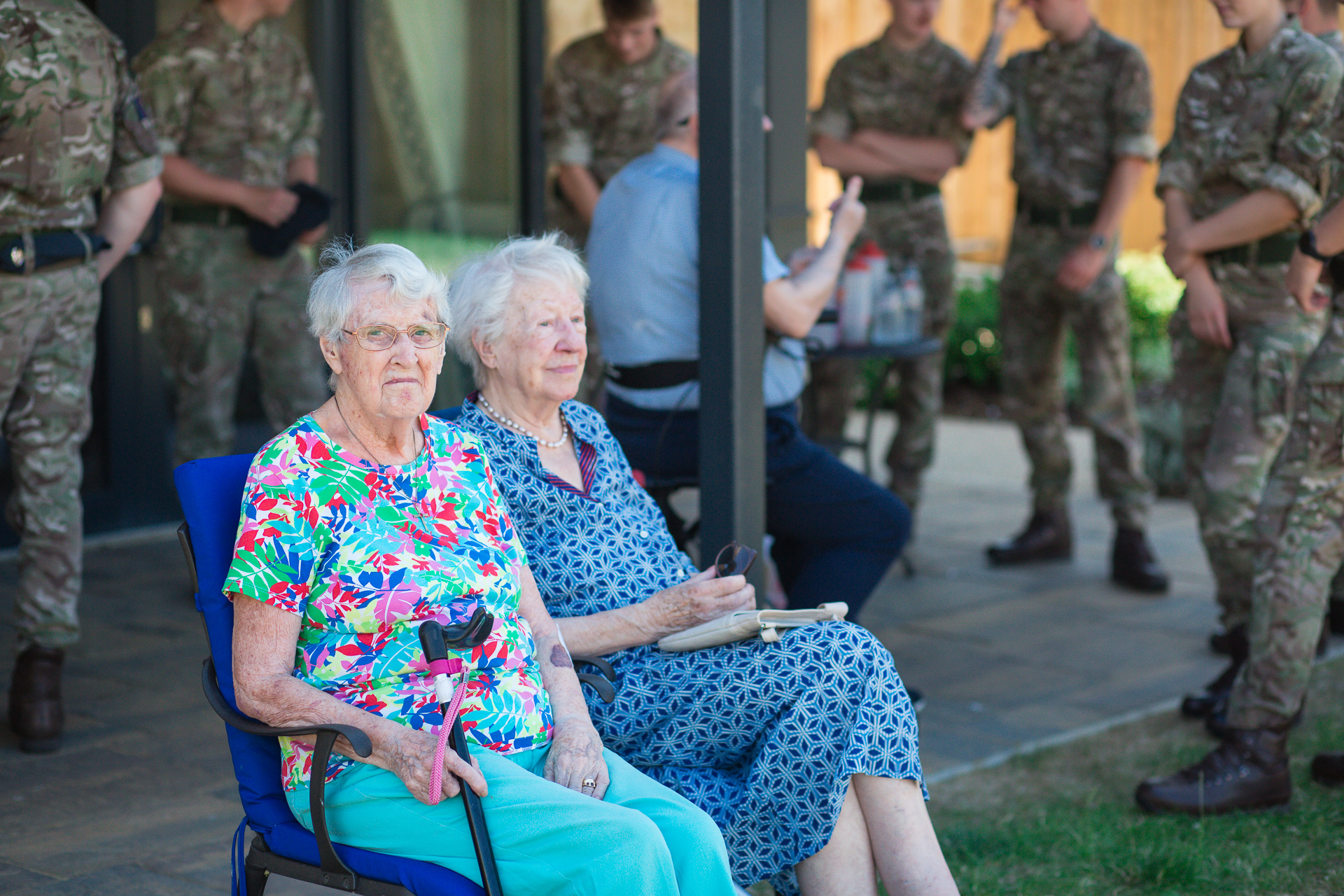
Care Costs at Home: Hidden Costs and All-Inclusive Value
A clear UK care-cost guide for families
Care Costs at Home: The Real Price, Hidden Extras and Long-Term Value
Comparing care can feel like comparing completely different things.
An hourly rate may look manageable, while a weekly care-home fee can
appear larger because it brings care, accommodation, meals, nursing,
medical support and everyday living together. This guide helps you
compare the whole cost—not simply the first number you see.
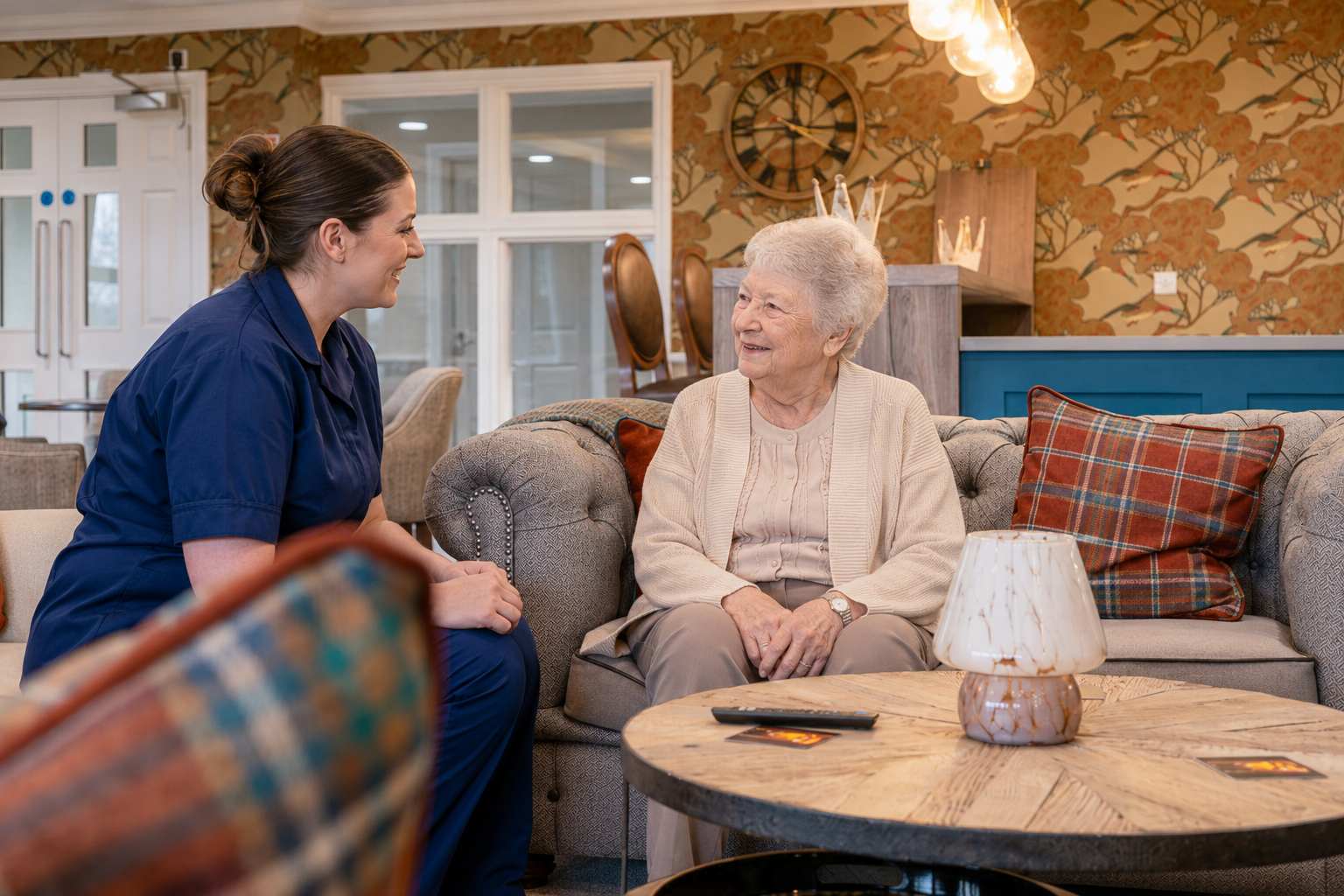
Families are not just searching for a price
Searches for care costs at home,
care at home costs and
private health care costs often begin when life has
changed unexpectedly.
Mum may have had a fall. Dad may be forgetting medication or struggling
with meals. A hospital discharge may be approaching, or a family carer
may simply have reached the point where continuing alone no longer
feels safe.
Families are not only asking,
“What will care cost?”
They are also asking:
- Will someone be available when my relative needs help?
- What happens during the night or after a fall?
- Who notices if their health or behaviour changes?
- Are meals, drinks and medication being managed?
- Will they still enjoy company and meaningful days?
- Can we understand the cost without worrying about surprises?
These questions matter because the cheapest-looking arrangement is not
always the option offering the strongest value, safety or peace of mind.
£26–£38
Broad hourly home-support range
£34.42
2026/27 sustainable hourly reference rate
15 hours
Time without booked support after nine paid hours each day
How quickly can care at home costs increase?
Home care is normally charged according to time. The total increases
when more visits, longer visits, a second carer or overnight assistance
are required.
MoneyHelper currently gives a broad private home-care range of
approximately £26 to £38 per hour and estimates live-in arrangements at
approximately £900 to £2,000 per week. Families can
review its independent guidance on arranging long-term support
.
| Paid care each day | Hours each week | Estimated weekly cost | Estimated annual cost | Hours without booked care each day |
|---|---|---|---|---|
| 2 hours | 14 | £364–£532 | £18,928–£27,664 | 22 hours |
| 4 hours | 28 | £728–£1,064 | £37,856–£55,328 | 20 hours |
| 6 hours | 42 | £1,092–£1,596 | £56,784–£82,992 | 18 hours |
| 8 hours | 56 | £1,456–£2,128 | £75,712–£110,656 | 16 hours |
| 9 hours | 63 | £1,638–£2,394 | £85,176–£124,488 | 15 hours |
| 10 hours | 70 | £1,820–£2,660 | £94,640–£138,320 | 14 hours |
| 12 hours | 84 | £2,184–£3,192 | £113,568–£165,984 | 12 hours |
These calculations are illustrations, not quotations. Actual charges
can be higher for short visits, complex needs, nights, weekends, bank
holidays or visits requiring two carers.
The Homecare Association’s sustainable-price methodology is intended to
account for lawful employment costs, care-worker travel and the minimum
cost of operating a compliant service. Families can
examine how the sector calculates sustainable provision
.
See how care costs can grow
The graphs below use £34.42 per hour and show paid care only. They do not
include accommodation, meals, household bills, cleaning, laundry,
activities, transport, appointment escorts, private medical services or
additional overnight support.
Weekly cost as home-care hours increase
The weekly care invoice rises directly with the number of paid hours.
At nine hours each day, care alone reaches approximately £2,168 per
week, while fifteen hours each day remain outside the scheduled
support period.
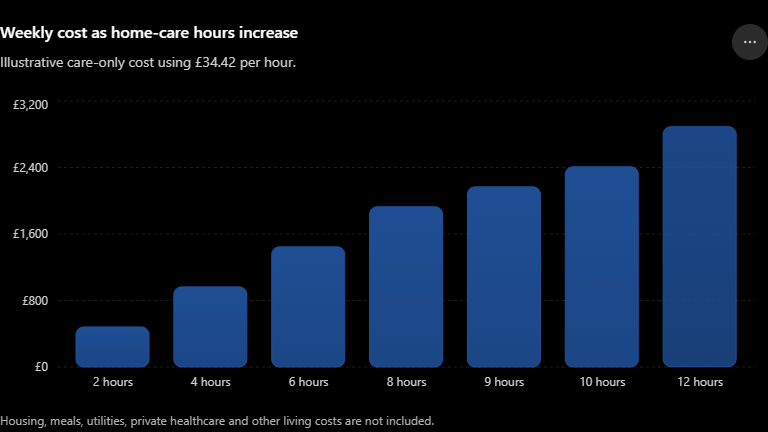
Accommodation, meals, utilities, laundry, activities, transport,
private medical support and other living costs are not included.
View the weekly cost figures as an accessible table
| Paid care each day | Weekly hours | Weekly care-only cost | Annual care-only cost |
|---|---|---|---|
| 2 hours | 14 hours | £482 | £25,058 |
| 4 hours | 28 hours | £964 | £50,116 |
| 6 hours | 42 hours | £1,446 | £75,173 |
| 8 hours | 56 hours | £1,928 | £100,231 |
| 9 hours | 63 hours | £2,168 | £112,760 |
| 10 hours | 70 hours | £2,409 | £125,289 |
| 12 hours | 84 hours | £2,891 | £150,347 |
Projected care at home costs from 2026 to 2036
Nobody can predict future care prices precisely. These lines show
illustrative planning scenarios using annual increases of 3%, 4%
and 5%. They do not represent Esmere Gardens fees or a promise about
the future charges of any provider.
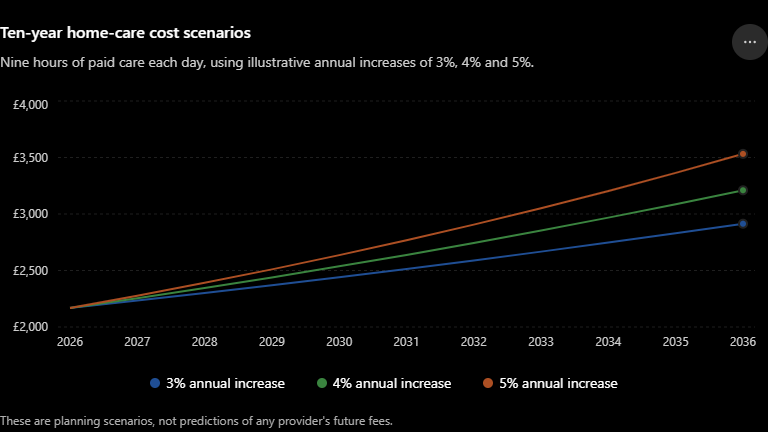
day. The graph assumes annual increases of 3%, 4% and 5%. These
scenarios are not predictions of Esmere Gardens fees or another
provider’s future charges.
View the ten-year cost scenarios as an accessible table
| Year | 3% annual scenario | 4% annual scenario | 5% annual scenario |
|---|---|---|---|
| 2026 | £2,168 | £2,168 | £2,168 |
| 2027 | £2,234 | £2,255 | £2,277 |
| 2028 | £2,301 | £2,345 | £2,391 |
| 2029 | £2,370 | £2,439 | £2,510 |
| 2030 | £2,441 | £2,537 | £2,636 |
| 2031 | £2,514 | £2,638 | £2,768 |
| 2032 | £2,589 | £2,744 | £2,906 |
| 2033 | £2,667 | £2,854 | £3,051 |
| 2034 | £2,747 | £2,968 | £3,204 |
| 2035 | £2,829 | £3,086 | £3,364 |
| 2036 | £2,914 | £3,210 | £3,532 |
The care invoice is only one part of remaining at home
Care at home can be the right choice when someone remains relatively
independent and only needs limited assistance.
However, the hourly invoice does not normally replace the cost of
running the home or arranging other services.
Possible care-agency additions
- Minimum visit lengths
- Evening and weekend premiums
- Bank-holiday charges
- Waking-night or sleeping-night support
- A second carer for safe transfers
- Travel or mileage costs
- Hospital and appointment accompaniment
- Short-notice cancellation charges
- Annual price increases
Household costs that continue
- Mortgage, rent or property costs
- Heating, electricity and water
- Food, snacks and drinks
- Cleaning and laundry
- Gardening and property maintenance
- Security systems and equipment
- Transport and taxis
- Family time spent coordinating services
- Private appointments and medical services
There is also an emotional cost that does not appear on an invoice.
Relatives may spend each day checking cameras, arranging rotas,
preparing meals, managing medication and worrying about what will happen
between visits.
Good value is not simply spending the smallest amount. It is receiving
the right level of care while reducing risk, uncertainty and pressure
across the family.
everyday things that make life comfortable and meaningful: good food,
refreshments, companionship, housekeeping, activities and a welcoming
place to call home.
Is live-in care the same as continuous 24-hour support?
Live-in care can be a valuable option, particularly when someone wants
to remain in familiar surroundings. However, a live-in arrangement is
not automatically the same as having an awake carer continuously
available throughout every hour of the day and night.
Before comparing a live-in quotation with a nursing-home package,
families should confirm:
- How many active care hours are included?
- What breaks and rest periods must the carer receive?
- Who provides cover during those breaks?
- How are waking nights charged?
- What happens after repeated night-time disturbances?
- Is a second carer needed for transfers?
- Who pays for the carer’s meals and accommodation?
- Are registered nursing services included?
- Are private GP appointments included?
- Who organises transport and appointment escorts?
Important comparison:
a weekly live-in care quotation may still sit alongside food, energy,
property maintenance, insurance, equipment, additional night cover and
private medical costs. Ask for every likely cost in writing.
What do private health care costs cover?
The phrase private health care costs can refer to
private GP appointments, diagnostic testing, consultations, treatment
or medical insurance.
These services are different from social care. Social care supports
everyday life, including washing, dressing, eating, drinking, mobility,
medication routines, safety, supervision and companionship.
Private medical insurance does not automatically provide long-term
personal care, accommodation or continuous nursing support. Policy
terms and exclusions should be checked carefully.
Private GP support is included at Esmere Gardens
At Esmere Gardens Nursing Home, dedicated private GP input works
alongside our registered nurses and care team.
This helps provide greater continuity, proactive review and
reassurance when a resident’s health, medication, appetite, mobility
or behaviour changes.
Private GP support is integrated into our wider all-inclusive approach
rather than routinely arriving as another separate medical invoice.
Why Esmere Gardens focuses on complete value
The right comparison is not one hourly rate against one weekly fee.
It is the total cost of keeping someone safe, comfortable, supported and
meaningfully connected.
Esmere Gardens is not positioned around a deliberately low headline
figure followed by a long list of routine additions.
Our all-inclusive approach is designed to provide clear expectations,
no unexpected routine charges within the agreed package and greater
confidence for families making a long-term decision.
Personalised care
Support shaped around assessed needs, preferences and established
routines.
24-hour reassurance
A care team is available throughout the day and night, not only
during booked visits.
Registered nurses
Nursing support for residents with ongoing, complex or changing
health needs.
Private GP support
Dedicated medical input is integrated into the wider care package.
Meals and refreshments
Meals, snacks and drinks form part of comfortable everyday life.
Laundry and housekeeping
Everyday household responsibilities are managed within the home.
Activities and trips
Meaningful experiences, social engagement and organised outings.
Appointment escorts
Practical support when a resident needs help attending an
appointment.
Care that can adapt
Residential, nursing, dementia and short-term support in one home.
Read more about
what sits behind our all-inclusive approach
and
how we explain care fees clearly
.
A fairer way to compare care options
| Need or service | Care arranged at home | Esmere Gardens approach |
|---|---|---|
| Care availability |
Usually limited to booked visits or the agreed live-in arrangement. |
A care team is present throughout the day and night. |
| Registered nursing | May require a separate community, agency or private service. | Nursing support is available within the home. |
| Private GP support | Often arranged and charged separately. | Dedicated private GP input is part of the wider package. |
| Meals and drinks | Food, shopping, preparation and monitoring remain separate. | Meals, snacks and refreshments form part of everyday care. |
| Accommodation and utilities | Housing, energy, insurance and maintenance costs continue. |
Accommodation and normal household running costs are brought into one approach. |
| Laundry and cleaning | Completed by relatives or arranged as an additional service. | Laundry and housekeeping are managed within the home. |
| Activities and companionship | May require separate clubs, transport or family organisation. |
Activities, shared spaces and companionship are part of daily life. |
| Trips and appointments | Transport and accompanying support may be charged separately. |
Organised trips and appointment escorts form part of the agreed approach. |
| Family coordination |
Relatives may coordinate agencies, appointments, food and emergencies. |
The home coordinates care and keeps families informed. |
Individual assessments and contractual terms apply. Families should
request a current written explanation of all inclusions before making a
final decision.
Sometimes the greatest value is becoming a family again
When care is fragmented, relatives often become unpaid coordinators.
They arrange rotas, chase appointments, prepare meals, monitor
medication, manage the home and worry about the hours when nobody is
there.
The right care home can change that relationship.
A daughter can visit as a daughter. A husband can spend time with his
wife without carrying every practical responsibility. Grandchildren can
enjoy a conversation rather than arriving with a list of jobs.
That is part of the value Esmere Gardens provides: professional care for
the resident, with greater certainty and breathing space for the people
who love them.
Discover
what everyday life at Esmere Gardens can feel like
.
How might care costs change over the next ten years?
Nobody can predict the exact future price of care. Staffing, wage
requirements, regulation, food, energy, insurance and individual
clinical needs can all affect costs.
The Office for National Statistics reported annual CPI inflation of
2.8% in May 2026. Care is labour intensive, so its costs may rise at a
different rate from general consumer inflation.
The graph therefore uses 3%, 4% and 5% annual increases as planning
scenarios rather than forecasts. Families can
review the official inflation release
.
The projection also assumes the person continues to need exactly nine
hours of paid assistance each day. In reality, mobility, memory or
clinical needs may change, increasing the number of hours or carers
required.
Care that can adapt without another disruptive move
Esmere Gardens provides several levels of support within the same
Moreton-in-Marsh home. Subject to assessment, this can offer valuable
continuity if someone’s needs increase.
Residential care
Daily support, personal care, meals, medication assistance,
companionship and round-the-clock reassurance.
Nursing care
Registered nursing oversight for people with ongoing, complex or
changing healthcare needs.
Dementia care
Calm routines, thoughtful communication, meaningful engagement and
support shaped around the individual.
Respite care
Short-term reassurance for recovery, family-carer breaks, trial
stays or urgent circumstances.
Questions to ask before agreeing to any care package
Ask each provider the same questions and request written answers. This
makes quotations easier to compare and reduces the risk of unexpected
charges later.
-
What is included in the regular fee?
Ask specifically about meals, snacks, laundry, utilities, activities,
transport, nursing, medical support and personal-care items. -
Which services are charged separately?
Request a complete current price list rather than accepting a general
statement that extras may apply. -
How many active care hours are provided?
This is especially important when comparing visiting care and live-in
arrangements. -
What happens during the night?
Ask who responds, how quickly help is available and whether waking
support creates another charge. -
What happens if two carers become necessary?
Mobility and transfer needs can change, significantly affecting the
cost of remaining at home. -
How are increasing needs reviewed?
Ask who completes the review, how fees may change and how much notice
the family receives. -
Are clinical services included?
Confirm whether nurses, private GP appointments, medication reviews
and appointment escorts form part of the package. -
What happens during a hospital stay?
Check whether the room or care package remains chargeable and for how
long. -
How are annual increases calculated?
Ask when reviews occur and how changes will be explained. -
Can all promises be included in the agreement?
A trustworthy provider should provide clear written information before
admission.
Value also depends on the quality of care
Cost matters, but it should never be separated from safety, leadership,
staffing and the experience of residents.
Esmere Gardens is currently rated Good overall by the
Care Quality Commission, with Good ratings for safe, effective, caring,
responsive and well-led.
Families can
check the latest independent assessment
.
All-inclusive care in Moreton-in-Marsh and the Cotswolds
Esmere Gardens Nursing Home is located on Stow Road in
Moreton-in-Marsh, Gloucestershire.
Our North Cotswolds location is accessible for families travelling from
nearby towns and villages, helping relatives remain involved in everyday
life.
- Moreton-in-Marsh
- Stow-on-the-Wold
- Chipping Campden
- Blockley
- Broadway
- Bourton-on-the-Water
- Bourton-on-the-Hill
- Evesham
- Shipston-on-Stour
- North Gloucestershire
- South Warwickshire
- Worcestershire
Esmere Gardens Nursing Home
Stow Road, Moreton-in-Marsh, Gloucestershire, GL56 0DS
Telephone: 01608 692222
Frequently asked questions about care costs and all-inclusive care
These direct answers address the questions families commonly ask when
comparing home care, live-in support, residential care and nursing care.
Care at home costs
How much does care at home cost in the UK?
Privately arranged support commonly costs approximately £26 to £38
per hour. The amount depends on location, visit length, time of day,
care complexity and whether one or two carers are required.
What affects the cost of care at home?
Costs are affected by the number and length of visits, night support,
weekends, bank holidays, travel, medication needs, clinical
complexity and whether two carers are needed for safe transfers.
How much would two hours of care at home cost each day?
At £34.42 per hour, two hours every day would cost approximately £482
per week or £25,058 per year. Housing, meals, utilities, cleaning and
other living costs remain separate.
How much would four hours of home care cost each day?
Four hours every day would cost approximately £964 per week at
£34.42 per hour. This provides 28 paid hours each week but leaves
twenty hours of every day without scheduled support.
How much would eight hours of home care cost each day?
Eight hours every day would cost approximately £1,928 per week at
£34.42 per hour. Accommodation, meals, bills, laundry, transport,
activities and private medical services remain additional.
How much would nine hours of home care cost each day?
Nine hours every day would cost approximately £2,168 per week or
£112,760 per year at £34.42 per hour. This is a care-only cost and
leaves fifteen hours each day without booked support.
Does visiting home care provide 24-hour support?
No. Visiting home care provides assistance during booked visits.
Continuous support requires additional daytime, live-in or overnight
arrangements, which can significantly increase the total cost.
What household costs continue with care at home?
Mortgage or rent, utilities, food, cleaning, laundry, maintenance,
gardening, insurance, transport, security, equipment and property
adaptations may continue alongside the care invoice.
Live-in care
Is live-in care the same as an awake carer 24 hours a day?
No. Live-in carers require breaks and uninterrupted rest. Repeated
waking-night needs, replacement cover or two-person assistance may
require additional carers and separate charges.
Is live-in care cheaper than a care home?
It can be suitable and cost-effective for some people, but families
must also account for housing, energy, food, maintenance, equipment,
night cover, nursing and medical services before comparing value.
What is normally not included in a live-in care quote?
Arrangements vary, but housing costs, household bills, food,
property maintenance, carer breaks, repeated waking nights,
registered nursing, private GP services and appointment transport
may remain separate.
When might two home carers be required?
Two carers may be needed for certain transfers, repositioning,
personal-care tasks or mobility support. This can substantially
increase the hourly and weekly cost of remaining at home.
Comparing home care and care homes
How should I compare home care with a care-home fee?
Compare the complete cost and level of support. Include paid hours,
night care, housing, meals, bills, cleaning, laundry, activities,
transport, medical support and the time contributed by relatives.
When might a care home offer better overall value?
A care home may offer stronger value when someone needs several
daily visits, night reassurance, nursing oversight, support with
food and medication or regular supervision to remain safe.
Is the lowest advertised care-home fee always best value?
No. A lower starting fee can become more expensive if nursing,
increased support, meals, activities, laundry, transport, escorts or
medical services are charged separately.
What hidden care-home costs should families ask about?
Ask about deposits, administration fees, premium rooms, increased
care needs, one-to-one support, transport, appointment escorts,
activities, laundry, toiletries, hospital absences, annual increases
and notice periods.
How can I avoid unexpected care charges?
Request a written quotation and complete list of inclusions. Ask for
examples of circumstances that could change the fee and ensure
verbal promises are reflected in the agreement.
What should I ask before signing a care-home contract?
Ask about the total fee, all inclusions, possible additions, annual
reviews, hospital absences, increasing needs, notice periods and
arrangements following a resident’s death.
Can care-home fees increase each year?
Providers may review fees to reflect staffing, inflation and
operating costs. The contract should explain when reviews occur, how
changes are calculated and how much notice families receive.
All-inclusive care at Esmere Gardens
What does all-inclusive care mean?
All-inclusive care brings agreed accommodation, care and everyday
services into one clearer fee. Families should still receive a
written list explaining precisely what sits within the package.
What is included at Esmere Gardens Nursing Home?
Esmere Gardens brings accommodation, personalised care, registered
nursing, meals, drinks, laundry, utilities, activities, organised
trips, appointment escorts and dedicated private GP support into its
wider all-inclusive approach.
Does all-inclusive mean there can never be an extra charge?
The aim is to remove unexpected routine charges within the agreed
package. An exceptional third-party service or item outside the
agreement should be explained before a charge is made.
Does Esmere Gardens include private GP support?
Yes. Dedicated private GP input works alongside the nursing and care
teams, helping provide continuity and reassurance when a resident’s
health, medication or needs change.
Does Esmere Gardens provide 24-hour nursing care?
Esmere Gardens provides registered nursing support around the clock
for residents with ongoing, complex or changing healthcare needs.
Are meals, snacks and drinks included?
Meals, snacks and refreshments form part of daily life at Esmere
Gardens. Dietary preferences, nutritional needs and suitable support
with eating and drinking are considered within the care plan.
Are activities and organised trips included?
Meaningful activities, social engagement and organised trips form
part of the wider all-inclusive approach, helping residents maintain
their interests and community connections.
Are residents escorted to appointments?
Appointment escorts form part of the Esmere Gardens approach where
suitable arrangements are required, reducing practical pressure on
residents and their families.
Changing care needs
Can Esmere Gardens support someone if their needs increase?
Esmere Gardens provides residential, nursing, dementia and respite
care within the same home. Subject to assessment, this can provide
continuity as a resident’s needs develop.
Does Esmere Gardens provide dementia care?
Yes. Dementia support is shaped around the individual’s routines,
communication, preferences, safety and emotional wellbeing.
Can a respite stay become a permanent placement?
It may be possible for a temporary stay to become permanent, subject
to assessment, suitability and room availability. A short stay can
also help a family experience the home before deciding.
What happens if someone needs nursing care later?
Because Esmere Gardens provides residential and nursing support
within the same home, an updated assessment may allow the care plan
to change without the resident needing another disruptive move.
Help with paying for care
Can the local council help with care costs?
A local authority may contribute following a care-needs assessment
and financial assessment. The amount depends on eligible needs,
savings, income and local funding arrangements.
What is NHS Continuing Healthcare?
NHS Continuing Healthcare is NHS-funded support for adults whose
primary need is assessed as a health need. Eligibility depends on
the nature, complexity, intensity and unpredictability of needs.
What is NHS-funded nursing care?
NHS-funded nursing care is a contribution paid by the NHS towards
registered nursing supplied within an eligible nursing home. It is
different from full NHS Continuing Healthcare funding.
Do I always have to sell my home to pay for care?
Not necessarily. The answer depends on the type of care, financial
circumstances, property ownership, other residents in the property
and eligibility for support. Specialist financial advice may be
appropriate.
Visiting Esmere Gardens
Where is Esmere Gardens Nursing Home?
Esmere Gardens is on Stow Road in Moreton-in-Marsh,
Gloucestershire, in the heart of the North Cotswolds.
Which local areas are close to Esmere Gardens?
Esmere Gardens is convenient for families travelling from
Stow-on-the-Wold, Chipping Campden, Blockley, Broadway,
Bourton-on-the-Water, Evesham, Shipston-on-Stour and surrounding
Gloucestershire, Warwickshire and Worcestershire communities.
Is Esmere Gardens rated Good by the CQC?
Yes. Esmere Gardens is currently rated Good overall, with Good
ratings for safe, effective, caring, responsive and well-led.
How do I arrange a care assessment or visit?
Contact Esmere Gardens to discuss the person’s circumstances and
arrange a visit. The team can explain the assessment, care options,
availability and inclusions before any decision is made.
Contact the Esmere Gardens team
.
One clear package. Complete care. Greater peace of mind.
You should not need a spreadsheet of hourly visits, household bills,
meals, laundry, activities, transport and private appointments to
understand whether someone you love will be safe.
At Esmere Gardens, our all-inclusive approach brings personalised care,
24-hour reassurance, registered nurses, everyday living and dedicated
private GP support together in one trusted Cotswold home.
Not simply a room. Not simply a weekly fee. Complete long-term value
for the resident and their family.
Calculations are illustrative and based on publicly available UK
guidance reviewed in July 2026. They are not quotations or predictions
of fees from Esmere Gardens or another provider. Individual costs depend
on assessed needs, availability, contractual terms and future economic
conditions. This article provides general information rather than
personalised legal or financial advice.
Inside the new model: continuous in-house medical teams cutting hospital visits for older residents
Can a Care Home with Private GP Support Help Reduce Avoidable Hospital Visits?
“Will Mum end up in A&E again if we choose a care home?”
It is one of the most important questions families ask when arranging care for an older relative, particularly when that person is living with frailty, dementia or several long-term health conditions.
The honest answer is that no care home can prevent every hospital admission. Sometimes emergency hospital treatment is necessary and should never be delayed.
However, a care home with 24-hour nursing oversight, prompt access to a GP and a team who knows the resident well may be better placed to notice changes early, seek medical advice and begin appropriate treatment before a situation becomes a crisis.
NHS England’s Enhanced Health in Care Homes framework supports this proactive, coordinated approach to improving health outcomes for people living in care homes. Research has also found associations between care from clinicians who specialise in nursing-home residents and fewer hospital or emergency-department visits.
At Esmere Gardens Nursing Home in Moreton-in-Marsh, residents benefit from 24-hour nursing support and dedicated onsite private GP support as part of our all-inclusive approach. The aim is simple: to provide earlier attention, clearer clinical oversight and greater reassurance for residents and their families.
The simple answer
A care home may help reduce avoidable hospital visits when it can:
- recognise early signs that someone is becoming unwell;
- arrange prompt clinical assessment;
- monitor changes closely;
- review medicines and possible side effects;
- manage appropriate conditions safely within the home;
- communicate clearly with relatives and healthcare professionals; and
- escalate to hospital quickly when hospital treatment is genuinely needed.
The important difference is not simply whether a care home can call a doctor. It is whether nurses, carers and medical professionals work together consistently around the resident.
Why older people are sometimes transferred to hospital
Older people living with frailty may become unwell quickly. A relatively small change, such as reduced fluid intake, constipation, pain, a suspected infection or a change in medication, can sometimes lead to a noticeable decline.
Early warning signs may include:
- increased confusion or unusual behaviour;
- reduced appetite or fluid intake;
- changes in mobility or balance;
- increased sleepiness;
- a new cough or breathing difficulty;
- changes in continence;
- unexplained pain; or
- a resident appearing generally less well than usual.
These signs can be subtle. They are often easier to recognise when residents are supported by a familiar team who understands their normal routines, communication and behaviour.
At Esmere Gardens, our approach to nursing care in Moreton-in-Marsh includes regular monitoring, personalised care planning and 24-hour professional nursing support. This allows changes to be identified, recorded and acted upon appropriately.
What does clinical continuity mean in a care home?
Clinical continuity means that healthcare is not treated as a series of isolated appointments.
Instead, the people supporting a resident understand:
- their medical history;
- current medication;
- known health risks;
- usual behaviour and communication;
- personal wishes;
- agreed care plans; and
- what matters to the resident and their family.
This familiarity can make clinical conversations more informed. Rather than beginning from scratch each time something changes, the team can provide meaningful observations and relevant background information.
NHS England describes enhanced care-home support as a partnership between care homes, primary care, community health services and other professionals, with the intention of delivering more proactive, personalised and coordinated care.
How can quicker clinical support make a difference?
When a health concern is recognised early, the nursing and medical team may be able to assess the resident, review possible causes and agree an appropriate plan.
Depending on the person’s needs, this could involve:
- increasing observation and monitoring;
- reviewing hydration or nutrition;
- checking for signs of infection;
- reviewing pain management;
- discussing medication concerns;
- contacting the GP or another healthcare professional;
- updating the resident’s care plan; or
- arranging an urgent hospital assessment.
Early intervention does not mean avoiding hospital at all costs. It means making a more informed decision about the safest and most appropriate place for the resident to receive care.
This is particularly important for families who have previously experienced repeated ambulance call-outs or hospital admissions and want to know that a change in their relative’s health will be noticed promptly.
Why hospital visits can be particularly difficult for someone with dementia
An emergency department can be busy, unfamiliar and disorientating. For someone living with dementia, changes in environment, routine and familiar faces may increase distress or confusion.
Research has found that people living with dementia can experience poorer outcomes following emergency hospital admission, including longer hospital stays and greater risks of readmission or other complications.
This does not mean someone with dementia should not go to hospital when it is medically necessary. It means that unnecessary transfers should be avoided where a condition can be assessed and managed safely within the care home.
A 2025 US cohort study involving more than 417,000 long-stay nursing-home residents with dementia found that care from clinicians who primarily practised in nursing homes was associated with approximately 7% lower odds of hospitalisation and 7% lower odds of an emergency visit for certain potentially manageable conditions. Because this was an observational US study, it does not prove that the same result will occur in every UK care home, but it supports the wider principle of familiar, care-home-focused clinical support.
At Esmere Gardens, our specialist dementia care combines calm routines, personalised support, 24-hour nursing and dedicated onsite private GP input. Residents are supported as individuals, with care shaped around their life story, communication, preferences and changing health needs.
What private GP support means at Esmere Gardens
At Esmere Gardens, dedicated onsite private GP support is included within our all-inclusive care approach.
For residents and families, this provides:
- greater familiarity with the resident’s medical history;
- prompt attention when concerns arise;
- clinical input alongside our nursing team;
- support with health reviews and changing needs;
- clearer communication and decision-making; and
- additional reassurance for families.
It does not replace emergency hospital care where that is required. Instead, it strengthens the clinical support available within the home and helps the team make informed decisions about monitoring, treatment and escalation.
You can read more in our guide to care homes with private GP support.
A care home should support the whole person, not only respond to illness
Avoiding unnecessary hospital visits is important, but good care involves much more than medical intervention.
A resident’s overall wellbeing can also be supported through:
- nutritious meals and regular hydration;
- safe movement and mobility support;
- meaningful activities;
- companionship and social connection;
- familiar daily routines;
- comfortable surroundings;
- medication support;
- personalised care planning; and
- regular communication with relatives.
At Esmere Gardens, residents can access residential care, nursing care, dementia care and short-term respite care within one home. This means care can adapt as someone’s needs change, helping to reduce unnecessary disruption.
Our all-inclusive care package is designed to give families greater clarity about what is included, while allowing them to focus on their loved one’s comfort, safety and quality of life.
What should families ask when comparing care homes?
Families should look beyond bedrooms, décor and facilities. Those things matter, but it is equally important to understand what happens when a resident becomes unwell.
Ask each care home:
- Are registered nurses available 24 hours a day?
- How quickly can a resident receive GP input?
- Does the GP visit the home or provide remote support?
- How are changes in a resident’s health recognised and recorded?
- What happens during evenings, weekends and bank holidays?
- How are relatives informed when someone becomes unwell?
- How are medication concerns reviewed?
- How does the home decide when hospital treatment is necessary?
- Can the home continue supporting the resident if their needs increase?
- Are there additional charges for GP or clinical services?
Our complete guide explains what to ask when choosing a care home.
Why families choose Esmere Gardens
Esmere Gardens is a family-led care home and nursing home in Moreton-in-Marsh, supporting families across Gloucestershire and the Cotswolds, including Stow-on-the-Wold, Chipping Campden, Broadway, Blockley, Bourton-on-the-Water and Evesham.
Families choose Esmere Gardens for:
- 24-hour nursing support;
- dedicated onsite private GP support;
- residential, nursing, dementia and respite care;
- personalised care that can adapt as needs change;
- clear, all-inclusive fees;
- comfortable, purpose-designed surroundings;
- meaningful activities and community connections; and
- open communication with families.
Esmere Gardens is currently rated Good by the Care Quality Commission across all five assessment areas. It also has a current carehome.co.uk review score of 9.9 out of 10, based on independently submitted reviews.
Explore life at Esmere Gardens or view our care-home photo gallery to get a clearer feeling for the home.
A calmer and more informed approach to care
Choosing a care home is not about trying to eliminate every risk. It is about choosing a team that can recognise risks, respond appropriately and keep your loved one’s comfort, dignity and safety at the centre of each decision.
With consistent nursing oversight, familiar carers and prompt GP support, some conditions may be identified and managed earlier. When hospital treatment is required, the resident can be escalated appropriately with clearer information about their needs and medical history.
At Esmere Gardens, our aim is to give families confidence that their loved one is known, monitored and properly supported—not only when something goes wrong, but every day.
Speak to our care team on 01608 692222 to discuss residential, nursing, dementia or respite care in Moreton-in-Marsh. You can also arrange a personal visit to meet the team and ask questions about our onsite private GP and all-inclusive care.
Frequently Asked Questions
Can a care home prevent hospital admissions?
No care home can guarantee that a resident will never need hospital treatment. However, 24-hour nursing oversight, early recognition of illness and prompt access to medical advice may help some health concerns be managed before they become emergencies.
Does Esmere Gardens have an onsite GP?
Yes. Esmere Gardens provides dedicated onsite private GP support as part of its all-inclusive approach, alongside 24-hour nursing care. This provides added continuity and reassurance when health concerns arise.
Is private GP support included in the care-home fee?
Dedicated private GP support is included within Esmere Gardens’ all-inclusive care approach. Families should speak directly with the home for a current and personalised explanation of fees and everything included within the package.
You can also read our guide to all-inclusive care-home fees.
What happens if a resident becomes unwell at night?
Esmere Gardens provides 24-hour nursing support. The nursing team can assess the resident, monitor their condition, follow appropriate clinical procedures and arrange further medical or emergency assistance when necessary.
Is hospital always avoided when someone has dementia?
No. Hospital care is sometimes necessary and can be lifesaving. The aim is not to avoid appropriate hospital treatment, but to prevent unnecessary transfers where a condition can be assessed and managed safely within the home.
Can Esmere Gardens support someone after hospital discharge?
Subject to assessment and availability, Esmere Gardens may provide nursing, residential or respite care after a hospital stay. Support can include personalised care planning, medication assistance, mobility support, nutrition, hydration and ongoing monitoring.
Families needing care at short notice can read about urgent care-home admissions in Gloucestershire.
Can someone stay at Esmere Gardens temporarily?
Yes. Respite care is available for temporary support, recovery following illness or hospital treatment, family carer breaks and trial stays. Every placement is subject to an assessment of the individual’s needs and current availability.
How can I arrange a visit?
Call Esmere Gardens on 01608 692222 to discuss your relative’s needs and arrange a personal tour. During the visit, you can meet the team, see the home and ask detailed questions about nursing care, private GP support, fees and availability.
This article provides general information and should not replace medical advice. In an emergency, call 999 or follow the advice of the resident’s healthcare professionals.