Emergency Care Home Placements: What Families Need to Know in 2026
Emergency care home placements: what families need to know in 2026
When a loved one needs care urgently after a fall, hospital discharge or sudden change at home, speed matters — but so does safety, oversight and clear assessment.
Emergency placements in care homes can be a lifeline, but they also bring understandable worries about safety, oversight and whether the setting can truly meet complex needs.
Across the UK we have our own regulatory landscape. Recent policy direction from the Prime Minister’s renewed focus on adult social care, ongoing Care Quality Commission (CQC) developments, and the continuing pressure of hospital discharges are all reshaping what a safe emergency admission looks like in practice.
This guide explains the current direction of travel and, most importantly, what families in Gloucestershire and the Cotswolds should look for when arranging urgent care.
Regulators are focusing more attention where risk is highest.
Emergency admissions still require clear assessment and documentation.
Preparedness, escalation pathways and night-time checks matter.
Clear processes help families feel more confident in urgent situations.
What families should expect from a safe emergency placement
A well-managed urgent admission should include:
- A prompt but thorough assessment of needs and risks
- Clear documentation that supports continuity of care
- Visible emergency and escalation procedures
- Evidence that the home can safely support the person’s needs
- Open communication with the family throughout the process
Speed is important. Thoroughness is essential. The best providers manage both.
The current UK policy direction
Adult social care has returned to the centre of national attention. The Prime Minister’s recent emphasis on reforming and strengthening adult social care reflects growing recognition that hospital pressures, delayed discharges and rising complexity of need cannot be solved by the NHS alone.
At the same time, the Care Quality Commission continues to refine its approach under the Single Assessment Framework. The direction of travel is clear: more attention on risk, outcomes and the lived experience of people using services, alongside greater expectations around preparedness and continuous improvement.
For families arranging an emergency placement, this means providers are under clearer expectations to demonstrate that they can respond safely at short notice.
CQC Single Assessment Framework
Hospital discharge pressures
Risk-based regulation
From routine inspection to risk-based oversight
Regulators across health and social care systems are moving toward more risk-based models of oversight. In the UK, this is visible in the CQC’s focus on targeting inspection and monitoring where the risk of harm, poor outcomes or persistent concerns is higher.
Rather than treating every service as requiring the same intensity of routine scrutiny, the emphasis is increasingly on identifying higher-risk providers earlier and maintaining sustained attention where problems persist.
Concentrated attention
Greater focus on homes with higher risk of harm, repeated concerns or complex needs.
Faster response to concerns
Serious complaints and safety signals can trigger more rapid regulatory attention.
Higher expectations of providers
Homes are expected to demonstrate clear processes even during busy or urgent periods.
What this means for families
A risk-based approach can improve safety if it leads to earlier identification of problems. It also raises the bar on what good providers must show at short notice: clear assessments, auditable decisions, and robust emergency procedures that stand up to scrutiny.
Risk assessment as a baseline expectation
Risk assessment is no longer treated as a “nice to have.” It is a core expectation of safe care, particularly when someone is admitted urgently.
This goes far beyond fire or flood planning. It includes the practical realities of keeping residents safe if circumstances change suddenly — staffing disruption, clinical deterioration, access to medicines, or the need to coordinate rapidly with external health services.
- Clear lines of clinical responsibility
- Contingency plans for deterioration
- Ability to coordinate with GPs, community nursing and hospitals
- Preparedness for overnight needs and unexpected events
In an urgent admission, these “behind the scenes” systems are often what prevent a crisis from turning into avoidable harm.
Faster assessments and tighter documentation
Emergency admissions compress the usual timescales for assessment and care planning. That does not remove the need for a structured process.
A safe urgent placement still requires rapid confirmation of needs and risks — particularly around mobility, cognition, swallowing, skin integrity, medication management and any behaviour changes linked to dementia or delirium.
Good documentation supports continuity. It helps staff across shifts understand the person’s baseline, identifies what must be monitored, and provides evidence that the placement decision was appropriate, not simply convenient.
Speed should not replace thoroughness
Even when a move needs to happen quickly, families should expect (and welcome) a clear paper trail. Structured assessment and transparent records are a sign of a provider that takes responsibility seriously.
Post-incident reforms and everyday safety
Regulation often tightens after serious incidents. Across the care sector there is growing emphasis on overnight safety checks, clearer emergency-response standards, improved incident tracking and visible evacuation procedures.
These expectations are especially important during emergency admissions. A person who is new to the home, disoriented, or unable to follow instructions needs systems that protect them from the first night.
Overnight safety
Who checks residents, how often, and what is recorded?
Incident tracking
How are concerns reported, reviewed and acted upon?
Evacuation readiness
Are procedures clear, practised and suitable for people with complex needs?
Funding, capacity and clearer boundaries
National conversations about adult social care funding and capacity continue to influence what can be delivered safely in different settings. As expectations around on-site health support become clearer, the boundaries between residential, nursing and more specialist care also become more important.
For families arranging urgent care, this can mean sharper questions about suitability: which needs can be met safely in a particular home, what would trigger a move to a higher-acuity setting, and what evidence supports that decision.
Clarity reduces the risk of repeated moves — something that is particularly distressing for older people.
Data-driven improvement and family conversations
Care systems are becoming more data-informed. Patterns around falls, medication incidents, delayed responses or repeated hospital transfers can help identify risk earlier.
For emergency placements, better use of information can support more structured conversations at admission: why the crisis occurred, what resources the person had at home, and what needs to change to reduce the chance of another emergency.
Practical questions families should ask
When arranging an urgent placement, these questions can help you assess whether a home is ready to support your relative safely:
- How quickly can a full assessment of needs and risks be completed?
- What information do you need from us, the hospital or the GP?
- How are overnight checks carried out and recorded?
- What happens if someone’s condition deteriorates suddenly?
- How do you coordinate with external health professionals?
- Can we see examples of how emergency procedures work in practice?
The fundamentals still matter most
For families in Gloucestershire and the Cotswolds seeking a calm, well-supported move, the strongest reassurance comes from the basics: prompt assessment, transparent documentation, clear escalation pathways and practised emergency procedures.
When those pieces are in place, an urgent admission can feel less like a crisis and more like the first step toward stability and dignity.
Visit Esmere Gardens Nursing Home in Moreton-in-Marsh
Esmere Gardens Nursing Home is located on Stow Road, Moreton-in-Marsh, Gloucestershire GL56 0DS. We support families facing both planned and urgent care decisions and welcome conversations at short notice.
Frequently asked questions
Can a care home accept an emergency admission at short notice?
Yes, many homes can consider urgent placements, subject to assessment, suitability and available capacity. A structured assessment is still required even when the move needs to happen quickly.
What information is needed for an urgent placement?
Key information usually includes current health needs, medication, mobility, cognition, any recent hospital information, and details of risks such as falls or swallowing difficulties.
How does the CQC approach risk in care homes?
The CQC uses a risk-based approach under its Single Assessment Framework, focusing greater attention on services where the risk of harm or poor outcomes is higher.
What should families ask about night-time safety?
Ask how often residents are checked overnight, who carries out the checks, what is recorded, and how concerns are escalated if someone deteriorates.
Is emergency placement only for hospital discharges?
No. Urgent placements can also be needed after a fall at home, a sudden decline in health, carer breakdown, or other crises that make remaining at home unsafe.
Does Esmere Gardens consider urgent admissions?
Yes. Esmere Gardens can discuss both planned and urgent placements, subject to individual assessment, clinical suitability and room availability.
How can I start a conversation about an urgent placement?
Call 01608 692222 or contact the team through the Esmere Gardens website. We will listen carefully and advise on the next practical steps.


Why discharge reforms and virtual wards are reshaping emergency moves into care settings
Across the NHS, the way older people move from emergency services into the “right” care setting is changing quickly. Families in Gloucestershire and the Cotswolds often feel this change first-hand: an A&E visit that once led to a long hospital stay may now lead to a faster discharge pathway, supported at home or in the community, with residential or nursing care introduced earlier where it is genuinely needed.
Two linked developments are driving this shift: discharge reforms (designed to reduce delays once someone is medically ready to leave hospital) and the rapid expansion of virtual wards (hospital-level treatment delivered at home). Together, they are reshaping emergency moves into care settings,creating new opportunities for safer, more personalised recovery, while also introducing new decisions for families at a stressful time.
1) Why the NHS is redesigning “emergency flow” from the ground up
Urgent and emergency care remains under intense pressure. NHS England’s June 2025 operational statistics indicate that over 140,000 people a day access urgent and emergency care services, including around 20,700 people seen by ambulance services and more than 11,000 who require hospital admission for a day or more. When demand is this high, delays in one part of the system quickly affect everything else.
NHS England’s urgent and emergency care plan for 2025/26 is explicit that the biggest impact will come from shifting more care into more appropriate settings,particularly primary, community and mental health services,so that hospitals can focus on those who truly need acute beds. This is the policy direction often summarised as “hospital to community”, and it is now embedded in operational planning rather than being a distant ambition.
For families, this means an emergency attendance is increasingly treated as the start of a managed pathway, not simply “admit and wait”. The system is working towards clearer alternatives to admission and faster step-down options, which can include urgent community response teams, same-day pathways, home-based support, and,where appropriate,residential, nursing or dementia care.
2) Discharge reforms: turning “medically fit” into “safely moved on”
A major cause of crowded A&E departments and delayed ambulance handovers is bed blocking,when people who are medically ready to leave hospital cannot be discharged promptly. To tackle this, the NHS has made discharge performance much more measurable and visible. One key tool is the Discharge Ready Date metric, which tracks the time between when a patient is clinically ready to leave and when they actually do.
This statistic became an official statistic after a review in September 2025, signalling that discharge readiness is being treated as a core measure of system performance, not a local administrative detail. It is also being actively updated and corrected: NHS England published revisions for April 2025 to March 2026 on 9 July 2026, highlighting that this is now a live operational management tool.
In practice, these reforms push systems to identify the next step earlier,whether that is a return home with support, a short period of rehabilitation, or a move into a care setting. For families, it can feel quicker and more decisive than in the past. The upside is reduced time in hospital (which can be disorientating for older people), but it also means relatives may need guidance to make confident, informed choices at pace.
3) Virtual wards: hospital-level care at home becomes “real capacity”
NHS England defines virtual wards as care that allows patients to receive hospital-level treatment at home. Importantly, virtual wards are positioned for two key purposes: to avoid avoidable hospital admissions and to support people to safely leave hospital sooner. In other words, they are not simply “extra monitoring” but a structured alternative to a physical bed.
The programme is scaling, not shrinking. NHS England has indicated that virtual-ward capacity should be embedded and expanded across England, with a national time series published from July 2023 onward and monthly data continuing through 2026. This steady reporting reinforces that virtual wards are becoming part of routine capacity planning.
To underline that point, the NHS virtual-wards framework sets an expectation to optimise occupancy so it is consistently above 80%. That is the language of a core service, not a pilot. When virtual wards run at meaningful scale, they free physical beds, reduce bottlenecks, and make discharge planning more flexible,particularly for people who can recover safely with the right clinical oversight at home.
4) Evidence of impact: fewer admissions, faster recovery, less emergency use
Regional reporting suggests virtual wards are already taking real pressure off hospitals. NHS England South East stated there were over 85,000 admissions to virtual wards in 2024, up 18% from 2023, with more than 2,000 virtual-ward beds supporting discharge and recovery at home. While Gloucestershire and the Cotswolds have their own local arrangements, these figures illustrate the national direction of travel.
Some local models also report reductions in emergency use after discharge. NHS England South East cited analysis from the Buckinghamshire, Oxfordshire, Berkshire West (BOB) ICB virtual-ward programme showing emergency admission rates fell by 73% for adults and 85% for children in the relevant post-discharge context described in the release. Results will vary by population and pathway, but the signal is clear: well-run virtual wards can stabilise recovery and prevent “revolving door” returns to hospital.
For families, the practical meaning is that “going home” after an emergency episode may no longer mean being left to cope alone. Virtual wards can bring clinical input,monitoring, medication optimisation, escalation plans and frequent contact,without the risks that long hospital stays can bring for older people, such as deconditioning, delirium, or loss of confidence.
5) How this changes emergency moves into care settings for older people
Discharge reform and virtual wards change the timing and purpose of care placements. Historically, a care home move might happen only after a long inpatient stay. Now, the system is pushing for earlier decisions: either intensive support at home (including virtual wards and urgent community response) or timely transition to a care setting when home is no longer safe or sustainable.
As a result, families may be asked to consider short-term options such as respite or step-down care sooner, sometimes directly after an emergency admission. This can be a positive shift if it avoids unnecessary hospital days and provides calm, structured support,particularly when someone needs help with mobility, medication routines, nutrition, or personal care while they regain strength.
It can also mean that “emergency care” is increasingly delivered across multiple settings, not just in the hospital. For example, someone might be assessed in A&E, treated in a Same Day Emergency Care unit, supported by a virtual ward at home, and then move into respite or longer-term residential or nursing care if their needs evolve. Understanding that pathway can help families feel less blindsided when discharge planning conversations start early.
6) The wider urgent-care reform: quicker handovers, more community alternatives
NHS England’s 2025/26 urgent and emergency care plan links reform directly to expanding care outside hospital, including urgent community response teams and virtual wards, and it ties winter planning to timely discharge goals. This is not just about convenience,it is about restoring flow so that the sickest patients can access beds promptly.
Ambulance delays are a key driver. The plan sets out an ambition to eradicate lengthy ambulance handover delays by meeting the 45-minute handover standard, helping return 550,000 more ambulances to the road. Faster discharges and better diversion into community pathways are central to that aim, because handover delays often reflect a lack of available space inside hospitals.
The reform agenda also includes same-day alternatives to admission. NHS England has stated it will support around 40 new Same Day Emergency Care and Urgent Treatment Centres that treat and discharge patients on the same day, reducing unnecessary admissions. For families, this can mean fewer overnight hospital stays, earlier follow-up plans, and more rapid consideration of community or care-home-based support where appropriate.
7) What families should ask during discharge planning (and why it matters)
When discharge moves quickly, clarity becomes essential. Families can help by asking what the clinical goal is for the next setting: is it rehabilitation, monitoring, medication stabilisation, personal care support, dementia support, or end-of-life comfort? A clear goal makes it easier to choose between home with a virtual ward, community services, respite, nursing care, or a longer-term placement.
It is also reasonable to ask what support will be in place immediately,not in a week’s time. For virtual wards, ask what “hospital-level” support means in practice: how often contact will happen, what equipment is provided, who to call out of hours, and what would trigger escalation back into hospital. For care settings, ask about clinical oversight, access to nursing, and how changes in condition are handled.
Finally, ask how risk is being managed. Older people can deteriorate quickly after an acute episode, especially with frailty, dementia, heart failure, COPD, diabetes, or complex medication regimens. Good discharge pathways,whether at home or into a care home,include a clear plan for monitoring, hydration and nutrition support, falls prevention, and timely review by clinicians. This is where personalised, well-coordinated care makes a real difference to confidence and outcomes.
Discharge reforms and virtual wards are reshaping emergency moves into care settings because the NHS is actively redesigning where urgent care happens. With daily demand remaining high and ambitious targets for A&E performance and ambulance handovers, the system is prioritising “right care, right place, right time”,supported by measurable discharge metrics and expanding virtual-ward capacity treated as genuine operational capacity.
For families in Gloucestershire and the Cotswolds, these changes can feel faster and more complex, but they also create a more flexible set of options. Whether the safest next step is recovery at home with virtual-ward support, a short period of respite, or a move into residential, dementia or nursing care, the aim is the same: a safe transition, fewer avoidable returns to hospital, and the reassurance that your relative is in the right environment to recover and live well.

When Mum’s Memory Is Getting Worse: Dementia Assessment, Support & Care in Gloucestershire
When Mum’s memory is getting worse: where to turn, what to ask, and when care may be the kindest next step
A clear, compassionate guide for families navigating memory concerns, dementia assessment waiting times, specialist support and dementia care in the Cotswolds.
“Where do we turn for specialist help when Mum’s memory is getting worse, and how long will we wait?”
If you are asking that question, you are not alone. Many families across Gloucestershire and the Cotswolds find themselves juggling GP appointments, memory worries, referral pathways and the day-to-day reality of supporting someone who is becoming more forgetful, anxious or confused.
The hardest part is often not the memory loss itself. It is the uncertainty. Is this normal ageing? Is it dementia? Should we wait for a diagnosis before arranging more support? What happens if Mum starts wandering, Dad misses medication, or the family carer is exhausted?
This guide explains how dementia assessment works in Gloucestershire, what families can do while waiting, and when residential, nursing or dementia care may become a practical, compassionate step.
The quick answer
If memory problems are affecting day-to-day life, speak to a GP and keep a written record of what has changed. In Gloucestershire, Managing Memory Together provides memory assessment, community dementia nurses, and information and education support for people worried about memory, people living with dementia and carers.
Waiting times vary. Some people move through assessment quickly; others may wait longer, especially if further tests are needed. If home life is becoming unsafe or unsustainable, do not wait silently for a formal diagnosis. Practical support, respite care, dementia care or nursing care may need to be explored while assessment is underway.
A diagnosis helps explain what is happening. Support helps families cope with what is happening now.
Why specialist dementia support matters early, before a crisis
Memory changes can have many causes. Stress, anxiety, depression, medication side effects, infection, sleep problems, delirium and other health conditions can all affect memory and thinking. Dementia is one possible cause, but it should not be assumed without proper assessment.
Early specialist input can help separate what may be reversible from what needs longer-term planning. It can also reduce the fear that builds when a family knows something is wrong but does not yet have language, advice or a plan.
For many families, specialist support means more than a diagnosis. It may include advice around routines, communication, safety, sleep, medication, carer strain, legal planning and what support may be needed as symptoms change.
Useful trusted reading: NHS guidance on memory loss and NHS guidance on dementia symptoms.
The three routes families often need to understand
When someone’s memory is getting worse, families often need three things at the same time: medical assessment, practical dementia support and a realistic care plan if home becomes unsafe.
1. Medical assessment
Speak to the GP first where possible. The GP can check for treatable causes, arrange initial tests and refer to a memory assessment service where appropriate.
Read Alzheimer’s Society diagnosis guidance2. Practical support
Families may need help with routines, medication, safety, communication, benefits, carer pressure and local support while assessment is underway.
View Managing Memory Together3. Care planning
If the person is unsafe, distressed or no longer coping at home, residential, nursing or dementia care may need to be considered before a crisis occurs.
Explore Esmere Gardens dementia careSigns that memory changes need action
Occasional forgetfulness is common. The concern increases when memory problems begin to affect safety, independence, relationships or daily life.
| What families may notice | Why it matters | Practical next step |
|---|---|---|
| Repeating the same questions | May suggest recent memory is becoming harder to retain. | Keep a simple dated record to share with the GP or memory service. |
| Missed medication | Can create immediate health risks, especially with complex medicines. | Ask for a medication review and consider supervised support. |
| Getting lost or disorientated | Can increase risk when someone leaves home alone or becomes confused outdoors. | Discuss safety urgently with the GP, memory service or social care. |
| Falls, infections or sudden confusion | Sudden changes may have medical causes and should not be dismissed as dementia. | Seek medical advice promptly, especially if the change is rapid. |
| Anxiety, agitation or sleep disruption | May suggest the person is finding daily life harder to understand or manage. | Ask about dementia support, routines and carer advice. |
| Family carer exhaustion | When the carer is at breaking point, the whole support arrangement becomes fragile. | Explore respite, home care, nursing care or residential dementia care options. |
Dementia assessment in Gloucestershire: where families can turn
In Gloucestershire, Managing Memory Together provides a memory assessment service, community dementia nurses, and information and education support for people who are worried about memory, people living with dementia and carers.
The service advises people who are worried about memory to visit their GP first where possible, so other causes can be considered. The GP may carry out a physical health check, arrange blood tests and refer to the Memory Assessment Service if appropriate.
Where someone feels unable to talk to a GP about their own memory problems, or the memory problems of a family member, the service information says people can contact Managing Memory Together directly.
Helpful Gloucestershire and national resources
How long does it take to get a dementia assessment?
There is no single waiting time that applies to every person or every area. Waiting times can vary depending on local capacity, urgency, complexity, appointment options and whether additional tests, such as scans, are needed.
The Alzheimer’s Society explains that if a GP refers someone to a dementia specialist, they may wait a few weeks or several months for an appointment. It also explains that the overall diagnosis process can vary. For many people it may take a few weeks, while for others it can take much longer.
This is why families should separate two questions:
- How do we get a diagnosis? This usually begins with the GP and, where appropriate, a memory service or specialist assessment.
- How do we keep Mum or Dad safe while we wait? This may involve medication support, home care, respite care, nursing advice, dementia support or considering a care home.
The family question beneath the waiting-time question
Families rarely ask about waiting times out of curiosity. They ask because something is becoming harder to manage.
If the situation feels unsafe, unpredictable or unsustainable, ask for practical support now. You do not have to wait for every answer before improving safety and reducing stress.
What families can do while waiting for dementia assessment or diagnosis
Waiting can feel passive, but there are practical steps families can take while assessment is underway. The aim is to reduce risk, preserve dignity and make life easier without making the person feel that every choice has been taken away.
Make risks visible
Write down falls, missed medication, confusion, wandering, weight loss, distress, sleep disruption and changes in personal care. Dates and examples help professionals understand urgency.
Review daily support
Look honestly at meals, hydration, medication, washing, dressing, mobility, night-time safety and family carer strain. Small gaps can quickly become serious risks.
Explore care before crisis
A private care-home visit can be a fact-finding step, not a commitment. It helps families understand what dementia, nursing or respite support could look like if home becomes unsafe.
Families may also wish to explore respite care at Esmere Gardens if a short stay would help with recovery, carer rest or understanding whether a care-home environment may be suitable.
When does dementia care at home become unsafe or unsustainable?
Many families want to keep a loved one at home for as long as possible. That is understandable. Home can represent memory, marriage, identity, independence and control.
But there can come a point where staying at home no longer protects the life the person values. If someone is frightened at night, missing medication, falling, not eating, wandering, becoming distressed or relying on an exhausted relative, more structured support may become the kinder option.
- Memory loss is affecting safety at home.
- Medication needs have become difficult to manage.
- There are repeated falls, infections or hospital visits.
- Night-time confusion is affecting safety and sleep.
- A family carer is becoming exhausted or unwell.
- The person needs nursing oversight as well as dementia support.
Care is not giving up
Choosing residential, nursing or dementia care is often a proactive decision to stabilise health, reduce risk and restore family relationships. It can allow relatives to stop acting as crisis managers and return to being daughters, sons, partners and grandchildren.
Arrange a Private VisitWhy families consider Esmere Gardens for dementia care in the Cotswolds
At Esmere Gardens in Moreton-in-Marsh, families often ask how we support residents who are living with memory loss alongside everyday medical needs. This matters because dementia rarely exists in isolation. A person may also be managing frailty, falls risk, pain, diabetes, heart conditions, medication changes or reduced mobility.
Esmere Gardens provides dementia care, residential care, nursing care and respite care, subject to assessment, suitability and room availability.
Known as a person
Good dementia care starts with understanding routines, relationships, likes, dislikes, anxieties, strengths and the small details that help life feel familiar.
Clinical reassurance
Nurses onsite 24 hours a day can support residents whose needs are more complex or changing, alongside appropriate external healthcare services.
Private GP support
Dedicated private GP support is included within the all-inclusive approach, helping families feel more confident when health needs change.
One calm conversation can make the next step clearer
Tell us what has changed, what your loved one is finding difficult and what worries the family most. We will explain whether Esmere Gardens may be suitable and what assessment, availability and next steps could look like.
Questions to ask your GP, memory service or dementia care home
Ask the GP
- Could anything treatable be causing the memory changes?
- Are blood tests or medication reviews needed?
- Is referral to a memory assessment service appropriate?
- What should we do if symptoms worsen while waiting?
Ask the memory service
- Where will the assessment take place?
- Can a family member attend?
- What information should we prepare?
- What support is available after diagnosis?
Ask the care home
- How do you assess dementia care needs?
- What nursing support is available overnight?
- How does private GP support work?
- What happens if needs increase?
Visit Esmere Gardens Nursing Home in Moreton-in-Marsh
Esmere Gardens Nursing Home is located at Stow Road, Moreton-in-Marsh, Gloucestershire GL56 0DS. Families visit from Moreton-in-Marsh, Stow-on-the-Wold, Chipping Campden, Broadway, Bourton-on-the-Hill, Blockley, Kingham, Oxfordshire, Warwickshire, Gloucestershire and London.
Frequently asked questions about dementia assessment and care in Gloucestershire
How long does it take to get a dementia assessment in Gloucestershire?
Waiting times vary depending on local demand, complexity and the type of appointment needed. Families usually begin by speaking with a GP, who may carry out checks and refer to a memory assessment service where appropriate. If safety is becoming a concern, ask for practical support while waiting.
What is Managing Memory Together in Gloucestershire?
Managing Memory Together is a Gloucestershire Health and Care NHS Foundation Trust service for people worried about memory, people with dementia and carers. It provides a memory assessment service, community dementia nurses, and information and education support.
Should we speak to the GP first about memory problems?
Yes. If you are worried about your own memory or someone else’s memory, speaking to a GP is usually the first step. A GP can check for possible treatable causes and decide whether referral to a memory assessment service is appropriate.
Can dementia support begin before a formal diagnosis?
Yes. Families can still take practical steps before diagnosis, such as reviewing medication, improving routines, reducing falls risk, seeking carer support and exploring respite or care options if home life is becoming unsafe or unsustainable.
What are common signs that dementia may be getting worse?
Signs may include increasing confusion, repeated questions, missed medication, getting lost, difficulty managing money or appointments, changes in mood, reduced personal care, night-time restlessness, falls, wandering or family carer exhaustion.
When should someone with dementia consider a care home?
A care home may be worth considering when support at home no longer feels safe, predictable or sustainable. This may be due to falls, wandering, medication risk, night-time confusion, distress, isolation, carer exhaustion or increasing nursing needs.
Can Esmere Gardens support someone with dementia and nursing needs?
Esmere Gardens provides dementia care and nursing care, subject to assessment, suitability and room availability. This can be helpful when someone has memory loss alongside frailty, medication needs, physical health concerns or changing clinical needs.
Does Esmere Gardens have private GP support?
Yes. Esmere Gardens includes dedicated private GP support for residents within its all-inclusive approach, alongside nursing care and appropriate external healthcare services where needed.
Is Esmere Gardens CQC-rated Good?
Yes. Esmere Gardens is rated Good overall by the Care Quality Commission, with Good ratings across Safe, Effective, Caring, Responsive and Well-led.
How do I arrange a dementia care visit at Esmere Gardens?
Call 01608 692222 or use the website contact form. It helps to share what has changed, what support is currently in place, any diagnosis or assessment status, and what worries the family most.

Families choosing countryside care: why in-house GP services and specialist memory support matter in the Cotswolds
“How do I ask Mum to tour a care home without making her feel that the decision has already been made?”
That question comes from love, not failure. You may be noticing falls, missed medication, loneliness, memory changes or increasing frailty. Perhaps you are trying to coordinate care from London, or each visit ends with the same worry: is Mum or Dad still safe here alone?
The first goal is not to “win” an argument. It is to help your parent feel heard, preserve their choices and make the next step small enough to consider. A private care-home tour is not a commitment to move. It is a chance to meet people, see daily life and replace frightening assumptions with real information.
This guide explains how to talk to an elderly parent about a care home, what to look for when touring a long-term care facility, and how UK care can progress from independent living to residential, nursing or dementia support. It also explores why London families consider Esmere Gardens in the historic Cotswold market town of Moreton-in-Marsh for a reassuring long-term home.
The quick answer: invite, do not pressure
Begin with what matters to your parent: independence, familiar routines, safety, company or relief from managing the house. Speak about a visit, not a move. Offer two possible dates, agree that no decision is required on the day and ask the home to shape the tour around your parent’s interests.
During the visit, notice how staff speak to residents, whether the atmosphere feels calm and genuine, how health changes are handled, and whether the home could support your parent if their needs increase.
The best outcome is not simply that your parent agrees with you. It is that they remain part of a careful, informed and respectful decision.
Why families put Esmere Gardens on their tour list
- CQC-rated Good overall and Good across Safe, Effective, Caring, Responsive and Well-led.
- Several care pathways in one home: residential, nursing, dementia, respite and urgent care, subject to assessment.
- 24-hour nursing capability for residents who require nursing support.
- Dedicated onsite private GP support alongside nursing, NHS and specialist services where appropriate.
- All-inclusive care designed to give private, self-funding families greater clarity about regular services and costs.
- A connected Cotswold location in Moreton-in-Marsh, a historic market town with direct rail access from London.
Before you start the conversation: understand what the “no” may mean
When a parent says, “I am not going into a home,” they may not be rejecting care itself. They may be protecting everything the word home represents: privacy, identity, marriage, memories, neighbours, pets and the right to decide what happens next.
A refusal may also mean:
- “I am frightened that I will lose control.”
- “I think you want to get rid of me.”
- “I remember care homes from decades ago.”
- “I do not want to admit that daily life has become difficult.”
- “I worry I will never see my family or community again.”
- “I do not know how we will pay for it.”
Listen for the fear beneath the objection. If you answer only the words—by listing falls, forgotten tablets and unpaid bills—you may unintentionally make your parent defend their independence more fiercely. Begin by acknowledging what they could lose, then explore what the right support might help them keep.
A more helpful starting sentence
“Mum, I know staying in control matters to you. I’m worried that managing the house is taking more energy and that you’re spending too much time alone. Would you visit one place with me—not to decide anything, but so we both understand what the options really are?”
Lead with the life your parent wants, not a list of everything they can no longer do.
How to help a parent agree to tour a nursing or residential care home
1. Choose a calm moment—not the middle of a crisis
A rushed conversation after a fall, during an argument or while leaving hospital can feel like an ultimatum. If it is safe to do so, choose a quieter time when your parent is rested and able to engage. For someone living with dementia, that may mean the time of day when they are usually most alert and settled.
2. Use “we” and “I,” not “you must”
Try: “I am worried, and I want us to understand the choices.” Avoid: “You cannot cope anymore.” One opens a shared problem; the other can sound like a verdict.
3. Make the first decision smaller
You are asking for a tour, not permission to pack the house. Say clearly that visiting does not create an obligation. A cup of tea, lunch or a short look around may feel far more manageable than a formal “assessment visit.”
4. Connect the visit to your parent’s priorities
If your father misses company, ask to see the dining room and activities. If your mother loves gardening, arrange time in the garden. If health worries dominate, ask how nursing support, medicines and GP access work. The tour should answer their questions, not only yours.
5. Offer genuine choices
Would they prefer a morning or afternoon visit? Would they like a sibling, trusted friend or adviser to come? What are their non-negotiables? Choice restores agency even when the wider situation feels uncertain.
6. Be honest about concerns without using fear
You do not need to hide a pattern of falls, night-time confusion or carer exhaustion. Describe specific facts calmly: “There have been three falls this month, and I’m worried about what would happen overnight.” Then ask what solution would feel acceptable to them.
7. Expect more than one conversation
People rarely change their view about a major life decision in a single discussion. Give your parent time to absorb information. Return to the subject respectfully rather than treating the first “no” as either final or irrelevant.
8. Ask a trusted professional to help explain the options
A GP, social worker, occupational therapist, hospital discharge professional or care-home assessor may help separate clinical needs from family tension. The NHS recommends a needs assessment when considering whether a care home is suitable.
9. Respect capacity, wishes and legal safeguards
An adult should be assumed to have capacity unless it is established otherwise. A diagnosis of dementia does not automatically remove the right to decide. People should receive appropriate help to understand and communicate their choice. If a person cannot make the specific decision, any decision made for them must be in their best interests, take account of their wishes and use the least restrictive reasonable option.
For independent guidance, see the GOV.UK guidance on supporting decisions and best interests. Seek professional advice where capacity, safety, legal authority or family disagreement is uncertain.
Let us make the first visit feel less formal
Tell the Esmere Gardens team what your parent enjoys, what they are worried about and what would make the visit easier. The tour can focus on the questions that matter to your family.
What to look for when touring a long-term care facility
Beautiful rooms matter, but they are not the whole decision. Look at how the home feels when nobody appears to be performing for visitors. The strongest evidence is often found in ordinary moments.
| What to notice | Reassuring signs | Questions to ask |
|---|---|---|
| Welcome and atmosphere | Residents look comfortable; staff greet people by name; the pace feels calm rather than controlled. | How do you help a new resident settle during the first week? |
| Staff relationships | Conversations are warm, unhurried and respectful. Staff knock before entering private spaces. | How do you learn each resident’s history, routines and preferences? |
| Care and nursing | The team can clearly explain assessment, care planning, escalation and support at night. | What happens if mobility, health or medication needs change? |
| Dementia support | Routines, communication and surroundings support familiarity, dignity and reduced distress. | How do you respond when someone is anxious, restless or trying to leave? |
| Food and hydration | There is choice, flexible support and a plan for changing appetite or swallowing needs. | Can families join a meal, and how are special diets supported? |
| Daily life | Residents can join meaningful activities, enjoy quieter choices or continue personal interests. | What would an ordinary day look like for my parent? |
| Family involvement | The home explains communication, consent and how relatives can remain part of daily life. | Who contacts us after a health change, and how quickly? |
| Fees and continuity | Written inclusions, exclusions and possible changes are explained before admission. | Could my parent stay here if their assessed needs increase? |
Look beyond what you can photograph
Fresh décor can make a strong first impression. So can a garden, café or salon. But long-term confidence comes from less visible systems: staff knowledge, medicines management, clinical oversight, communication, safeguarding, emergency planning and whether changes are noticed early.
Read the latest inspection evidence
The Care Quality Commission regulates care homes in England. Read the current report rather than relying on an old brochure or a single headline rating. Esmere Gardens is currently rated Good overall and Good in all five assessed areas. You can verify this on the official Esmere Gardens CQC page.
Imagine an ordinary Tuesday—not only moving day
Could your parent choose when to get up? Would staff know how they take their tea? Is there somewhere peaceful to sit with family? What happens after a difficult night? The right home should support a meaningful life after the welcome flowers have gone.
Independent living to assisted living: progressive care options in the UK
“Assisted living” is widely searched online, but UK families may encounter different terms. The important question is not the label—it is what support the person needs today and what could be required later.
Independent living or retirement housing
Suitable for someone who can manage personal care and most daily tasks but wants a smaller home, community or easier maintenance. Support and staffing vary considerably, so check exactly what is available.
Home care
Carers visit the person’s own home for agreed tasks such as personal care, meals or medication prompts. This can preserve familiar surroundings, but it may become difficult when someone needs frequent help, overnight supervision, nursing support or more company than scheduled visits provide.
Extra-care or assisted-living housing
Usually combines a self-contained home with access to onsite care. Availability and service models differ. It may suit someone who values a private front door but needs planned support.
Residential care
Residential care at Esmere Gardens supports daily living, personal care, meals, medication routines, safety and companionship. It may be right when living alone has become unsafe or isolating but regular nursing intervention is not the primary need.
Nursing care
Nursing care at Esmere Gardens includes personal care alongside support from registered nurses for people with complex or changing health needs. The NHS describes nursing homes as providing personal care plus 24-hour care from qualified nurses.
Dementia care
Dementia care at Esmere Gardens is shaped around memory, communication, safety, familiarity and dignity. Depending on assessment, a person may need residential dementia care or dementia nursing care.
Respite care
Respite care may support recovery, give a family carer a break or allow someone to experience a care home before considering a permanent stay. It is not a disguised promise of long-term admission; any next step should remain subject to assessment, consent, suitability and availability.
Why progressive care matters
Moving home can be exhausting at any age and especially unsettling for someone living with dementia. A home that offers residential, nursing and dementia pathways may be able to review and adapt care as needs change, reducing the risk of another move.
This is always individual: no home should promise in advance that it can meet every future need. Ask how reassessment works and under what circumstances another setting might become necessary.
For independent guidance, read the NHS guide to care homes and the NHS guide to dementia and care homes.
Moving from London to a care home in the Cotswolds
For London families, choosing care can feel like choosing between closeness and quality of life. A Cotswolds home may offer more space, quieter surroundings and a different pace—but relatives still need to know that visits can remain part of ordinary family life.
Some families already have Cotswold connections. Others are moving an older parent closer to adult children who left London, choosing a midpoint between relatives, or looking for a long-term home outside the capital without becoming disconnected from it.
Ask practical questions before choosing distance
- Can close relatives visit by both rail and road?
- Is the home in a living community rather than an isolated setting?
- Can family join meals, celebrations or time in the garden?
- How will relatives receive updates when they cannot visit?
- Can care adapt, reducing the chance of another relocation?
- Does the location feel like somewhere your parent could belong—not somewhere they have been sent?
A move from London should not mean losing family connection. It should create a safer everyday life for your parent while helping visits become relaxed time together again—not hurried inspections of the fridge, medication and post.
Moreton-in-Marsh: a historic Cotswold town that remains connected
Moreton-in-Marsh offers something valuable to families considering countryside care: Cotswold character without complete isolation. It is a historic North Cotswold market town shaped by the Roman Fosse Way, known for its broad High Street, honey-coloured buildings and long market tradition.
It is also served by direct rail services from London. That connection can make regular visits more realistic for children, grandchildren and old friends who remain in the capital. The town’s shops, cafés, community life and surrounding countryside can help a care-home move feel connected to a recognisable place rather than removed from everyday life.
Learn more through the official Cotswolds tourism guide to Moreton-in-Marsh.
Esmere Gardens is on Stow Road, within reach of Moreton-in-Marsh, Chipping Campden, Stow-on-the-Wold, Broadway, Kingham, Daylesford, Bourton-on-the-Hill, Blockley and other North Cotswold communities.
Why tour Esmere Gardens for long-term residential care?
A website can tell you what a home provides. Only a visit can help you judge whether your parent might feel known there.
- Care that can be reviewed: residential, nursing and dementia pathways within one home, subject to ongoing assessment.
- Clinical reassurance: 24-hour nursing capability and dedicated onsite private GP support working alongside appropriate NHS and specialist services.
- Clearer private-care planning: an all-inclusive approach to care fees, with current inclusions, exclusions and terms explained before admission.
- Daily life beyond care tasks: comfortable living spaces, gardens, dining, activities and choices designed to help residents continue familiar routines.
- Family connection: relatives are encouraged to remain involved, subject to the resident’s wishes and appropriate care considerations.
- Independent evidence: a current CQC Good rating that families can check directly.
- A connected Cotswold setting: Moreton-in-Marsh combines countryside surroundings, a historic town and direct London rail access.
Explore life at Esmere Gardens, learn about the home, or arrange a private visit to see how the written promises feel in person.
You do not have to decide today
A private tour is simply the next piece of information. Bring Mum or Dad, bring your questions and take the time to notice how the home feels.
Care-home tour checklist: 20 questions to take with you
- How will you assess what care my parent needs now?
- How will my parent be involved in their care plan and everyday choices?
- What would their first day and first week look like?
- How do staff learn residents’ histories, preferences and routines?
- What staffing and nursing support is available overnight?
- How are falls, infections, pain and sudden confusion handled?
- How does onsite private GP support work in practice?
- How do you work with NHS services and external specialists?
- How are medicines reviewed, administered and monitored?
- How do you support anxiety, distress, wandering or changes linked with dementia?
- What activities are available, and can residents choose not to join?
- Can residents continue hobbies, religious practices and community connections?
- How flexible are waking, bathing, dining and bedtime routines?
- Can families visit, share meals or celebrate special occasions?
- Who keeps relatives informed, subject to consent and confidentiality?
- What is included in the fee, and what could cost extra?
- How and when can fees change?
- What happens if my parent’s mobility, memory or health needs increase?
- Could respite provide a gentle introduction before permanent care?
- Do you currently have a suitable room, and what are the next assessment steps?
One final question to ask yourself: after meeting the team, do you feel more informed and reassured—or more rushed and uncertain?
Visit Esmere Gardens Nursing Home in Moreton-in-Marsh
Esmere Gardens Nursing Home is located at Stow Road, Moreton-in-Marsh, Gloucestershire GL56 0DS.
Frequently asked questions about helping a parent consider a care home
How do I convince my parent to tour a nursing home?
Do not begin by trying to win an argument. Listen to what your parent fears losing, connect the visit to what matters to them and make the first step small. Explain that a tour is not a commitment, offer genuine choices about when and how to visit, and allow time for more than one conversation.
What if my parent refuses to discuss a care home?
Pause and try to understand the reason for the refusal. Use specific, calm examples of your concerns and explore alternatives together. A GP, social worker or other trusted professional may help. If safety or mental capacity is in question, seek appropriate professional advice rather than attempting to force a move.
Can someone with dementia decide whether to move into a care home?
A dementia diagnosis does not automatically mean a person lacks capacity. Capacity is decision-specific and may fluctuate. The person should be supported to understand and communicate their choice. If they cannot make the decision, the relevant decision-maker must follow the Mental Capacity Act and act in the person’s best interests.
What should I look for when touring a care home?
Observe how staff speak to residents, the everyday atmosphere, cleanliness, food, meaningful activity, privacy, family communication and clinical support. Ask how the home assesses needs, manages health changes, supports dementia, explains fees and adapts care over time. Check the latest CQC report.
What is the difference between residential care and nursing care?
Residential care provides accommodation, personal care, meals, support and companionship. Nursing care provides these services plus 24-hour support from qualified nurses for people with more complex health needs.
What does progressive care mean?
Progressive care means support can be reviewed and adjusted as a person’s needs change. A home offering residential, nursing and dementia pathways may reduce the need for another move, although continued suitability must always depend on individual assessment.
Can respite care help a parent try a care home?
Sometimes. Subject to assessment and availability, respite may provide short-term recovery, a family-carer break or an opportunity to experience daily life in the home. It should not be presented deceptively, and any permanent move requires a separate, careful decision.
Why might London families consider a care home in Moreton-in-Marsh?
Moreton-in-Marsh offers a Cotswold setting within a historic working market town and has direct rail access from London. For some families, this provides quieter surroundings for the resident while helping relatives and friends maintain regular contact.
Is Esmere Gardens a long-term nursing and residential care home?
Yes. Esmere Gardens provides permanent residential, nursing and dementia care as well as respite and urgent care, subject to assessment, suitability and room availability.
How do I arrange a tour of Esmere Gardens?
Call 01608 692222 or use the website contact form. Tell the team about your parent’s needs, interests and concerns so the visit can focus on what matters most to your family.
Care Home or Assisted Living? How to Choose the Right Care

A complete guide for UK families
Care Home or Assisted Living? How to Choose the Right Care
Clear, compassionate answers about residential care, nursing care, all-inclusive fees and private carers at home.
A calmer place to begin
Choosing care can feel overwhelming. It does not have to feel rushed.
Families are often trying to understand unfamiliar terms, compare very different services and make an important decision while managing worry, urgency or guilt.
Questions such as “What is the difference between a care home and assisted living?”, “How much will care really cost?” and “What should we look for during a visit?” are completely understandable. This guide explains the main options in England, what all-inclusive care can mean, and how to compare a care home with support at home.
The most useful starting point: focus less on age and more on safety, health, independence, social connection and whether the current care arrangement is sustainable for everyone involved.
This guide provides general information, not medical, legal or financial advice. A local-authority needs assessment, financial assessment and advice from relevant professionals may be appropriate.

Understanding the options
What is the difference between a care home and assisted living?
Assisted living usually means having your own flat or accommodation with support available or purchased separately. In the UK, you may also hear the terms extra-care housing, retirement living with support or sheltered housing.
A care home brings accommodation, meals, personal care and ongoing staff support together in one managed setting. A nursing home provides those services too, with registered nurses available for more complex health needs.
At-a-glance comparison
Which setting is designed for which level of support?
The right answer depends on the person, not the label. Providers differ, so always confirm exactly what is available.
Recognising changing needs
How do I know if a care home is right for my loved one?
There is rarely one single moment. More often, smaller concerns build until the current arrangement no longer feels safe or sustainable.
Safety is changing
- Falls or unexplained bruising
- Appliances left on
- Increasing confusion
- Anxiety when alone
Daily needs are unmet
- Missed medication
- Weight loss or dehydration
- Difficulty washing or dressing
- Poor housekeeping or unopened post
The arrangement is stretched
- Frequent emergency calls
- Repeated hospital admissions
- Isolation or low mood
- Family-carer exhaustion
A simple decision pathway
From first concerns to an informed decision
Notice
Record changes in safety, health and daily life.
Assess
Discuss needs with health and care professionals.
Compare
Match the level of care, not just the setting.
Experience
Visit together or consider a respite stay.
Ask five practical questions
- Is my loved one safe when nobody else is present?
- Are health and personal-care needs met consistently?
- Are they eating, drinking and taking medication properly?
- Are they socially connected and emotionally well?
- Is the current arrangement sustainable for the whole family?
Several “no” answers do not automatically mean someone must move into a care home. They do suggest that a professional care assessment would be sensible. The NHS guide to care homes explains when a care home may be appropriate and the main alternatives.
Make every visit count
What questions should I ask when visiting a care home?
A visit should reveal more than the building and bedroom. It should show how residents are treated, how the team works and how openly the home communicates with families.
Care and clinical support
- How will you assess my relative’s needs?
- How is the care plan created and reviewed?
- Are registered nurses available when needed?
- How do you manage medication and changing health?
- What happens if a resident becomes unwell?
- Can you support dementia and end-of-life needs?
Staffing and communication
- How are staffing levels decided for each shift?
- How often are agency staff used?
- What training and supervision do staff receive?
- How quickly are call bells normally answered?
- Who is the main contact for families?
- How will relatives hear about important changes?
Daily life, food and choice
- Can residents choose their routines?
- How are hobbies and interests supported?
- Can residents personalise their rooms?
- Are meals freshly prepared with genuine choice?
- How are allergies and specialist diets managed?
- Can relatives join meals or activities?
Fees and practical details
- What is included in the weekly fee?
- Which services or appointments cost extra?
- How and when are fees reviewed?
- Are there deposits or notice periods?
- What happens to fees during a hospital stay?
- Can I have the full fee schedule in writing?
Look beyond the décor
Red flags to watch for when choosing a care home
Beautiful surroundings matter, but warmth, attentiveness, dignity and safe practice tell you much more about everyday care.
Check the regulator: Esmere Gardens is regulated by the Care Quality Commission. View the current CQC profile and inspection information for Esmere Gardens.
Your visit checklist
Everything to inspect before choosing a nursing home
Notice what you see, hear and feel. Ask for examples, and visit more than once if you can.
The environment and bedroom
- Clean, secure and well maintained
- Clear corridors, good lighting and handrails
- Accessible bathrooms and safe outdoor space
- Comfortable, ventilated bedroom
- Room for mobility equipment and personal items
- An accessible nurse-call system
Care, safety and health
- Staff available day and night
- Nursing cover appropriate to residents’ needs
- Care plans reviewed as circumstances change
- Medication managed securely
- Falls and health risks monitored
- Emergency procedures clearly explained
Daily life and relationships
- Residents treated with warmth and dignity
- Meaningful activities actually taking place
- Preferred routines supported
- Cultural and personal preferences respected
- Family involved appropriately in care planning
- Residents appear known as individuals
Food and communication
- Varied menus and accessible drinks
- Support to eat and drink where needed
- Special diets understood and accommodated
- A clear contact for relatives
- Regular reviews and prompt updates
- A fair, visible complaints process
Download Age UK’s independent care-home checklist to take on visits.

Clarity and confidence
What does all-inclusive senior care actually mean?
In the UK, “all-inclusive care” generally means most essential care-home services are covered by one regular fee. There is no single universal package, so ask every provider for a written breakdown.
A package may include accommodation, personal care, nursing support, meals, refreshments, laundry, housekeeping, utilities, activities, Wi-Fi and selected appointments or services. The details matter because some homes include services that others charge separately.
Ask what is included
Request a complete written list covering care, accommodation, food, housekeeping, activities, appointments and everyday services.
Ask what may change
Understand how changing needs, nursing requirements, one-to-one support or annual reviews could affect the fee.
Compare the likely total
Do not compare one headline weekly fee with an hourly care rate. Include every recurring and occasional cost.
At Esmere Gardens: the all-inclusive approach is designed to give families clearer, more predictable information. Nursing support, meals, activities and dedicated onsite/private GP support form part of the wider care offer. Eligibility, assessment and the precise written fee package should always be confirmed with the home.
Compare like with like
How much does all-inclusive care really cost?
Costs vary with location, accommodation, health needs, the level of personal or nursing care and the services included. A lower starting price is not necessarily a lower total cost.
Assisted living or care at home may involve rent or service charges, care visits, night support, meals, utilities, cleaning, maintenance, alarms and transport. A care-home fee may combine many of these categories.
Cost-category map
What belongs in a fair monthly comparison?
Night support
Food
Household
Property
Include when staying at home
- Care-agency or employed-carer fees
- Overnight or two-person support
- Food, cleaning and laundry
- Heating, utilities and council tax
- Maintenance, gardening and adaptations
- Transport, alarm services and equipment
- Any income family members give up to provide care
Include when moving to a care home
- The weekly fee
- Any nursing or enhanced-care supplement
- Personal expenses
- Services excluded from the package
- Transport or appointment charges
- How annual increases work
- Fees during hospital absences
For independent guidance, read MoneyHelper’s guide to paying care-home fees and the government’s Care and Support Statutory Guidance. Financial rules and thresholds can change, so use current official information.
Two valid options, different strengths
All-inclusive care home or private carers at home: which is better?
Neither is automatically right for everyone. The best choice depends on how much support is needed, whether the home remains suitable, the availability of family help and how needs may change.
Private carers at home may suit someone who…
- Is safe between scheduled visits
- Has relatively predictable support needs
- Values familiar surroundings and neighbours
- Can manage nights with limited or planned support
- Has a home that can be adapted safely
Watch for long periods alone, changing carers, gaps filled by relatives and rising costs as hours or night support increase.
A care home may suit someone who…
- Needs support throughout the day and night
- Benefits from regular meals and hydration support
- Needs prompt help after a fall or change in health
- Would enjoy companionship and activities
- Needs nursing support or an accessible environment
The right home should support independence, not simply replace it, while providing reassurance as needs change.
A gentler first step
Should we try respite care first?
A short stay can provide recovery after hospital, give a family carer a break, offer professional insight into changing needs or allow someone to experience care-home life before considering a permanent move.
It can also challenge assumptions. Having support with practical tasks may allow someone to take part in more activities, feel less isolated and worry less about everyday routines.
Look at the whole picture
How to make the final decision
Try not to decide on one feature alone. A beautiful building does not guarantee excellent care; equally, practical details matter because this may become someone’s home.
- Safety and clinical support
- Staff approach and communication
- Daily life, food and activities
- Fee clarity and future needs
- Location and family connection
- How the home genuinely feels
For someone living with dementia, the Alzheimer’s Society guide to choosing a care home offers additional specialist questions.
Why families visit Esmere Gardens
Care that can adapt, in one familiar home
Esmere Gardens is a family-led care and nursing home in Moreton-in-Marsh, supporting families from across Gloucestershire and the North Cotswolds.
- Residential care with everyday support and companionship
- 24-hour nursing care for more complex health needs
- Specialist dementia care shaped around the person
- Short-term respite care, subject to assessment and availability
- Dedicated onsite/private GP support within the wider care offer
- Clear all-inclusive fee information
- A CQC rating families can independently check

Visit the home
Esmere Gardens, Moreton-in-Marsh
Stow Road
Moreton-in-Marsh
Gloucestershire GL56 0DS
Conveniently placed for families across the Cotswolds, including Stow-on-the-Wold, Chipping Campden, Broadway, Blockley, Bourton-on-the-Hill and surrounding areas.
Frequently asked questions
Quick answers for families
Is assisted living the same as a care home?
What is the difference between residential and nursing care?
When should someone move into a care home?
What should I look for during a care-home visit?
What are the biggest care-home red flags?
Are all care-home fees genuinely all-inclusive?
Is a care home cheaper than 24-hour care at home?
Can someone try a care home before deciding permanently?
No pressure. Just a helpful conversation.
Talk through the next step with Esmere Gardens
You do not need to have every answer before you call. Tell us what is happening now, and our team can help you understand whether residential, nursing, dementia or respite care may be suitable.


How neighbourhood primary care partnerships are reshaping residential support in rural England
“How will Mum receive the right medical support if we choose a care home in a rural area?”
It is one of the most important questions families ask when comparing residential care, nursing care or dementia care in the Cotswolds.
Living outside a large town should not mean accepting fragmented healthcare. A well-run care home should have clear arrangements for GP support, medication reviews, community nursing, hospital discharge and urgent changes in a resident’s health.
For families considering a care home in Moreton-in-Marsh, Stow-on-the-Wold, Chipping Campden, Broadway or the wider Gloucestershire area, the key is not simply whether medical services are available. It is how confidently those services work together around the person.
The quick answer
Care homes in England normally work with local GP practices, Primary Care Networks, community nurses, pharmacists and other health professionals. NHS guidance expects care-home residents to receive proactive, coordinated healthcare rather than waiting for a crisis.
However, the consistency and accessibility of this support can vary. Families should therefore ask exactly who provides medical oversight, how often residents are reviewed, what happens when someone becomes unwell and how quickly the family will be contacted.
How does medical support work in a care home?
A care home is responsible for a resident’s day-to-day care, safety, comfort and wellbeing. Healthcare is normally delivered through a wider team that may include:
- GPs and advanced clinical practitioners
- Registered nurses employed by the nursing home
- District and community nurses
- Clinical pharmacists
- Physiotherapists and occupational therapists
- Community mental health and dementia teams
- Dietitians, speech and language therapists and specialist clinicians
- Urgent community response and ambulance services
The care-home team remains central because staff are with residents throughout the day and night. They may be the first to notice a subtle change in appetite, mobility, sleep, breathing, skin condition, confusion, mood or behaviour.
Good care is therefore not simply about calling a doctor when somebody becomes seriously unwell. It is about recognising changes early, recording them accurately and knowing who to contact before a manageable concern becomes a crisis.
This is particularly important for people receiving 24-hour nursing care, living with several long-term health conditions or needing specialist dementia care.
What are Primary Care Networks—and how do they support care homes?
Primary Care Networks, commonly called PCNs, bring local GP practices together with community, pharmacy, mental health, social care, hospital and voluntary services.
NHS England describes approximately 1,250 PCNs across England. They usually serve communities of around 30,000 to 50,000 people, although the structure can be adapted to reflect local geography and population needs.
For an older person living in a residential or nursing home, the purpose of this model is straightforward: different professionals should work as one connected team rather than expecting the resident or family to coordinate separate services themselves.
In practice, this may support:
- regular clinical reviews
- structured medication reviews
- frailty assessments
- personalised care planning
- support following hospital discharge
- earlier identification of deterioration
- planning for future or changing health needs
Not every resident will need every service. The important point is that there should be a clear pathway for accessing the right professional when needs change.
What does Enhanced Health in Care Homes mean for families?
The NHS Enhanced Health in Care Homes framework is intended to move care away from a purely reactive model and towards proactive, personalised support.
NHS England states that people living in care homes should expect the same level of healthcare support as somebody living in their own home. To help achieve this, the framework says every care home should:
- be aligned with a Primary Care Network
- have a named clinical lead
- receive a weekly home round supported by a multidisciplinary team
- have arrangements for information sharing and shared care planning
- identify residents who may benefit from a structured medication review
The framework also says that, within seven working days of admission or readmission, a resident should participate in a comprehensive personalised assessment and the development of their care and support plan.
For a family, these are useful expectations—but they should still be explored during a care-home visit. Ask how the arrangements work in that particular home, who attends clinical reviews and how decisions are communicated to relatives.
Why does joined-up medical support matter more in rural areas?
Rural life can offer peace, space and a calmer environment. Those qualities can be deeply valuable for an older person, particularly somebody who finds busy surroundings tiring or unsettling.
However, distance can make healthcare coordination more complicated. GP practices may serve several villages, community clinicians may cover a wide geographical area and hospital journeys may take longer.
That makes planning especially important for care homes in the Cotswolds and rural Gloucestershire.
A strong rural care home should be able to explain:
- which GP practice or clinical service supports its residents
- how routine and urgent reviews are requested
- how medicines are ordered, reviewed and monitored
- how community nursing and specialist referrals are coordinated
- what happens during evenings, weekends and bank holidays
- how residents are supported following an A&E visit or hospital stay
- when and how the resident’s family will be contacted
The answer should be more detailed than “we call the GP.” Families need to understand the complete process—from the first concern being noticed to assessment, treatment, monitoring and communication.
Why care-home staff are such an important part of the clinical picture
Doctors and community clinicians may only see a resident for a limited period. Care-home staff see the person throughout ordinary daily life.
They know whether someone is usually sociable or quiet, steady or unsteady, hungry or disinterested in food. This makes their observations particularly valuable.
Small changes can sometimes be early signs of infection, pain, dehydration, medication side effects, increasing frailty or emotional distress. In dementia care, a sudden change in behaviour or confusion may be the clearest indication that something is wrong.
A well-led care home creates a culture in which staff observations are taken seriously, documented clearly and escalated promptly. Families should ask how information passes between carers, nurses, managers, GPs and relatives—especially across different shifts.
What proactive care should look like
NHS neighbourhood-health policy increasingly focuses on providing more care closer to home, intervening earlier and using hospital care when it is clinically necessary rather than as the automatic first option.
The NHS neighbourhood-health guidance describes three broad shifts: from hospital to community, from treatment to prevention and from analogue systems to better use of digital information.
Within a care home, proactive support may include:
- planned health and wellbeing reviews
- regular monitoring of long-term conditions
- medication reviews and medicines optimisation
- falls-risk assessments
- nutrition and hydration monitoring
- pressure-area and skin-integrity checks
- advance care planning where appropriate
- clear guidance explaining what staff should do if a condition worsens
This does not mean that every hospital admission can or should be avoided. It means concerns are more likely to be recognised early and decisions can be made calmly, with the resident’s needs and wishes at the centre.
What should happen when someone moves from hospital into a care home?
Moving from hospital into residential or nursing care can feel overwhelming. Families may be processing a new diagnosis, a sudden decline in mobility or the realisation that returning home is no longer safe.
At this point, continuity matters. The care home should receive accurate information about:
- the person’s diagnoses and current health needs
- prescribed medication and recent changes
- mobility and falls risks
- nutrition, hydration and swallowing needs
- wound care or pressure-area support
- follow-up appointments and outstanding referrals
- communication, cognition and mental capacity
- the person’s preferences, routines and emotional needs
The first few days should not simply be about completing paperwork. They are an opportunity to help the person feel safe, observe how they settle and ensure the care plan reflects the individual rather than only the discharge summary.
Families considering a temporary recovery stay can learn more about respite and short-term care, while those comparing ongoing support can explore our approach to long-term residential care.
What difference can a care home with private GP support make?
NHS services remain an essential part of healthcare for care-home residents. However, some private care homes provide additional clinical support to improve accessibility, familiarity and continuity.
At Esmere Gardens, private GP support is included within the care package. This gives residents and the care team an additional route to medical guidance without families having to arrange separate private appointments themselves.
For relatives, the value is not simply that a doctor is available. It is the reassurance that clinical questions can be discussed by professionals who understand the resident, the care environment and the wider support already in place.
Private GP provision does not replace emergency services, hospital specialists or every part of NHS community care. It adds another layer of continuity around the resident.
Read more about our care home with private GP support and how it forms part of the wider Esmere Gardens care package.
12 questions to ask about medical support when visiting a care home
Families are sometimes shown beautiful bedrooms, gardens and dining spaces without being given enough information about day-to-day healthcare. These questions can help you look beyond appearances:
- Which GP practice or clinical service supports the home?
- Does the home have a named clinical lead?
- How often are clinical rounds or multidisciplinary reviews held?
- Are registered nurses available in the home, and at what times?
- What happens if a resident becomes unwell during the night or weekend?
- How are medication reviews organised?
- How do staff identify and escalate early signs of deterioration?
- What support is provided following hospital discharge?
- How are dementia-related changes distinguished from possible illness or pain?
- How quickly will the family be informed about a significant change?
- Are any healthcare services charged separately?
- Can you give a practical example of how the team managed a recent health concern?
The final question is particularly valuable. A real example can reveal more about a home’s communication, judgement and responsiveness than a general promise that everything is “person-centred.”
You can also use our detailed care-home viewing checklist for families.
Check the care home’s registration and inspection information
Before making a decision, families should review the provider’s regulatory information and ask the care home about any improvements made since its latest inspection.
You can use the Care Quality Commission care-service search to check registered services in England.
An inspection rating is useful, but it should form part of a wider decision. Visit the home, speak with staff, observe how residents are treated and ask detailed questions about care, communication and clinical oversight.
Finding a care home in Moreton-in-Marsh and the Cotswolds
Esmere Gardens is located in Moreton-in-Marsh, within reach of families looking for a care home near:
- Stow-on-the-Wold
- Chipping Campden
- Blockley
- Broadway
- Bourton-on-the-Water
- Shipston-on-Stour
- Evesham
- Chipping Norton
- Northleach
- Stratford-upon-Avon
Our location also makes Esmere Gardens accessible to families across Gloucestershire, Warwickshire, Worcestershire and Oxfordshire.
More important than distance alone is whether the home can safely meet the person’s needs. Families should consider the type of care required now, how those needs may change and whether nursing or dementia support can be increased without another disruptive move.
Esmere Gardens Nursing Home in Moreton-in-Marsh
Why families choose Esmere Gardens
Choosing care is rarely an ordinary purchase. It can involve worry, guilt and the fear of making a decision that cannot easily be reversed.
At Esmere Gardens, our role is to replace as much of that uncertainty as possible with clear information, dependable support and care that feels personal.
We provide:
- permanent residential care
- 24-hour nursing care
- personalised dementia care
- short-term and respite care
- private GP support included within the care package
- clear, all-inclusive fees designed to reduce unexpected costs
Our focus is not only on responding when something goes wrong. It is on knowing each resident, noticing changes, communicating clearly and helping families feel confident that somebody is paying attention.
Learn more about our all-inclusive care-home fees or arrange a visit to Esmere Gardens.
Frequently asked questions about medical support in care homes
Do care-home residents still have an NHS GP?
Yes. People living in a care home remain entitled to NHS primary and community healthcare. The home should explain which GP practice or clinical service supports its residents and how appointments and reviews are arranged.
How often should a GP visit a care home?
There is no single visit frequency that applies to every individual. Under the Enhanced Health in Care Homes model, homes should have a weekly home round supported by a multidisciplinary team, although the professionals involved and the way the round is delivered may vary locally.
What happens if someone becomes unwell at night?
Staff should assess the situation, follow the resident’s care and escalation plan, and contact the appropriate out-of-hours, urgent community or emergency service. A nursing home will also have registered nursing staff available to provide clinical assessment and support.
What is the difference between a residential care home and a nursing home?
A residential care home supports personal care, daily living, safety and wellbeing. A nursing home also employs registered nurses to provide ongoing nursing care for residents with more complex clinical needs.
Can a care home manage dementia and physical health needs together?
Many homes support residents who live with dementia alongside conditions such as diabetes, heart disease, reduced mobility or frailty. Families should ask about dementia training, nursing availability, medical oversight and how changes in behaviour are investigated.
Are medication reviews available in care homes?
Care-home residents should be considered for structured medication reviews where appropriate. These reviews can involve a GP, clinical pharmacist and the wider care team, with the resident and family included where suitable.
How quickly should a care plan be completed after admission?
NHS Enhanced Health in Care Homes guidance says a resident should participate in a comprehensive personalised assessment and care-plan development within seven working days of admission or readmission.
Does private GP support replace the NHS?
No. Private GP support can provide additional accessibility and continuity, but it does not replace emergency services, hospital specialists or all NHS community services.
Can a rural care home provide reliable medical support?
Yes, provided it has clear relationships with primary care, community services, pharmacies and urgent support. Families should ask how these arrangements work in practice rather than judging the quality of support by location alone.
What should I look for when choosing a nursing home in the Cotswolds?
Look at nursing availability, medical oversight, staff responsiveness, communication with families, medication management, dementia expertise, hospital-discharge arrangements, regulatory information and whether the home can meet changing needs.
Are private GP appointments included in Esmere Gardens’ fees?
Private GP support forms part of the Esmere Gardens care package. Families should speak with the team about how the service operates and what support would be appropriate for their relative.
How can I arrange a visit to Esmere Gardens?
You can contact the Esmere Gardens team to discuss your relative’s current needs, ask questions about availability and arrange a personal visit to the home in Moreton-in-Marsh.

Care Costs at Home: Hidden Costs and All-Inclusive Value
A clear UK care-cost guide for families
Care Costs at Home: The Real Price, Hidden Extras and Long-Term Value
Comparing care can feel like comparing completely different things.
An hourly rate may look manageable, while a weekly care-home fee can
appear larger because it brings care, accommodation, meals, nursing,
medical support and everyday living together. This guide helps you
compare the whole cost—not simply the first number you see.
Families are not just searching for a price
Searches for care costs at home,
care at home costs and
private health care costs often begin when life has
changed unexpectedly.
Mum may have had a fall. Dad may be forgetting medication or struggling
with meals. A hospital discharge may be approaching, or a family carer
may simply have reached the point where continuing alone no longer
feels safe.
Families are not only asking,
“What will care cost?”
They are also asking:
- Will someone be available when my relative needs help?
- What happens during the night or after a fall?
- Who notices if their health or behaviour changes?
- Are meals, drinks and medication being managed?
- Will they still enjoy company and meaningful days?
- Can we understand the cost without worrying about surprises?
These questions matter because the cheapest-looking arrangement is not
always the option offering the strongest value, safety or peace of mind.
£26–£38
Broad hourly home-support range
£34.42
2026/27 sustainable hourly reference rate
15 hours
Time without booked support after nine paid hours each day
How quickly can care at home costs increase?
Home care is normally charged according to time. The total increases
when more visits, longer visits, a second carer or overnight assistance
are required.
MoneyHelper currently gives a broad private home-care range of
approximately £26 to £38 per hour and estimates live-in arrangements at
approximately £900 to £2,000 per week. Families can
review its independent guidance on arranging long-term support
.
| Paid care each day | Hours each week | Estimated weekly cost | Estimated annual cost | Hours without booked care each day |
|---|---|---|---|---|
| 2 hours | 14 | £364–£532 | £18,928–£27,664 | 22 hours |
| 4 hours | 28 | £728–£1,064 | £37,856–£55,328 | 20 hours |
| 6 hours | 42 | £1,092–£1,596 | £56,784–£82,992 | 18 hours |
| 8 hours | 56 | £1,456–£2,128 | £75,712–£110,656 | 16 hours |
| 9 hours | 63 | £1,638–£2,394 | £85,176–£124,488 | 15 hours |
| 10 hours | 70 | £1,820–£2,660 | £94,640–£138,320 | 14 hours |
| 12 hours | 84 | £2,184–£3,192 | £113,568–£165,984 | 12 hours |
These calculations are illustrations, not quotations. Actual charges
can be higher for short visits, complex needs, nights, weekends, bank
holidays or visits requiring two carers.
The Homecare Association’s sustainable-price methodology is intended to
account for lawful employment costs, care-worker travel and the minimum
cost of operating a compliant service. Families can
examine how the sector calculates sustainable provision
.
See how care costs can grow
The graphs below use £34.42 per hour and show paid care only. They do not
include accommodation, meals, household bills, cleaning, laundry,
activities, transport, appointment escorts, private medical services or
additional overnight support.
Weekly cost as home-care hours increase
The weekly care invoice rises directly with the number of paid hours.
At nine hours each day, care alone reaches approximately £2,168 per
week, while fifteen hours each day remain outside the scheduled
support period.
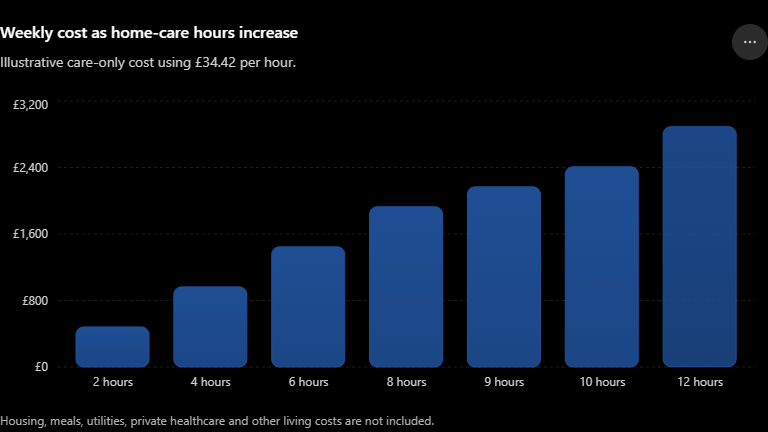
Accommodation, meals, utilities, laundry, activities, transport,
private medical support and other living costs are not included.
View the weekly cost figures as an accessible table
| Paid care each day | Weekly hours | Weekly care-only cost | Annual care-only cost |
|---|---|---|---|
| 2 hours | 14 hours | £482 | £25,058 |
| 4 hours | 28 hours | £964 | £50,116 |
| 6 hours | 42 hours | £1,446 | £75,173 |
| 8 hours | 56 hours | £1,928 | £100,231 |
| 9 hours | 63 hours | £2,168 | £112,760 |
| 10 hours | 70 hours | £2,409 | £125,289 |
| 12 hours | 84 hours | £2,891 | £150,347 |
Projected care at home costs from 2026 to 2036
Nobody can predict future care prices precisely. These lines show
illustrative planning scenarios using annual increases of 3%, 4%
and 5%. They do not represent Esmere Gardens fees or a promise about
the future charges of any provider.
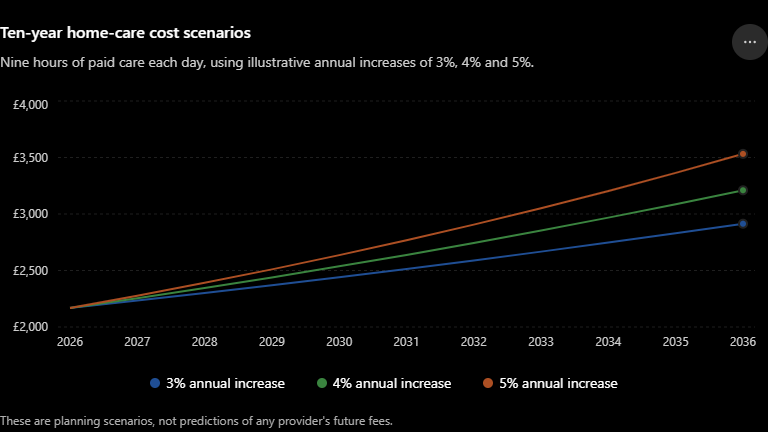
day. The graph assumes annual increases of 3%, 4% and 5%. These
scenarios are not predictions of Esmere Gardens fees or another
provider’s future charges.
View the ten-year cost scenarios as an accessible table
| Year | 3% annual scenario | 4% annual scenario | 5% annual scenario |
|---|---|---|---|
| 2026 | £2,168 | £2,168 | £2,168 |
| 2027 | £2,234 | £2,255 | £2,277 |
| 2028 | £2,301 | £2,345 | £2,391 |
| 2029 | £2,370 | £2,439 | £2,510 |
| 2030 | £2,441 | £2,537 | £2,636 |
| 2031 | £2,514 | £2,638 | £2,768 |
| 2032 | £2,589 | £2,744 | £2,906 |
| 2033 | £2,667 | £2,854 | £3,051 |
| 2034 | £2,747 | £2,968 | £3,204 |
| 2035 | £2,829 | £3,086 | £3,364 |
| 2036 | £2,914 | £3,210 | £3,532 |
The care invoice is only one part of remaining at home
Care at home can be the right choice when someone remains relatively
independent and only needs limited assistance.
However, the hourly invoice does not normally replace the cost of
running the home or arranging other services.
Possible care-agency additions
- Minimum visit lengths
- Evening and weekend premiums
- Bank-holiday charges
- Waking-night or sleeping-night support
- A second carer for safe transfers
- Travel or mileage costs
- Hospital and appointment accompaniment
- Short-notice cancellation charges
- Annual price increases
Household costs that continue
- Mortgage, rent or property costs
- Heating, electricity and water
- Food, snacks and drinks
- Cleaning and laundry
- Gardening and property maintenance
- Security systems and equipment
- Transport and taxis
- Family time spent coordinating services
- Private appointments and medical services
There is also an emotional cost that does not appear on an invoice.
Relatives may spend each day checking cameras, arranging rotas,
preparing meals, managing medication and worrying about what will happen
between visits.
Good value is not simply spending the smallest amount. It is receiving
the right level of care while reducing risk, uncertainty and pressure
across the family.

everyday things that make life comfortable and meaningful: good food,
refreshments, companionship, housekeeping, activities and a welcoming
place to call home.
Is live-in care the same as continuous 24-hour support?
Live-in care can be a valuable option, particularly when someone wants
to remain in familiar surroundings. However, a live-in arrangement is
not automatically the same as having an awake carer continuously
available throughout every hour of the day and night.
Before comparing a live-in quotation with a nursing-home package,
families should confirm:
- How many active care hours are included?
- What breaks and rest periods must the carer receive?
- Who provides cover during those breaks?
- How are waking nights charged?
- What happens after repeated night-time disturbances?
- Is a second carer needed for transfers?
- Who pays for the carer’s meals and accommodation?
- Are registered nursing services included?
- Are private GP appointments included?
- Who organises transport and appointment escorts?
Important comparison:
a weekly live-in care quotation may still sit alongside food, energy,
property maintenance, insurance, equipment, additional night cover and
private medical costs. Ask for every likely cost in writing.
What do private health care costs cover?
The phrase private health care costs can refer to
private GP appointments, diagnostic testing, consultations, treatment
or medical insurance.
These services are different from social care. Social care supports
everyday life, including washing, dressing, eating, drinking, mobility,
medication routines, safety, supervision and companionship.
Private medical insurance does not automatically provide long-term
personal care, accommodation or continuous nursing support. Policy
terms and exclusions should be checked carefully.

Private GP support is included at Esmere Gardens
At Esmere Gardens Nursing Home, dedicated private GP input works
alongside our registered nurses and care team.
This helps provide greater continuity, proactive review and
reassurance when a resident’s health, medication, appetite, mobility
or behaviour changes.
Private GP support is integrated into our wider all-inclusive approach
rather than routinely arriving as another separate medical invoice.
Why Esmere Gardens focuses on complete value
The right comparison is not one hourly rate against one weekly fee.
It is the total cost of keeping someone safe, comfortable, supported and
meaningfully connected.
Esmere Gardens is not positioned around a deliberately low headline
figure followed by a long list of routine additions.
Our all-inclusive approach is designed to provide clear expectations,
no unexpected routine charges within the agreed package and greater
confidence for families making a long-term decision.
Personalised care
Support shaped around assessed needs, preferences and established
routines.
24-hour reassurance
A care team is available throughout the day and night, not only
during booked visits.
Registered nurses
Nursing support for residents with ongoing, complex or changing
health needs.
Private GP support
Dedicated medical input is integrated into the wider care package.
Meals and refreshments
Meals, snacks and drinks form part of comfortable everyday life.
Laundry and housekeeping
Everyday household responsibilities are managed within the home.
Activities and trips
Meaningful experiences, social engagement and organised outings.
Appointment escorts
Practical support when a resident needs help attending an
appointment.
Care that can adapt
Residential, nursing, dementia and short-term support in one home.
Read more about
what sits behind our all-inclusive approach
and
how we explain care fees clearly
.
A fairer way to compare care options
| Need or service | Care arranged at home | Esmere Gardens approach |
|---|---|---|
| Care availability |
Usually limited to booked visits or the agreed live-in arrangement. |
A care team is present throughout the day and night. |
| Registered nursing | May require a separate community, agency or private service. | Nursing support is available within the home. |
| Private GP support | Often arranged and charged separately. | Dedicated private GP input is part of the wider package. |
| Meals and drinks | Food, shopping, preparation and monitoring remain separate. | Meals, snacks and refreshments form part of everyday care. |
| Accommodation and utilities | Housing, energy, insurance and maintenance costs continue. |
Accommodation and normal household running costs are brought into one approach. |
| Laundry and cleaning | Completed by relatives or arranged as an additional service. | Laundry and housekeeping are managed within the home. |
| Activities and companionship | May require separate clubs, transport or family organisation. |
Activities, shared spaces and companionship are part of daily life. |
| Trips and appointments | Transport and accompanying support may be charged separately. |
Organised trips and appointment escorts form part of the agreed approach. |
| Family coordination |
Relatives may coordinate agencies, appointments, food and emergencies. |
The home coordinates care and keeps families informed. |
Individual assessments and contractual terms apply. Families should
request a current written explanation of all inclusions before making a
final decision.
Sometimes the greatest value is becoming a family again
When care is fragmented, relatives often become unpaid coordinators.
They arrange rotas, chase appointments, prepare meals, monitor
medication, manage the home and worry about the hours when nobody is
there.
The right care home can change that relationship.
A daughter can visit as a daughter. A husband can spend time with his
wife without carrying every practical responsibility. Grandchildren can
enjoy a conversation rather than arriving with a list of jobs.
That is part of the value Esmere Gardens provides: professional care for
the resident, with greater certainty and breathing space for the people
who love them.
Discover
what everyday life at Esmere Gardens can feel like
.
How might care costs change over the next ten years?
Nobody can predict the exact future price of care. Staffing, wage
requirements, regulation, food, energy, insurance and individual
clinical needs can all affect costs.
The Office for National Statistics reported annual CPI inflation of
2.8% in May 2026. Care is labour intensive, so its costs may rise at a
different rate from general consumer inflation.
The graph therefore uses 3%, 4% and 5% annual increases as planning
scenarios rather than forecasts. Families can
review the official inflation release
.
The projection also assumes the person continues to need exactly nine
hours of paid assistance each day. In reality, mobility, memory or
clinical needs may change, increasing the number of hours or carers
required.
Care that can adapt without another disruptive move
Esmere Gardens provides several levels of support within the same
Moreton-in-Marsh home. Subject to assessment, this can offer valuable
continuity if someone’s needs increase.
Residential care
Daily support, personal care, meals, medication assistance,
companionship and round-the-clock reassurance.
Nursing care
Registered nursing oversight for people with ongoing, complex or
changing healthcare needs.
Dementia care
Calm routines, thoughtful communication, meaningful engagement and
support shaped around the individual.
Respite care
Short-term reassurance for recovery, family-carer breaks, trial
stays or urgent circumstances.
Questions to ask before agreeing to any care package
Ask each provider the same questions and request written answers. This
makes quotations easier to compare and reduces the risk of unexpected
charges later.
-
What is included in the regular fee?
Ask specifically about meals, snacks, laundry, utilities, activities,
transport, nursing, medical support and personal-care items. -
Which services are charged separately?
Request a complete current price list rather than accepting a general
statement that extras may apply. -
How many active care hours are provided?
This is especially important when comparing visiting care and live-in
arrangements. -
What happens during the night?
Ask who responds, how quickly help is available and whether waking
support creates another charge. -
What happens if two carers become necessary?
Mobility and transfer needs can change, significantly affecting the
cost of remaining at home. -
How are increasing needs reviewed?
Ask who completes the review, how fees may change and how much notice
the family receives. -
Are clinical services included?
Confirm whether nurses, private GP appointments, medication reviews
and appointment escorts form part of the package. -
What happens during a hospital stay?
Check whether the room or care package remains chargeable and for how
long. -
How are annual increases calculated?
Ask when reviews occur and how changes will be explained. -
Can all promises be included in the agreement?
A trustworthy provider should provide clear written information before
admission.
Value also depends on the quality of care
Cost matters, but it should never be separated from safety, leadership,
staffing and the experience of residents.
Esmere Gardens is currently rated Good overall by the
Care Quality Commission, with Good ratings for safe, effective, caring,
responsive and well-led.
Families can
check the latest independent assessment
.
All-inclusive care in Moreton-in-Marsh and the Cotswolds
Esmere Gardens Nursing Home is located on Stow Road in
Moreton-in-Marsh, Gloucestershire.
Our North Cotswolds location is accessible for families travelling from
nearby towns and villages, helping relatives remain involved in everyday
life.
- Moreton-in-Marsh
- Stow-on-the-Wold
- Chipping Campden
- Blockley
- Broadway
- Bourton-on-the-Water
- Bourton-on-the-Hill
- Evesham
- Shipston-on-Stour
- North Gloucestershire
- South Warwickshire
- Worcestershire
Esmere Gardens Nursing Home
Stow Road, Moreton-in-Marsh, Gloucestershire, GL56 0DS
Telephone: 01608 692222
Frequently asked questions about care costs and all-inclusive care
These direct answers address the questions families commonly ask when
comparing home care, live-in support, residential care and nursing care.
Care at home costs
How much does care at home cost in the UK?
Privately arranged support commonly costs approximately £26 to £38
per hour. The amount depends on location, visit length, time of day,
care complexity and whether one or two carers are required.
What affects the cost of care at home?
Costs are affected by the number and length of visits, night support,
weekends, bank holidays, travel, medication needs, clinical
complexity and whether two carers are needed for safe transfers.
How much would two hours of care at home cost each day?
At £34.42 per hour, two hours every day would cost approximately £482
per week or £25,058 per year. Housing, meals, utilities, cleaning and
other living costs remain separate.
How much would four hours of home care cost each day?
Four hours every day would cost approximately £964 per week at
£34.42 per hour. This provides 28 paid hours each week but leaves
twenty hours of every day without scheduled support.
How much would eight hours of home care cost each day?
Eight hours every day would cost approximately £1,928 per week at
£34.42 per hour. Accommodation, meals, bills, laundry, transport,
activities and private medical services remain additional.
How much would nine hours of home care cost each day?
Nine hours every day would cost approximately £2,168 per week or
£112,760 per year at £34.42 per hour. This is a care-only cost and
leaves fifteen hours each day without booked support.
Does visiting home care provide 24-hour support?
No. Visiting home care provides assistance during booked visits.
Continuous support requires additional daytime, live-in or overnight
arrangements, which can significantly increase the total cost.
What household costs continue with care at home?
Mortgage or rent, utilities, food, cleaning, laundry, maintenance,
gardening, insurance, transport, security, equipment and property
adaptations may continue alongside the care invoice.
Live-in care
Is live-in care the same as an awake carer 24 hours a day?
No. Live-in carers require breaks and uninterrupted rest. Repeated
waking-night needs, replacement cover or two-person assistance may
require additional carers and separate charges.
Is live-in care cheaper than a care home?
It can be suitable and cost-effective for some people, but families
must also account for housing, energy, food, maintenance, equipment,
night cover, nursing and medical services before comparing value.
What is normally not included in a live-in care quote?
Arrangements vary, but housing costs, household bills, food,
property maintenance, carer breaks, repeated waking nights,
registered nursing, private GP services and appointment transport
may remain separate.
When might two home carers be required?
Two carers may be needed for certain transfers, repositioning,
personal-care tasks or mobility support. This can substantially
increase the hourly and weekly cost of remaining at home.
Comparing home care and care homes
How should I compare home care with a care-home fee?
Compare the complete cost and level of support. Include paid hours,
night care, housing, meals, bills, cleaning, laundry, activities,
transport, medical support and the time contributed by relatives.
When might a care home offer better overall value?
A care home may offer stronger value when someone needs several
daily visits, night reassurance, nursing oversight, support with
food and medication or regular supervision to remain safe.
Is the lowest advertised care-home fee always best value?
No. A lower starting fee can become more expensive if nursing,
increased support, meals, activities, laundry, transport, escorts or
medical services are charged separately.
What hidden care-home costs should families ask about?
Ask about deposits, administration fees, premium rooms, increased
care needs, one-to-one support, transport, appointment escorts,
activities, laundry, toiletries, hospital absences, annual increases
and notice periods.
How can I avoid unexpected care charges?
Request a written quotation and complete list of inclusions. Ask for
examples of circumstances that could change the fee and ensure
verbal promises are reflected in the agreement.
What should I ask before signing a care-home contract?
Ask about the total fee, all inclusions, possible additions, annual
reviews, hospital absences, increasing needs, notice periods and
arrangements following a resident’s death.
Can care-home fees increase each year?
Providers may review fees to reflect staffing, inflation and
operating costs. The contract should explain when reviews occur, how
changes are calculated and how much notice families receive.
All-inclusive care at Esmere Gardens
What does all-inclusive care mean?
All-inclusive care brings agreed accommodation, care and everyday
services into one clearer fee. Families should still receive a
written list explaining precisely what sits within the package.
What is included at Esmere Gardens Nursing Home?
Esmere Gardens brings accommodation, personalised care, registered
nursing, meals, drinks, laundry, utilities, activities, organised
trips, appointment escorts and dedicated private GP support into its
wider all-inclusive approach.
Does all-inclusive mean there can never be an extra charge?
The aim is to remove unexpected routine charges within the agreed
package. An exceptional third-party service or item outside the
agreement should be explained before a charge is made.
Does Esmere Gardens include private GP support?
Yes. Dedicated private GP input works alongside the nursing and care
teams, helping provide continuity and reassurance when a resident’s
health, medication or needs change.
Does Esmere Gardens provide 24-hour nursing care?
Esmere Gardens provides registered nursing support around the clock
for residents with ongoing, complex or changing healthcare needs.
Are meals, snacks and drinks included?
Meals, snacks and refreshments form part of daily life at Esmere
Gardens. Dietary preferences, nutritional needs and suitable support
with eating and drinking are considered within the care plan.
Are activities and organised trips included?
Meaningful activities, social engagement and organised trips form
part of the wider all-inclusive approach, helping residents maintain
their interests and community connections.
Are residents escorted to appointments?
Appointment escorts form part of the Esmere Gardens approach where
suitable arrangements are required, reducing practical pressure on
residents and their families.
Changing care needs
Can Esmere Gardens support someone if their needs increase?
Esmere Gardens provides residential, nursing, dementia and respite
care within the same home. Subject to assessment, this can provide
continuity as a resident’s needs develop.
Does Esmere Gardens provide dementia care?
Yes. Dementia support is shaped around the individual’s routines,
communication, preferences, safety and emotional wellbeing.
Can a respite stay become a permanent placement?
It may be possible for a temporary stay to become permanent, subject
to assessment, suitability and room availability. A short stay can
also help a family experience the home before deciding.
What happens if someone needs nursing care later?
Because Esmere Gardens provides residential and nursing support
within the same home, an updated assessment may allow the care plan
to change without the resident needing another disruptive move.
Help with paying for care
Can the local council help with care costs?
A local authority may contribute following a care-needs assessment
and financial assessment. The amount depends on eligible needs,
savings, income and local funding arrangements.
What is NHS Continuing Healthcare?
NHS Continuing Healthcare is NHS-funded support for adults whose
primary need is assessed as a health need. Eligibility depends on
the nature, complexity, intensity and unpredictability of needs.
What is NHS-funded nursing care?
NHS-funded nursing care is a contribution paid by the NHS towards
registered nursing supplied within an eligible nursing home. It is
different from full NHS Continuing Healthcare funding.
Do I always have to sell my home to pay for care?
Not necessarily. The answer depends on the type of care, financial
circumstances, property ownership, other residents in the property
and eligibility for support. Specialist financial advice may be
appropriate.
Visiting Esmere Gardens
Where is Esmere Gardens Nursing Home?
Esmere Gardens is on Stow Road in Moreton-in-Marsh,
Gloucestershire, in the heart of the North Cotswolds.
Which local areas are close to Esmere Gardens?
Esmere Gardens is convenient for families travelling from
Stow-on-the-Wold, Chipping Campden, Blockley, Broadway,
Bourton-on-the-Water, Evesham, Shipston-on-Stour and surrounding
Gloucestershire, Warwickshire and Worcestershire communities.
Is Esmere Gardens rated Good by the CQC?
Yes. Esmere Gardens is currently rated Good overall, with Good
ratings for safe, effective, caring, responsive and well-led.
How do I arrange a care assessment or visit?
Contact Esmere Gardens to discuss the person’s circumstances and
arrange a visit. The team can explain the assessment, care options,
availability and inclusions before any decision is made.
Contact the Esmere Gardens team
.
One clear package. Complete care. Greater peace of mind.
You should not need a spreadsheet of hourly visits, household bills,
meals, laundry, activities, transport and private appointments to
understand whether someone you love will be safe.
At Esmere Gardens, our all-inclusive approach brings personalised care,
24-hour reassurance, registered nurses, everyday living and dedicated
private GP support together in one trusted Cotswold home.
Not simply a room. Not simply a weekly fee. Complete long-term value
for the resident and their family.
Calculations are illustrative and based on publicly available UK
guidance reviewed in July 2026. They are not quotations or predictions
of fees from Esmere Gardens or another provider. Individual costs depend
on assessed needs, availability, contractual terms and future economic
conditions. This article provides general information rather than
personalised legal or financial advice.

Inside the new model: continuous in-house medical teams cutting hospital visits for older residents
Can a Care Home with Private GP Support Help Reduce Avoidable Hospital Visits?
“Will Mum end up in A&E again if we choose a care home?”
It is one of the most important questions families ask when arranging care for an older relative, particularly when that person is living with frailty, dementia or several long-term health conditions.
The honest answer is that no care home can prevent every hospital admission. Sometimes emergency hospital treatment is necessary and should never be delayed.
However, a care home with 24-hour nursing oversight, prompt access to a GP and a team who knows the resident well may be better placed to notice changes early, seek medical advice and begin appropriate treatment before a situation becomes a crisis.
NHS England’s Enhanced Health in Care Homes framework supports this proactive, coordinated approach to improving health outcomes for people living in care homes. Research has also found associations between care from clinicians who specialise in nursing-home residents and fewer hospital or emergency-department visits.
At Esmere Gardens Nursing Home in Moreton-in-Marsh, residents benefit from 24-hour nursing support and dedicated onsite private GP support as part of our all-inclusive approach. The aim is simple: to provide earlier attention, clearer clinical oversight and greater reassurance for residents and their families.
The simple answer
A care home may help reduce avoidable hospital visits when it can:
- recognise early signs that someone is becoming unwell;
- arrange prompt clinical assessment;
- monitor changes closely;
- review medicines and possible side effects;
- manage appropriate conditions safely within the home;
- communicate clearly with relatives and healthcare professionals; and
- escalate to hospital quickly when hospital treatment is genuinely needed.
The important difference is not simply whether a care home can call a doctor. It is whether nurses, carers and medical professionals work together consistently around the resident.
Why older people are sometimes transferred to hospital
Older people living with frailty may become unwell quickly. A relatively small change, such as reduced fluid intake, constipation, pain, a suspected infection or a change in medication, can sometimes lead to a noticeable decline.
Early warning signs may include:
- increased confusion or unusual behaviour;
- reduced appetite or fluid intake;
- changes in mobility or balance;
- increased sleepiness;
- a new cough or breathing difficulty;
- changes in continence;
- unexplained pain; or
- a resident appearing generally less well than usual.
These signs can be subtle. They are often easier to recognise when residents are supported by a familiar team who understands their normal routines, communication and behaviour.
At Esmere Gardens, our approach to nursing care in Moreton-in-Marsh includes regular monitoring, personalised care planning and 24-hour professional nursing support. This allows changes to be identified, recorded and acted upon appropriately.
What does clinical continuity mean in a care home?
Clinical continuity means that healthcare is not treated as a series of isolated appointments.
Instead, the people supporting a resident understand:
- their medical history;
- current medication;
- known health risks;
- usual behaviour and communication;
- personal wishes;
- agreed care plans; and
- what matters to the resident and their family.
This familiarity can make clinical conversations more informed. Rather than beginning from scratch each time something changes, the team can provide meaningful observations and relevant background information.
NHS England describes enhanced care-home support as a partnership between care homes, primary care, community health services and other professionals, with the intention of delivering more proactive, personalised and coordinated care.
How can quicker clinical support make a difference?
When a health concern is recognised early, the nursing and medical team may be able to assess the resident, review possible causes and agree an appropriate plan.
Depending on the person’s needs, this could involve:
- increasing observation and monitoring;
- reviewing hydration or nutrition;
- checking for signs of infection;
- reviewing pain management;
- discussing medication concerns;
- contacting the GP or another healthcare professional;
- updating the resident’s care plan; or
- arranging an urgent hospital assessment.
Early intervention does not mean avoiding hospital at all costs. It means making a more informed decision about the safest and most appropriate place for the resident to receive care.
This is particularly important for families who have previously experienced repeated ambulance call-outs or hospital admissions and want to know that a change in their relative’s health will be noticed promptly.
Why hospital visits can be particularly difficult for someone with dementia
An emergency department can be busy, unfamiliar and disorientating. For someone living with dementia, changes in environment, routine and familiar faces may increase distress or confusion.
Research has found that people living with dementia can experience poorer outcomes following emergency hospital admission, including longer hospital stays and greater risks of readmission or other complications.
This does not mean someone with dementia should not go to hospital when it is medically necessary. It means that unnecessary transfers should be avoided where a condition can be assessed and managed safely within the care home.
A 2025 US cohort study involving more than 417,000 long-stay nursing-home residents with dementia found that care from clinicians who primarily practised in nursing homes was associated with approximately 7% lower odds of hospitalisation and 7% lower odds of an emergency visit for certain potentially manageable conditions. Because this was an observational US study, it does not prove that the same result will occur in every UK care home, but it supports the wider principle of familiar, care-home-focused clinical support.
At Esmere Gardens, our specialist dementia care combines calm routines, personalised support, 24-hour nursing and dedicated onsite private GP input. Residents are supported as individuals, with care shaped around their life story, communication, preferences and changing health needs.
What private GP support means at Esmere Gardens
At Esmere Gardens, dedicated onsite private GP support is included within our all-inclusive care approach.
For residents and families, this provides:
- greater familiarity with the resident’s medical history;
- prompt attention when concerns arise;
- clinical input alongside our nursing team;
- support with health reviews and changing needs;
- clearer communication and decision-making; and
- additional reassurance for families.
It does not replace emergency hospital care where that is required. Instead, it strengthens the clinical support available within the home and helps the team make informed decisions about monitoring, treatment and escalation.
You can read more in our guide to care homes with private GP support.
A care home should support the whole person, not only respond to illness
Avoiding unnecessary hospital visits is important, but good care involves much more than medical intervention.
A resident’s overall wellbeing can also be supported through:
- nutritious meals and regular hydration;
- safe movement and mobility support;
- meaningful activities;
- companionship and social connection;
- familiar daily routines;
- comfortable surroundings;
- medication support;
- personalised care planning; and
- regular communication with relatives.
At Esmere Gardens, residents can access residential care, nursing care, dementia care and short-term respite care within one home. This means care can adapt as someone’s needs change, helping to reduce unnecessary disruption.
Our all-inclusive care package is designed to give families greater clarity about what is included, while allowing them to focus on their loved one’s comfort, safety and quality of life.
What should families ask when comparing care homes?
Families should look beyond bedrooms, décor and facilities. Those things matter, but it is equally important to understand what happens when a resident becomes unwell.
Ask each care home:
- Are registered nurses available 24 hours a day?
- How quickly can a resident receive GP input?
- Does the GP visit the home or provide remote support?
- How are changes in a resident’s health recognised and recorded?
- What happens during evenings, weekends and bank holidays?
- How are relatives informed when someone becomes unwell?
- How are medication concerns reviewed?
- How does the home decide when hospital treatment is necessary?
- Can the home continue supporting the resident if their needs increase?
- Are there additional charges for GP or clinical services?
Our complete guide explains what to ask when choosing a care home.
Why families choose Esmere Gardens
Esmere Gardens is a family-led care home and nursing home in Moreton-in-Marsh, supporting families across Gloucestershire and the Cotswolds, including Stow-on-the-Wold, Chipping Campden, Broadway, Blockley, Bourton-on-the-Water and Evesham.
Families choose Esmere Gardens for:
- 24-hour nursing support;
- dedicated onsite private GP support;
- residential, nursing, dementia and respite care;
- personalised care that can adapt as needs change;
- clear, all-inclusive fees;
- comfortable, purpose-designed surroundings;
- meaningful activities and community connections; and
- open communication with families.
Esmere Gardens is currently rated Good by the Care Quality Commission across all five assessment areas. It also has a current carehome.co.uk review score of 9.9 out of 10, based on independently submitted reviews.
Explore life at Esmere Gardens or view our care-home photo gallery to get a clearer feeling for the home.
A calmer and more informed approach to care
Choosing a care home is not about trying to eliminate every risk. It is about choosing a team that can recognise risks, respond appropriately and keep your loved one’s comfort, dignity and safety at the centre of each decision.
With consistent nursing oversight, familiar carers and prompt GP support, some conditions may be identified and managed earlier. When hospital treatment is required, the resident can be escalated appropriately with clearer information about their needs and medical history.
At Esmere Gardens, our aim is to give families confidence that their loved one is known, monitored and properly supported—not only when something goes wrong, but every day.
Speak to our care team on 01608 692222 to discuss residential, nursing, dementia or respite care in Moreton-in-Marsh. You can also arrange a personal visit to meet the team and ask questions about our onsite private GP and all-inclusive care.
Frequently Asked Questions
Can a care home prevent hospital admissions?
No care home can guarantee that a resident will never need hospital treatment. However, 24-hour nursing oversight, early recognition of illness and prompt access to medical advice may help some health concerns be managed before they become emergencies.
Does Esmere Gardens have an onsite GP?
Yes. Esmere Gardens provides dedicated onsite private GP support as part of its all-inclusive approach, alongside 24-hour nursing care. This provides added continuity and reassurance when health concerns arise.
Is private GP support included in the care-home fee?
Dedicated private GP support is included within Esmere Gardens’ all-inclusive care approach. Families should speak directly with the home for a current and personalised explanation of fees and everything included within the package.
You can also read our guide to all-inclusive care-home fees.
What happens if a resident becomes unwell at night?
Esmere Gardens provides 24-hour nursing support. The nursing team can assess the resident, monitor their condition, follow appropriate clinical procedures and arrange further medical or emergency assistance when necessary.
Is hospital always avoided when someone has dementia?
No. Hospital care is sometimes necessary and can be lifesaving. The aim is not to avoid appropriate hospital treatment, but to prevent unnecessary transfers where a condition can be assessed and managed safely within the home.
Can Esmere Gardens support someone after hospital discharge?
Subject to assessment and availability, Esmere Gardens may provide nursing, residential or respite care after a hospital stay. Support can include personalised care planning, medication assistance, mobility support, nutrition, hydration and ongoing monitoring.
Families needing care at short notice can read about urgent care-home admissions in Gloucestershire.
Can someone stay at Esmere Gardens temporarily?
Yes. Respite care is available for temporary support, recovery following illness or hospital treatment, family carer breaks and trial stays. Every placement is subject to an assessment of the individual’s needs and current availability.
How can I arrange a visit?
Call Esmere Gardens on 01608 692222 to discuss your relative’s needs and arrange a personal tour. During the visit, you can meet the team, see the home and ask detailed questions about nursing care, private GP support, fees and availability.
This article provides general information and should not replace medical advice. In an emergency, call 999 or follow the advice of the resident’s healthcare professionals.

How to Choose the Best Care Home Near Moreton-in-Marsh: Reviews, Fees, CQC Ratings and What’s Included
How to Choose the Best Care Home Near Moreton-in-Marsh: Reviews, Fees, CQC Ratings and What’s Included
Choosing a care home near Moreton-in-Marsh is not just a practical decision. It is an emotional one.
For many families, the search begins with worry. A parent may be struggling at home. A loved one may have had a fall. Dementia may be making daily life less safe. A hospital stay may have changed what support is now needed. Or you may simply feel that someone you love needs more care, more company and more reassurance than family can safely provide alone.
At that point, most families start looking online for things like care home near me, nursing home Moreton-in-Marsh, dementia care in the Cotswolds, care home reviews or care home fees in Gloucestershire.
But choosing the right care home is not about finding the lowest price or the grandest building. It is about understanding the full value of what is being offered.
Real value in care means safety, dignity, clear fees, good communication, trusted support, strong reviews, clinical reassurance and peace of mind for the whole family.
At Esmere Gardens Nursing Home in Moreton-in-Marsh, we support families across the North Cotswolds with residential care, nursing care, dementia care and respite care, with an all-inclusive care package designed to give families fewer surprises and greater peace of mind.
Start by asking what type of care is actually needed
Before comparing care homes, it helps to understand what kind of care your loved one may need.
Not every care home provides the same level of support. Some homes offer residential care only. Others provide nursing care, dementia care or respite care as well.
The main types of care are:
- Residential care — support with daily life, personal care, meals, medication, safety, routine and companionship.
- Nursing care — residential-style care with additional support from qualified nurses for people with more complex health needs.
- Dementia care — calm, person-centred support for people living with memory loss, confusion or dementia-related changes.
- Respite care — short-term care for recovery, family support, trial stays, holidays or temporary care needs.
If you are unsure where to start, read our guide: What is a care home? Residential, nursing, dementia and respite care explained.
One of the advantages of choosing Esmere Gardens care services is that families can explore residential, nursing, dementia and respite care in one place. This can be reassuring when someone’s needs may change over time.
Check the CQC rating, but do not stop there
The Care Quality Commission, often called the CQC, regulates and inspects care homes in England.
A CQC rating is an important starting point because it gives families an independent view of how a care home is performing. The four main CQC ratings are:
- Outstanding — the service is performing exceptionally well.
- Good — the service is performing well and meeting expectations.
- Requires Improvement — the service is not performing as well as it should.
- Inadequate — the service is performing badly and action has been taken.
Esmere Gardens is rated Good by the CQC. You can view the latest CQC profile for Esmere Gardens Nursing Home.
A CQC rating matters, but it should not be the only thing you consider. Families should also read the latest report, visit the home, speak to the manager, review family feedback and ask how the home responds when needs change.
For a more personal view of the home, you can also read about Esmere Gardens and our approach to care.
Read care home reviews properly
Reviews can tell you things that brochures cannot.
A review score is useful, but the words inside the reviews often matter more. Families should look for signs of kindness, communication, dignity, safety, food quality, cleanliness, activities and reassurance.
When reading care home reviews, ask:
- Are the reviews recent?
- Are there enough reviews to show consistency?
- Do families mention kindness and communication?
- Do reviews talk about safety and dignity?
- Are food, activities and daily life mentioned?
- Do families say they feel reassured?
- Are there reviews from sons, daughters, spouses or residents?
The most powerful reviews are often the ones that describe small moments of care: staff noticing a change, helping someone settle, remembering preferences, supporting families through difficult decisions, or making daily life feel more personal.
You can read independent family feedback on the Esmere Gardens carehome.co.uk profile.
Compare care home fees carefully
Care home fees matter, but the weekly price alone does not tell the full story.
When families compare care homes near Moreton-in-Marsh, Stow-on-the-Wold, Chipping Campden, Broadway, Blockley, Bourton-on-the-Water, Evesham or the wider Cotswolds, they may see very different weekly fees.
It is natural to start with price. But in care, the cheapest option is not always the best value.
A lower weekly fee may look attractive at first, but families should always ask what is included and what may cost extra. Some homes may charge separately for certain services, activities, transport, appointments, hairdressing, wellbeing extras or additional support.
When comparing care home fees, ask:
- What is included in the weekly fee?
- What is charged separately?
- Are meals, snacks and drinks included?
- Are activities and wellbeing support included?
- Is laundry included?
- Are communal facilities included?
- Is nursing care available if needs change?
- Is GP support included?
- How often are fees reviewed?
- Will the home provide a clear written fee breakdown?
For more guidance, read our page on paying for care at Esmere Gardens.
Understand what all-inclusive care really means
The phrase all-inclusive care should mean more than a nice promise.
For families, all-inclusive care should make things clearer. It should reduce uncertainty, limit unexpected extras and help everyone understand what is being paid for from the start.
At Esmere Gardens, our all-inclusive care package is designed to give families greater confidence and fewer surprises.
That matters because families do not only need a room. They need reassurance that daily life, care, comfort, health and communication are being properly supported.
Value is not just the price you pay. Value is what that price protects.
It protects safety. It protects dignity. It protects routine. It protects health. It protects family peace of mind.
Ask what happens if care needs change
One of the most important questions to ask any care home is:
What happens if my loved one’s needs increase?
This is especially important if someone is becoming frailer, living with dementia, recovering from illness, struggling with mobility or beginning to need more clinical support.
Ask the home:
- Can you support residential care and nursing care?
- Can you support dementia care?
- Can you support respite stays?
- What happens if mobility declines?
- How often are care plans reviewed?
- How do you manage medication?
- How do you communicate changes to families?
- How do you identify early signs of illness or decline?
- Do qualified nurses support residents 24 hours a day?
A care home that can support changing needs can give families greater reassurance. It may reduce the worry of having to move again if care becomes more complex.
At Esmere Gardens, families can explore residential care, nursing care, dementia care and respite care within one home.
Look for clinical reassurance, not just comfort
A comfortable room matters. Good food matters. Activities matter. But clinical reassurance matters too.
In later life, small changes can sometimes be important. A change in appetite, sleep, confusion, mood, skin condition, mobility or energy may need attention.
This is why families should ask how health concerns are noticed, reviewed and communicated.
Private GP access can add another layer of reassurance in a care home.
It can support:
- Earlier conversations about health concerns
- More familiar clinical oversight
- Continuity for residents and families
- Regular review where appropriate
- Clearer communication around medical concerns
- Greater peace of mind for relatives
Private GP support does not replace emergency care or NHS services, but it can help create a stronger sense of continuity and confidence.
At Esmere Gardens, dedicated onsite/private GP support is part of our wider all-inclusive approach. You can read more about onsite private GP support at Esmere Gardens.
Think about daily life, not just care needs
A good care home should support more than physical care. It should support the whole person.
Daily life matters. Meals matter. Conversation matters. Fresh air matters. Choice matters. Activities matter. Family visits matter. Familiar routines matter.
When visiting a care home, ask yourself:
- Does the home feel calm and welcoming?
- Are staff visible and approachable?
- Do residents look comfortable?
- Are communal spaces being used?
- Is there a choice of places to sit, eat and relax?
- Are activities meaningful?
- Does the home feel safe without feeling clinical?
- Are families welcomed warmly?
At Esmere Gardens, daily life is part of the value. Residents can enjoy comfortable spaces, social opportunities, activities and facilities designed to make life feel supported, engaging and reassuring. You can learn more about life at Esmere Gardens.
Check how families are kept informed
Good care is not only about the resident. It is also about families feeling informed, included and reassured.
When choosing a care home, ask how communication works.
Good questions include:
- Who will be my main point of contact?
- How often will care plans be reviewed?
- How will you let us know if something changes?
- Can families speak to senior staff when needed?
- How do you handle concerns or complaints?
- How do you involve families in care decisions?
For many relatives, peace of mind comes from knowing they will not be left chasing answers.
A good care home should make families feel supported too.
Use this care home visit checklist
Before visiting a care home, it helps to write down your questions.
Here is a simple checklist to take with you:
- Care: What type of care do you provide?
- Nursing: Are nurses available 24 hours a day?
- Dementia: How do you support people living with dementia?
- Fees: What is included and what costs extra?
- Reviews: Can I read recent family reviews?
- CQC: What is your latest CQC rating?
- Health: How are GP appointments and health concerns managed?
- Food: What meals are offered and can preferences be supported?
- Activities: What does daily life look like?
- Family: How do you keep relatives updated?
- Changing needs: What happens if care needs increase?
- Feeling: Does the home feel calm, kind and safe?
The right home should welcome these questions. You should never feel rushed or made to feel awkward for asking them.
Why the cheapest care home may not be the best value
There is a difference between price and value.
Price is the weekly fee.
Value is what that fee gives back.
In care, value can mean:
- Fewer unexpected extras
- Clearer financial planning
- Better continuity of care
- Nursing support when needed
- Dementia support where appropriate
- Private GP access for added reassurance
- Good food, activities and daily comfort
- Family communication
- A safer environment
- Confidence that your loved one is known and cared for
That is why care should not be judged by the room alone. It should be judged by the care, reassurance and quality of life around that room.
The real return on investment is peace of mind.
It is knowing your loved one is supported. It is knowing there is a team around them. It is knowing that health, dignity, comfort and companionship are being protected every day.
Why families compare Esmere Gardens differently
When families compare care homes, it is easy to start with the weekly fee. But Esmere Gardens is best understood as a value-led choice, not simply a room-led choice.
Our all-inclusive approach brings together care, comfort, nursing support, dementia care, respite care, daily wellbeing and dedicated onsite/private GP support.
This gives families a clearer picture of what they are paying for and what their loved one receives in return.
For many families, that value is not only financial. It is emotional. It is the confidence of knowing someone is safe, supported, known and cared for every day.
If you are comparing care homes in Moreton-in-Marsh, Stow-on-the-Wold, Chipping Campden, Broadway, Blockley, Bourton-on-the-Water, Evesham or the wider Cotswolds, Esmere Gardens offers a clear and reassuring choice.
Why Esmere Gardens is a strong-value care home in the North Cotswolds
Esmere Gardens brings together many of the things families are told to look for when choosing a care home:
- Residential care for daily support, comfort and companionship
- Nursing care for more complex health needs
- Dementia care for calm, person-centred support
- Respite care for short-term stays, recovery or family support
- All-inclusive care for clearer expectations and fewer surprises
- Dedicated onsite/private GP support for added peace of mind
- Comfortable facilities and meaningful daily life
- A calm, trusted care home in Moreton-in-Marsh
The value is not only in what is included. It is in the reassurance families feel when care is clearer, health support is closer and everyday life continues with dignity.
Choosing care is never just a financial decision. It is a decision about safety, comfort, health, confidence and trust.
At Esmere Gardens, our aim is to make that decision feel less overwhelming and more human.
If you are looking for a care home or nursing home near Moreton-in-Marsh, we would be happy to talk through your options and help you understand the right next step.
Contact Esmere Gardens to speak with our team or arrange a visit.
Frequently Asked Questions
How do I choose the best care home near Moreton-in-Marsh?
Start by understanding the type of care your loved one needs. Then compare the home’s CQC rating, recent reviews, fees, what is included, whether nursing care is available, how dementia is supported and how the home feels when you visit. You can also explore Esmere Gardens care services to understand the different types of support available.
What should I look for when visiting a care home?
Look for kindness, cleanliness, calm surroundings, visible staff, comfortable residents, clear answers, good food, meaningful activities and a manager who takes time to understand your concerns. You may also want to look at life at Esmere Gardens to see how daily life is supported.
Should I check the CQC rating?
Yes. The CQC rating is an important independent indicator of quality. Families should also read the latest report, check how recent it is, read reviews and ask detailed questions when visiting.
Are care home reviews useful?
Yes. Reviews can help families understand what relatives and residents say about the home. Read the words inside the reviews, not just the headline score. Look for comments about care, communication, dignity, food, activities and reassurance.
What should I ask about care home fees?
Ask what is included, what costs extra, how often fees are reviewed, whether activities and laundry are included, whether nursing care is available and whether GP support is included. You can read more on our paying for care page.
What does all-inclusive care mean?
All-inclusive care means more of the everyday care, support and lifestyle services are included within one clearer fee. This can reduce uncertainty and make planning easier for families. Learn more about all-inclusive care at Esmere Gardens.
Is the cheapest care home always the best value?
No. The cheapest care home is not always the best value. Real value depends on the quality of care, what is included, how changing needs are supported and how much reassurance the family receives.
Why might a nursing home cost more than residential care?
Nursing homes usually cost more because they provide qualified nursing support for people with more complex health needs. This can include medication support, clinical monitoring, wound care, frailty support and help with changing needs. You can read more about nursing care at Esmere Gardens.
What happens if my loved one’s needs increase?
This depends on the care home. Some homes only provide residential care, while others can support residential, nursing, dementia and respite care. Esmere Gardens offers different types of care in one home, including dementia care and nursing care.
Why is private GP access useful in a care home?
Private GP access can provide added reassurance by supporting earlier conversations, continuity and more familiar clinical oversight. It does not replace emergency care or NHS services, but it can give families greater confidence. Read more about onsite private GP support at Esmere Gardens.
Can respite care help before making a permanent decision?
Yes. Respite care can be a useful way to experience a care home before making a longer-term decision. It can also support recovery after illness, give family carers a break or provide temporary support. Learn more about respite care at Esmere Gardens.
What makes Esmere Gardens different?
Esmere Gardens offers residential, nursing, dementia and respite care in Moreton-in-Marsh, with an all-inclusive approach, dedicated onsite/private GP support, comfortable facilities and a calm Cotswolds setting. The focus is on value in care, value in clarity and value in peace of mind.
Looking for a care home or nursing home near Moreton-in-Marsh? Speak to Esmere Gardens and let our team help you compare your options with clarity and confidence.

What Is a Care Home? Residential, Nursing & Dementia Care Explained
What Is a Care Home? A Simple Family Guide to Residential, Nursing, Dementia and Respite Care
Choosing a care home is rarely a simple decision.
For many families, it starts with a worry. A parent may be struggling at home. A loved one may have had a fall. Dementia may be making daily life less safe. A hospital stay may have changed what is possible. Or you may simply feel that someone you love needs more support, more company and more reassurance than family can safely provide alone.
At that point, the search can feel overwhelming.
You may find yourself asking:
- What is a care home?
- What is the difference between a care home and a nursing home?
- Is residential care enough?
- What does dementia care include?
- What is respite care?
- How do I compare prices, reviews and what is actually included?
This guide explains the main types of care in plain English, so you can make a clearer, calmer and more confident decision.
At Esmere Gardens Nursing Home in Moreton-in-Marsh, we support families across the Cotswolds with residential care, nursing care, dementia care and respite care, all within one calm, purpose-built home.
What is a care home?
A care home is a place where someone can live when they need regular support with daily life.
This may include help with washing, dressing, medication, meals, mobility, personal care, safety, companionship and general wellbeing. A good care home should provide more than practical support. It should help someone feel safe, known, respected and part of daily life.
For many older people, moving into a care home is not about giving up independence. It is about gaining the right support around them, so they can live with more comfort, confidence and dignity.
The NHS explains that care homes can provide accommodation, personal care and, in some settings, nursing care. You can read more in the NHS guide to care homes.
What is the difference between a care home and a nursing home?
The phrase care home is often used as a broad term, but not all care homes provide the same level of support.
The main difference is this:
A residential care home supports people with daily living, personal care, meals, safety and companionship.
A nursing home provides all of this, but also has qualified nursing support for people with more complex health needs.
That difference matters.
Residential care may be suitable for someone who needs help with everyday life but does not need regular nursing care. Nursing care may be more suitable for someone with changing health needs, reduced mobility, complex medication, wound care, frailty, long-term conditions or a higher level of clinical oversight.
carehome.co.uk explains that a nursing home has a qualified nurse on-site to provide medical care, while residential care homes focus on personal care and daily support. You can read their guide to the difference between a care home and a nursing home.
At Esmere Gardens, we provide both residential care and nursing care, which means families can discuss current needs and future needs in one place.
What is residential care?
Residential care is for people who need support with daily life but do not necessarily need nursing care.
This could include help with:
- Washing and dressing
- Medication support
- Meals and nutrition
- Mobility and moving safely
- Personal care
- Companionship
- Daily routine
- Activities and social life
- Safety and reassurance
Residential care can be a positive choice for someone who is becoming isolated, finding home harder to manage, or needing more support than family carers can safely provide.
For families, residential care can also bring peace of mind. It means someone is not alone at night, meals are prepared, support is available and there is a team around them every day.
At Esmere Gardens Residential Care in Moreton-in-Marsh, residents receive everyday support in a calm, comfortable and friendly setting, while still being encouraged to keep their independence wherever possible.
What is nursing care?
Nursing care is for people who need support from qualified nurses as part of their daily care.
This may be needed when someone has more complex health needs, such as:
- Frailty or reduced mobility
- Complex medication needs
- Long-term health conditions
- Recovery after illness or hospital admission
- Wound care
- Diabetes or other clinical needs
- End-of-life care
- Higher risk of falls
- Changing or unpredictable health needs
A nursing home can provide greater reassurance because clinical support is available within the home. This can be especially important when a person’s needs are likely to change over time.
At Esmere Gardens Nursing Care, residents are supported with 24-hour nursing care in a warm, calm and comfortable environment. This helps families feel more confident that health needs can be monitored, reviewed and responded to with care.
What is dementia care?
Dementia care supports people living with memory loss, confusion, communication changes and other symptoms linked to dementia.
Good dementia care should be calm, patient and person-centred. It should focus on routine, reassurance, safety, dignity and meaningful daily life.
This may include:
- Familiar routines
- Personalised care plans
- Gentle communication
- Safe surroundings
- Meaningful activities
- Support with eating and drinking
- Help with personal care
- Family involvement
- Calm reassurance during moments of confusion or distress
Dementia does not affect every person in the same way, so care should never feel one-size-fits-all. The right home should take time to understand the person, not just the diagnosis.
At Esmere Gardens Dementia Care, support is calm, inclusive and person-centred, with nursing support available where dementia is combined with frailty, mobility changes or more complex health needs.
What is respite care?
Respite care is short-term care.
It may be used for a few days, several weeks, or sometimes longer depending on the person’s needs and the home’s availability.
Families often consider respite care when:
- A family carer needs a rest
- Someone is recovering after illness or hospital treatment
- Extra support is needed temporarily
- A loved one would benefit from company and routine
- A family wants to try a care home before making a permanent decision
- Emergency support is needed at short notice
Respite care can be helpful for the person receiving care and for the family. It gives everyone time to pause, recover and understand what level of support may be needed next.
At Esmere Gardens Respite Care in Moreton-in-Marsh, short-term residents receive the same warmth, attention and access to facilities as long-term residents.
What should a good care home include?
Every care home is different, so it is important to ask what is included before making a decision.
A good care home should usually provide:
- A clear assessment before admission
- Personalised care planning
- Safe, comfortable accommodation
- Nutritious meals and drinks
- Support with personal care
- Medication support
- Activities and social opportunities
- Laundry and housekeeping
- Family communication
- Access to healthcare support
- Safe communal spaces
- Respect for privacy, choice and dignity
Families should also ask what costs extra.
Some homes may charge separately for certain services, appointments, activities, hairdressing, transport or additional support. Others may offer a more inclusive model.
This is where value becomes important.
A lower weekly fee may look attractive at first, but it does not always mean better value. Real value depends on what is included, how needs are supported, how clearly fees are explained and how much peace of mind the family receives.
You can also read more about our all-inclusive care package at Esmere Gardens.
What does all-inclusive care mean?
All-inclusive care means that more of the everyday care, support and lifestyle services are included within one clearer fee.
This can make care easier to understand and easier to plan for.
For families, all-inclusive care can reduce uncertainty. Instead of worrying about lots of separate extras, they can focus on whether the home feels right, whether the care is safe and whether their loved one will be happy and well supported.
At Esmere Gardens, our all-inclusive approach is designed to provide clarity, comfort and reassurance. It supports the idea that care should feel joined-up, not fragmented.
Families looking for a care home in Moreton-in-Marsh should always ask:
- What is included in the weekly fee?
- What is charged separately?
- Are activities included?
- Is nursing care available if needs change?
- Is GP access included?
- How are families kept updated?
- What happens if someone’s care needs increase?
The answer to these questions will often tell you far more than the headline price alone.
Why private GP access can make a difference in a care home
One of the biggest worries families have is whether health concerns will be noticed quickly.
Small changes can matter. A change in appetite, mood, mobility, sleep, confusion or energy can sometimes be the first sign that something is wrong.
Private GP access in a care home can support earlier conversations, better continuity and more reassurance for families. It does not replace emergency care or NHS services, but it can provide another layer of clinical support and confidence.
At Esmere Gardens, residents benefit from dedicated onsite/private GP support as part of our care model. This helps families feel that health concerns can be discussed, reviewed and supported with greater clarity.
For many families, that is where the real value lies.
Not just in the room.
Not just in the food.
Not just in the building.
But in knowing that the right people are around their loved one, watching, listening and responding.
How do you know which type of care is right?
The right type of care depends on the person.
Residential care may be right if someone needs daily support, companionship and a safer routine.
Nursing care may be right if someone has more complex health needs or needs regular support from qualified nurses.
Dementia care may be right if memory loss, confusion or changes in behaviour are making daily life less safe or more distressing.
Respite care may be right if support is needed temporarily, or if a family wants to try a care home before making a longer-term decision.
The best first step is usually to speak with the care home and arrange a proper assessment. A good home will not rush you. It will listen carefully, ask about the person’s needs and help you understand what support is appropriate.
Age UK also provides a useful guide to choosing a care home, including what to look for when visiting.
What should families look for when visiting a care home?
When visiting a care home, try to look beyond the brochure.
Ask yourself:
- Does the home feel calm?
- Are staff warm and visible?
- Are residents treated with kindness?
- Does the home smell clean and feel well cared for?
- Are meals appealing?
- Are activities meaningful?
- Are family members welcomed?
- Are questions answered clearly?
- Does the manager understand your concerns?
- Do residents look comfortable and respected?
You should also check the home’s CQC rating.
The Care Quality Commission inspects and rates care homes in England. CQC inspection reports can help families understand the quality of care and how the home is performing. You can use the CQC website to find and compare care homes.
Reviews are also useful. Look at what families say about care, communication, kindness, cleanliness, food, activities and support during difficult moments.
A high review score is helpful, but the words inside the reviews matter most.
Why value in care is not just about price
Care home fees are important. Families need clarity, honesty and confidence about cost.
But the lowest weekly fee is not always the best value.
True value in care is about the whole picture:
- What care is included?
- Is nursing support available?
- Can the home support changing needs?
- Is dementia care available?
- Are activities and wellbeing part of daily life?
- Are families kept informed?
- Is the home safe, calm and well-led?
- Is there access to GP support?
- Are fees clear and easier to plan around?
- Will your loved one feel known, respected and cared for?
A care home should not just be judged by what it costs each week. It should be judged by what it protects.
Safety.
Dignity.
Health.
Routine.
Confidence.
Family peace of mind.
That is the real return on investment.
At Esmere Gardens, we believe value means giving families more certainty, fewer surprises and greater reassurance. Our all-inclusive approach, nursing support, dementia care, respite care and dedicated private GP access are designed to help residents feel well cared for and families feel more at ease.
Why families choose Esmere Gardens Nursing Home in Moreton-in-Marsh
Esmere Gardens Nursing Home is located on Stow Road in Moreton-in-Marsh, in the heart of the Cotswolds.
We support families from Moreton-in-Marsh, Stow-on-the-Wold, Chipping Campden, Broadway, Blockley, Bourton-on-the-Water, Evesham and the wider Gloucestershire area.
Families choose Esmere Gardens because we offer different types of care in one place:
- Residential care for daily support, comfort and companionship
- Nursing care for people with more complex health needs
- Dementia care for calm, person-centred support
- Respite care for short-term stays, recovery or family support
- All-inclusive care for clearer planning and peace of mind
Most importantly, Esmere Gardens is built around reassurance.
Reassurance that your loved one is safe.
Reassurance that care needs can be supported.
Reassurance that health concerns are taken seriously.
Reassurance that families are not facing the decision alone.
If you are beginning to look for a care home or nursing home in Moreton-in-Marsh, the Cotswolds or Gloucestershire, we would be happy to talk through your options and help you understand what type of care may be right.
Contact Esmere Gardens to speak with our team or arrange a visit.
Frequently Asked Questions
What is a care home?
A care home is a place where someone can live with regular support, personal care, meals, safety, companionship and help with daily life. Some care homes provide residential care only, while others also provide nursing care.
What is the difference between a care home and a nursing home?
A care home is a broad term. A residential care home supports people with daily living and personal care. A nursing home provides this support too, but also has qualified nursing staff available for people with more complex health needs.
When does someone need residential care?
Residential care may be suitable when someone is struggling to live safely at home, needs help with personal care, feels isolated, needs regular meals and routine, or would benefit from daily support and companionship.
When does someone need nursing care?
Nursing care may be needed when someone has more complex health needs, reduced mobility, frailty, complex medication, wound care, long-term conditions or changing health needs that require qualified nursing support.
What is dementia care?
Dementia care is specialist support for people living with memory loss, confusion or other symptoms of dementia. Good dementia care should be calm, patient, person-centred and focused on safety, routine, dignity and reassurance.
What is respite care?
Respite care is short-term care. It may be used after illness, during recovery, while a family carer takes a break, or as a trial stay before making a longer-term decision.
Are care home fees all-inclusive?
Not always. Every care home is different. Some include more services within one weekly fee, while others may charge separately for extras. Families should always ask what is included and what may cost more.
Why does all-inclusive care matter?
All-inclusive care can give families more clarity and confidence. It helps reduce uncertainty around extra costs and makes it easier to understand the full value of the care being provided.
Is the cheapest care home always the best value?
No. The cheapest care home is not always the best value. Real value depends on the quality of care, what is included, whether needs can be supported as they change, how families are updated and whether the resident feels safe, respected and well cared for.
Why is private GP access useful in a care home?
Private GP access can provide another layer of reassurance. It may support earlier conversations, regular review and greater continuity when health concerns arise. This can help families feel more confident that changes are being noticed and acted on.
Can someone move from residential care to nursing care if their needs change?
This depends on the care home. Some homes only provide residential care. Others, such as Esmere Gardens, provide residential, nursing, dementia and respite care, meaning changing needs can be discussed and supported in one place where appropriate.
How do I choose the right care home?
Start by understanding the type of care needed. Then compare CQC ratings, family reviews, what is included in the fee, whether nursing support is available, how dementia care is provided, how the home communicates with families and how the home feels when you visit.
Looking for residential, nursing, dementia or respite care in Moreton-in-Marsh or the Cotswolds? Speak to Esmere Gardens and let our team help you understand the right next step.